Technology
Extending exit and re-entry visas for workers via Absher Business: Your complete guide
Learn about the conditions and detailed steps for extending the exit and return visa for your establishment’s workers electronically through the Absher Business platform, as part of the Kingdom’s digital transformation efforts.

Digital transformation in the Kingdom: Absher platform as a leading model
As part of Saudi Arabia's pursuit of Vision 2030 goals, digital transformation has emerged as a key pillar for developing government services and streamlining procedures for citizens, residents, and businesses. The Absher platform, with its various branches, is a cornerstone of this transformation, having successfully transferred hundreds of services from traditional offices to the digital world, saving time and effort and enhancing the efficiency of government performance.
Historically, procedures such as issuing or extending visas required multiple visits to the General Directorate of Passports and the submission of paper documents, which consumed significant resources from employers. With the launch of the “Absher Business” platform, dedicated to serving the corporate sector, managing labor affairs, including visa services, is now fully electronic, reflecting the Kingdom’s commitment to providing an attractive and investment-friendly business environment.
The importance of the online exit and re-entry visa extension service
Extending exit and re-entry visas for workers currently outside the Kingdom is of paramount importance to business owners. This service ensures business continuity and avoids disruptions that could arise from employees' delayed return. It also helps safeguard the rights of both employees and employers, and ensures that businesses comply with applicable regulations and laws in the Kingdom. Providing this service electronically through the "Absher Business" platform reduces the administrative burden on companies, allowing them to focus on their core business activities, thus supporting overall economic growth.
Conditions for extending exit and re-entry visa
Before starting the extension process, the General Directorate of Passports has specified several conditions that must be met to ensure the application is accepted, which are as follows:
- The worker whose visa is to be extended must be outside the Kingdom at the time of application.
- The validity period of the worker’s “Resident Identity” (residence permit) must be valid.
- The worker's stay outside the Kingdom after the extension should not exceed 7 months (or more for some specific cases).
- Pay the prescribed visa extension fees through the government payment system (SADAD).
Steps to extend an exit and re-entry visa via Absher Business
The “Absher Business” platform provides a user-friendly interface that enables business owners to complete the service in just a few minutes. To do so, follow these steps carefully:
- Login: Access your establishment's account via the official “Absher Business” platform website.
- Accessing employment services: From the main menu, select the “My Business Services” icon.
- Selecting visa services: Within the list of available services, click on the “Visa Services” option.
- Identifying and Extending the Visa: A list of employees registered with your establishment will be displayed. Find the employee whose visa you want to extend, then click the “Extend Visa” option next to their name.
- Confirming data and paying fees: Review the worker's and visa details, then confirm the application. Payment of fees will be verified electronically to ensure successful completion of the process.
Positive impact on the work environment in the Kingdom
The digitization of such vital services not only streamlines procedures but also enhances the business and investment environment in the Kingdom, both domestically and internationally. Domestically, these services increase employer satisfaction and contribute to labor market stability. Internationally, they bolster the Kingdom's image as a modern nation that embraces cutting-edge technologies to serve global investors and companies, making it a more attractive destination for talent and capital.








Technology
Hexagon: Saudi Arabia strengthens its data sovereignty with the world's largest government center
The Saudi Cabinet praised the launch of the global 'Hexagon' data center, stressing its role in achieving data sovereignty and supporting the digital economy within the objectives of Vision 2030.


The Saudi Cabinet, in its session chaired by the Custodian of the Two Holy Mosques, King Salman bin Abdulaziz, commended the launch of the world's largest government data center in Riyadh, named "Hexagon." The Cabinet affirmed that this landmark project represents a major strategic leap towards strengthening the Kingdom's sovereignty over its data, supporting its digital economy, and solidifying its position as a leading global hub for technology and data, in line with the objectives of the Kingdom's Vision 2030.
General context: Digital transformation and Vision 2030
The launch of the Hexagon Center comes within the framework of Saudi Arabia’s ongoing efforts to accelerate digital transformation across all public and private sectors. Since the launch of Vision 2030, the Kingdom has prioritized building a sustainable, data-driven, and AI-powered economy. Robust digital infrastructure, such as large data centers, is the cornerstone of achieving these goals, providing the computing and storage capacity necessary to support digital initiatives, AI applications, the Internet of Things, and smart cities.
The importance of Hexagon for data sovereignty and security
The Hexagon Center represents a significant leap forward in the concept of “data sovereignty,” the principle that a country’s data should be governed by its own laws and regulations. By hosting sensitive government data within the Kingdom’s borders, the project ensures its protection from external interference and strengthens national cybersecurity. It also empowers the government with complete control over how data is collected, stored, and processed, supporting strategic decision-making based on accurate and reliable analysis and enhancing public and investor confidence in the Kingdom’s digital ecosystem.
Expected economic and technological impact
Domestically, Hexagon is expected to contribute to creating an integrated digital ecosystem that supports the competitiveness of the national economy. The project will encourage significant investments from global technology companies seeking to offer their services in the Saudi market, while adhering to data localization requirements. It will also serve as a platform to empower innovation among local startups and entrepreneurs in advanced technology fields. Regionally and internationally, this mega-project reinforces Riyadh's position as a digital capital in the Middle East and establishes the Kingdom as a key player in the global data center market, opening new avenues for international cooperation in the fields of digital economy and artificial intelligence.
Other decisions in the Cabinet meeting
In addition to commending the “Hexagon” project, the Cabinet discussed a number of important local and regional issues. The Cabinet was briefed on the latest developments in the region, reiterating the Kingdom’s support for efforts to achieve security and stability in Yemen. The Cabinet also affirmed the Kingdom’s continued humanitarian role in providing relief to the Palestinian people in the Gaza Strip, emphasizing that the Palestinian cause will remain firmly rooted in the conscience of the Saudi leadership and people. On the domestic front, the Cabinet approved several new regulations and agreements, including the rules of procedure for the National Minerals Program, the regulations for the National Commission for Education, Culture and Science, and the extension of the National Information Technology Sector Development Program until 2030.
Technology
European banks and artificial intelligence: A plan to lay off 200,000 employees
European banks are preparing to cut 200,000 jobs as they accelerate the adoption of artificial intelligence and automation. Learn about the future impacts and challenges facing the banking sector.

European banks are preparing to launch a large-scale plan that could lead to the elimination of nearly 200,000 jobs in the coming years, a move reflecting the rapid adoption of artificial intelligence and automation technologies within the banking sector. This strategy aims to drastically reduce operating costs and boost efficiency in the face of economic challenges and increasing competition from financial technology (FinTech) companies.
General context and digital transformation
This transformation is not a sudden occurrence, but rather the culmination of decades of digital development in the banking sector. From the introduction of ATMs in the 1970s, through online banking in the 1990s, to mobile banking apps, the sector has been steadily moving towards reducing its reliance on traditional branches and manual processes. However, the current wave, driven by artificial intelligence, is the most impactful and profound, now targeting cognitive functions that were previously considered immune to automation.
The importance of the event and its expected impact
According to estimates by Morgan Stanley, these potential job cuts could represent around 10% of the total workforce at approximately 35 major European banks by 2030. The firm anticipates that the use of artificial intelligence will boost productivity by up to 30% in critical areas such as data processing, regulatory compliance, risk management, and customer service via advanced chatbots. The layoffs are expected to primarily affect administrative, clerical, and back-office roles whose tasks can be easily automated.
Economic and social repercussions
Regionally, this plan raises significant economic and social concerns in Europe. The loss of such a large number of jobs will put pressure on labor markets and require proactive government responses and policies to retrain and reskill the affected workforce. Internationally, this European move reflects a global trend, as banks in North America and Asia face similar pressures to adopt technology and reduce costs, making this transformation a global phenomenon that will reshape the entire banking industry.
The challenge of balancing technology and the human element
Conversely, industry experts and analysts have warned of the risks of over-reliance on artificial intelligence. While the technology contributes to increased efficiency, there is growing concern about the long-term loss of accumulated human expertise and essential banking skills. The biggest challenge for bank leaders lies not only in reducing costs but also in striking a delicate balance between leveraging technological capabilities and retaining skilled human resources capable of handling complex tasks and making critical decisions that still require human judgment.
Technology
Saudi Arabia launches the world's largest government data center, 'Hexagon'
In a historic move, Saudi Arabia laid the foundation stone for the 'Hexagon' data center in Riyadh, the world's largest with a capacity of 480 megawatts, to boost the digital economy and achieve Vision 2030.
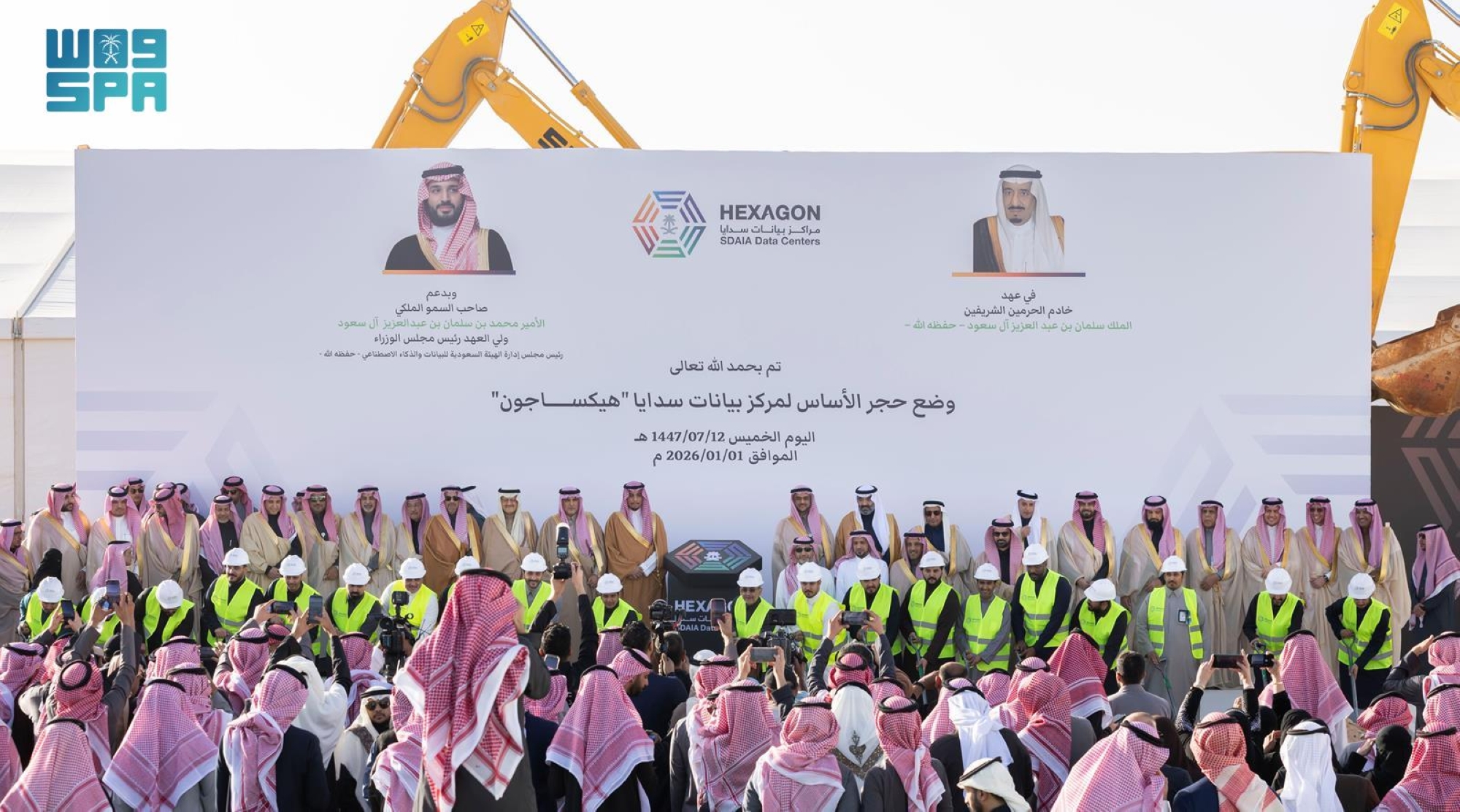
In a strategic move that reinforces its position as a leading force in the global digital economy, the Kingdom of Saudi Arabia today laid the foundation stone for the Hexagon Data Center project, owned by the Saudi Data & Artificial Intelligence Authority (SDAIA). This center is the largest of its kind for the government sector globally, designed to achieve the highest data center rating (Tier IV) from the Uptime Institute, ensuring the highest levels of availability and reliability.
This ambitious project comes within the framework of the comprehensive national transformation led by the Kingdom’s Vision 2030, which aims to diversify the economy and build a future based on knowledge and innovation. Digital infrastructure is the cornerstone of achieving these goals, and the Saudi Data & Artificial Intelligence Authority (SDAIA) was established in 2019 to serve as the national authority on all matters related to data and artificial intelligence, leading the Kingdom towards leadership in this vital field. The Hexagon Center represents a practical embodiment of this vision, providing the massive computing capabilities necessary to support digital government initiatives, enable advanced AI applications, and ensure the sovereignty and security of national data.
The center will be built on an area exceeding 30 million square feet in Riyadh, with a total capacity of 480 megawatts. The foundation stone laying ceremony was held in the presence of high-ranking officials, including His Royal Highness Prince Dr. Bandar bin Abdullah Al-Mishari, Assistant Minister of Interior for Technology Affairs; His Royal Highness Prince Fahd bin Khalid bin Faisal; His Excellency the Minister of Communications and Information Technology, Engineer Abdullah bin Amer Al-Swaha; and a number of other senior officials. They were received by His Excellency the President of SDAIA, Dr. Abdullah bin Sharaf Al-Ghamdi.
During the ceremony, His Excellency Dr. Essam bin Abdullah Al-Waqeet, Director of the National Information Center at SDAIA, presented a detailed overview of the project's technical and engineering specifications. He noted that its design adheres to the global TIA-942 standard, which relies on dual systems and independent pathways to ensure business continuity even under extreme conditions. This design not only guarantees the operational readiness of e-government services but also opens new avenues for attracting global technology investments to the Kingdom.
In a statement, His Excellency Dr. Abdullah Al-Ghamdi affirmed that this global national project enjoys the continuous support of His Royal Highness Prince Mohammed bin Salman bin Abdulaziz, Crown Prince, Prime Minister, and Chairman of the Board of Directors of SDAIA. He explained that Hexagon is the first of several strategic initiatives that will be followed by other centers, with the aim of making the Kingdom a global data hub. His Excellency added that the project has significant economic and environmental dimensions, as it is expected to contribute approximately 10.8 billion riyals to the GDP and reduce carbon emissions by about 30,000 tons annually.
The project also prioritizes environmental sustainability, designed to be eco-friendly through innovative energy efficiency and smart cooling solutions, the use of direct liquid cooling technologies, and reliance on renewable energy. The center aims to achieve LEED Gold certification for sustainability, which would make it one of the world's largest green data centers. This approach not only enhances operational efficiency but also reinforces the Kingdom's commitment to environmental sustainability on the international stage.
The launch of the “Hexagon” center is not just about adding a technological infrastructure, but a qualitative leap towards enabling the digital economy, promoting innovation, and securing the Kingdom’s future as a key player in the era of data and artificial intelligence, in line with the ambitious goals of Vision 2030.
-

 Reports 3 days ago
Achievements of Saudi government sectors in 2025
-
Local news two weeks ago
FDA warns of contaminated Nestle infant formula | Recall details
-
Technology 4 weeks ago
Artificial intelligence regulations in Saudi education and student data protection
-
Technology 4 weeks ago
US ban on drones: reasons and consequences
-
Sports 4 weeks ago
Salah leads Egypt to a thrilling comeback against Zimbabwe in the Africa Cup of Nations
-
Technology 4 weeks ago
SRMG and Snapchat partnership: The future of digital media in the Middle East
-
Technology 4 weeks ago
Saudi Arabia's Ministry of Islamic Affairs is employing artificial intelligence in public speaking
-
Sports 4 weeks ago
Napoli win the Italian Super Cup in Riyadh for the third time (2025)