
Reports
Death toll from Indonesia landslide rises to 74
The death toll from the landslide in Bandung, Indonesia, has risen to 74, including soldiers, as search operations continue despite bad weather and dozens of homes have been damaged.

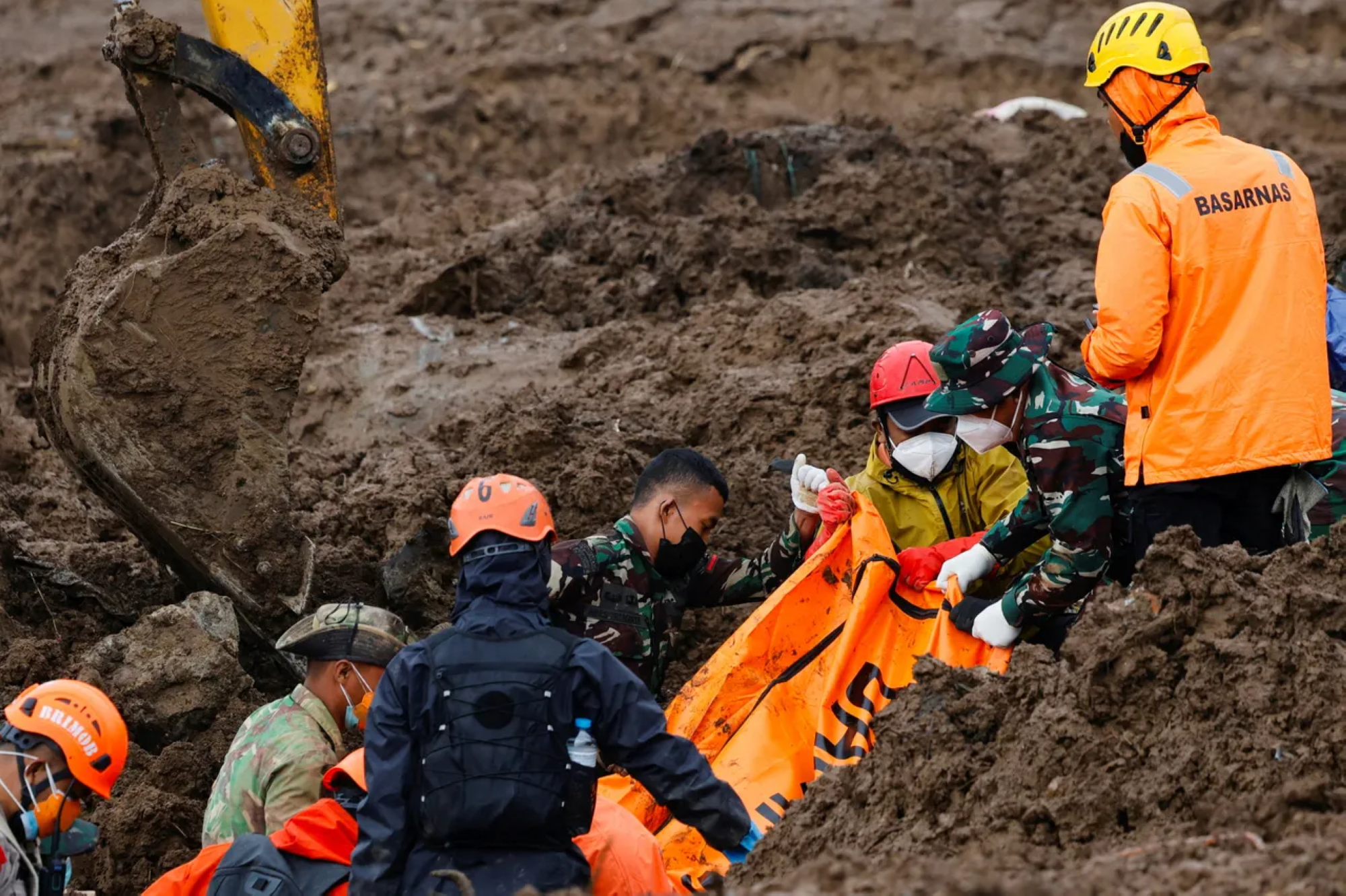
Indonesian authorities officially announced today (Friday) that the death toll from the tragic landslide that struck the Bandung area in West Java on January 24 has risen to 74, as emergency teams decided to extend the search for the missing and the recovery of bodies despite the difficult weather challenges.
The search area in the mountainous village of Pasirlango is facing harsh weather conditions, with dense fog and persistent heavy rain severely limiting visibility, increasing the risk of further landslides and endangering the safety of rescue teams. Despite these dangers, thousands of rescuers, supported by police, military personnel, and local volunteers, are continuing their tireless search through mounds of mud and debris, using heavy machinery and manual digging in areas inaccessible to equipment.
Heavy human and material losses
The Bandung search and rescue agency revealed that the identification process has so far included 74 victims, while an unspecified number of residents remain missing. Among the tragic details uncovered during the search operations, the Indonesian Navy confirmed that 23 of the victims were soldiers who happened to be in the area conducting military exercises in preparation for their deployment to the border between Indonesia and Papua New Guinea.
On the material level, the collapse caused massive destruction, with dozens of homes buried under muddy rubble and about 50 homes directly damaged, forcing more than 160 people to flee and live in temporary shelters, waiting for government solutions to resettle them or rehabilitate their areas.
The geographical and climatic context of disasters in Indonesia
This disaster is part of a series of recurring natural events in the Indonesian archipelago, which is characterized by its unique geography and climate. Located in a tropical region, Indonesia experiences a long rainy season, typically from October to March. Heavy and sudden rainfall often saturates the soil, leading to loss of stability and landslides, particularly in the mountainous areas and steep slopes that are abundant on the island of Java.
Furthermore, human-induced environmental factors play a crucial role in exacerbating these disasters. The Indonesian government and environmental reports have indicated that logging and deforestation for agriculture or urban expansion directly contribute to increased rates of flooding and landslides. Forests act as natural barriers; tree roots help stabilize the soil and absorb large quantities of rainwater. Without this vegetation cover, mountain villages become vulnerable to direct erosion.
It is worth noting that Sumatra witnessed similar disasters late last year, caused by the same reasons, which claimed the lives of about 1,200 people and caused the displacement of hundreds of thousands, highlighting the urgent need to strengthen environmental safety and disaster management measures in the country to confront the challenges of climate change and unsustainable human activity.




Reports
Plane crash in Colombia: 15 killed, including a member of parliament
Details of the Satina Airlines plane crash in Colombia, which killed 15 people, including a member of parliament. The plane went down in a rugged, mountainous area in the northeast of the country.

A tragic air crash in Colombia claimed the lives of 15 people, including a member of the Colombian parliament, after a plane belonging to the state-owned airline Satina crashed in a rugged, mountainous region in the northeast of the country. Colombian authorities confirmed the discovery of the wreckage and the absence of any survivors in the crash, which has deeply affected the local community.
Details of the ill-fated flight and the moments of disappearance
Satina Airlines explained in an official statement that the ill-fated aircraft was a Beechcraft 1900, which had taken off on a short domestic flight before noon from Cúcuta, a city on the border with Venezuela, bound for Ocana. According to air traffic control reports, air traffic control lost contact with the aircraft just 12 minutes after takeoff, prompting an immediate alert.
Among the ambiguities surrounding the incident, the company indicated that the aircraft's emergency alarm system was not activated, which could complicate the initial investigations into the cause of the sudden crash, whether it was due to a catastrophic technical malfunction or harsh weather conditions.
Crash site: Rugged terrain and security challenges
The plane crashed in a remote, mountainous region known for its rugged terrain and dense vegetation, an area famous for its coca plantations, the raw material for cocaine production. This region is particularly sensitive not only because of its difficult geography, but also because it is a stronghold for illegal armed groups.
Security reports indicate that the area where the plane disappeared is active with elements of the National Liberation Army (ELN) and factions that broke away from the Revolutionary Armed Forces of Colombia (FARC). While there is no immediate evidence of hostile action, the security situation in the area presents additional challenges for search, investigation, and recovery teams.
The context of aviation in Colombia and the role of Satina
Colombia faces significant challenges in the aviation sector due to its geography, particularly the Andes Mountains, which create volatile and often dangerous air currents and weather conditions. Satena, a state-owned airline, plays a vital role in connecting remote and border regions that may not be adequately served by major commercial airlines.
This incident has reopened the debate on aviation safety in complex mountainous regions and the importance of regular maintenance for aircraft serving these short but dangerous routes. The Colombian Civil Aviation Authority is expected to launch a comprehensive investigation to analyze the two black boxes and determine the precise causes of this disaster that claimed the lives of all those on board.
Reports
Saudi Arabia opens Princess Basma Hospital in Jordan with $98 million in funding
Saudi Arabia and Jordan inaugurated the new Princess Basma Hospital, funded by a $98 million grant from the Saudi Fund for Development. The hospital has 566 beds to enhance healthcare services.

In a move reflecting the deep fraternal and strategic relations between the Kingdom of Saudi Arabia and the Hashemite Kingdom of Jordan, His Majesty King Abdullah II bin Al-Hussein of Jordan, in the presence of the CEO of the Saudi Fund for Development, Sultan bin Abdulrahman Al-Murshid, inaugurated the new Princess Basma Hospital project. This massive project, funded by the Saudi Fund for Development with a total value of $98 million, represents a qualitative leap in the level of medical services provided in Jordan.
Medical facility with international standards
The new project focuses on revolutionizing healthcare infrastructure, with the hospital built on a vast area exceeding 88,000 square meters. The nine-story building is designed as a comprehensive medical complex with a capacity of 566 beds. It encompasses various specialized medical and consulting services, ensuring the provision of high-quality, comprehensive healthcare to patients and reducing the need to transfer patients to the capital or other distant centers.
To ensure the comfort of both medical staff and visitors, the project included the development of large outdoor spaces with more than 900 parking spaces to serve doctors, staff and visitors, facilitating access to specialized medical services and enhancing the efficiency of the facility’s daily operations.
Project importance and its developmental impact
This project holds immense strategic importance, as its role extends beyond simply providing treatment; it also contributes to supporting social and economic development in Jordan. The new hospital is a response to the growing demand for healthcare services resulting from population growth and aims to improve public health indicators by providing a modern treatment environment equipped with the latest medical technologies. The project also reflects the Kingdom of Saudi Arabia's ongoing commitment to supporting vital infrastructure projects in brotherly nations, thereby strengthening regional health security.
A long history of strategic partnership
This funding is not a one-off event, but rather a link in a long chain of fruitful cooperation between the Saudi Fund for Development and Jordan. Since 1978, the Fund has provided generous support to finance 20 development projects and programs covering multiple vital sectors, including energy, transportation, water, education, health, and infrastructure.
This support has taken various forms, including concessional development loans totaling over $545 million and grants from the Kingdom of Saudi Arabia, managed by the Fund, exceeding $1.5 billion. These ongoing efforts underscore the Kingdom's leading role in supporting sustainable development and enhancing the economic and social impact in Jordan, while also strengthening the bonds of brotherhood between the two nations.
Reports
Urgent investigation into Indonesian plane crash in Sulawesi: Full details
Indonesian authorities have launched an investigation into the crash of an ATR 42-500 aircraft in South Sulawesi that killed 11 people. Learn more about the incident and the history of aviation in Indonesia.

Indonesian authorities officially announced on Saturday the launch of a comprehensive and urgent investigation into the crash of an ATR 42-500 aircraft, which went down in a rugged area of South Sulawesi province after contact was lost. This announcement is the first step in a series of government measures aimed at determining the precise causes, whether technical or human, of this tragic air disaster.
Details of the incident and the complex geographical area
According to initial reports from relevant authorities, the ill-fated aircraft was carrying 11 people: eight crew members and three passengers. Contact was lost between the aircraft and air traffic control while it was flying over the Maros region. This area is known for its rugged terrain, characterized by tangled limestone hills and dense forests, posing a significant logistical challenge for search and rescue teams attempting to reach the wreckage and recover the victims or the black boxes, which are crucial to understanding the crash.
ATR's response and international cooperation
In an immediate response to the incident, the Franco-Italian aircraft manufacturer ATR issued a statement confirming its awareness of the accident involving one of its aircraft operated by Indonesia Air Transport. The company expressed its full commitment to providing all forms of technical and logistical support, emphasizing the readiness of its experts to cooperate closely with the Indonesian National Transportation Safety Committee and international investigators to analyze the technical data and determine the root causes of the accident, in accordance with international civil aviation protocols.
Indonesia's aviation sector: Geographical challenges and growth
To understand the context of the incident, it's essential to consider Indonesia's status as the world's largest archipelago, comprising over 17,000 islands. This geography makes air transport an indispensable lifeline for connecting far-flung cities and provinces, leading to tremendous growth in the domestic aviation sector over the past decades. However, this sector has historically faced challenges related to safety standards, airport infrastructure in remote areas, and the unpredictable tropical climate, characterized by heavy rain and dense fog, which places additional strain on pilots and navigation systems.
The importance of the investigation and its impact on air safety
The investigation into this accident has strategic importance that extends far beyond local borders. Internationally, aviation safety agencies are awaiting the results to determine whether there was a manufacturing defect in the ATR 42-500, one of the most widely used aircraft for short-haul regional flights worldwide, or whether the accident was caused by harsh environmental conditions or human error. The findings of this investigation are expected to lead to significant updates in maintenance and operating procedures, and to strengthen safety measures in rugged, mountainous regions like Sulawesi, to ensure that such tragedies are not repeated.
-

 Local news one week ago
Ramadan 2026 discounts in Saudi Arabia: Offers valid for 54 days
-
Culture and Art, 1 week ago
The death of artist Huda Shaarawi “Umm Zaki” and her funeral in Damascus
-
Technology one week ago
ICAN 2026 Conference Conclusion: Initiatives to Enhance Saudi Arabia's Leadership in Artificial Intelligence
-
Local news two days ago
Launch of the city's shuttle bus service in Ramadan 1447 AH: Routes and stations
-
Culture and Art, 1 week ago
Huda Shaarawi: Farewell to “Umm Zaki,” the icon of Syrian drama
-
Culture and Art, 1 week ago
The murder of Huda Shaarawi, "Umm Zaki": Details of the crime and its impact
-
Local News 4 days ago
Rabigh inaugurates the world's largest water innovation oasis and enters the Guinness World Records
-
Culture and Art 3 days ago
The series "Rouh OFF" was permanently canceled by a decision of the Actors' Syndicate


