Politics
Gulf-US statement: Reaching an immediate and sustainable ceasefire and the release of hostages and detainees
The joint ministerial meeting between the Gulf Cooperation Council and the United States of America was held on September 25, 2024 in New York, chaired by


The joint ministerial meeting between the Cooperation Council and the United States of America was held on September 25, 2024 in New York, chaired by the Prime Minister and Minister of Foreign Affairs of the State of Qatar, Chairman of the current session of the Ministerial Council of the Cooperation Council, Sheikh Mohammed bin Abdulrahman Al Thani, and the Secretary of State of the United States of America, Antony Blinken, with the participation of the foreign ministers of the Cooperation Council countries, and the Secretary-General of the Cooperation Council for the Arab States of the Gulf, Jassim Al-Budaiwi.
The ministers affirmed their shared commitment to the strategic partnership between the GCC and the United States, and to building on the achievements of previous ministerial meetings, including the most recent meeting held in Riyadh on April 29, 2024, to enhance consultation, coordination and cooperation in all areas.
The Palestinian-Israeli conflict
The ministers expressed their support for the establishment of an independent and viable Palestinian state living side by side in peace and security with Israel along the 1967 borders, with mutually agreed land swaps, in accordance with internationally recognized parameters and the 2002 Arab Peace Initiative.
The ministers stressed the need for all displaced civilians after October 7 to return to their homes, and affirmed their belief that lasting peace would be the foundation for a more integrated, stable and prosperous region. They emphasized the need to intensify efforts to enhance capacity, effectiveness and transparency within the Palestinian Authority in accordance with agreed mechanisms.
The ministers stressed the need for a unified Palestinian-led government in the Gaza Strip and the West Bank under the Palestinian Authority, and renewed their commitment to supporting Palestinian aspirations for self-determination and ensuring that Palestinians are at the heart of governance and security in Gaza after the conflict.
The ministers also expressed their support for improving the quality of life of Palestinians, including through humanitarian aid and efforts to accelerate Palestinian economic growth.
The ministers expressed their deep concern about the rising levels of settler and other extremist violence against Palestinians in the West Bank, and stressed the need to hold the perpetrators accountable.
They stressed the need to refrain from unilateral actions, including settlement expansion, that impede the prospects for genuine peace and security for Israelis and Palestinians.
The ministers noted the importance of protecting all holy sites and places of worship, as well as preserving the historical status quo of Jerusalem, while acknowledging the special role of the Hashemite Kingdom of Jordan in this regard.
Gaza
The ministers pledged to work together to achieve an immediate and sustainable ceasefire and the release of hostages and detainees, consistent with the parameters set by President Biden on May 31, 2024, and UN Security Council Resolution 2735.
The ministers called on the parties to refrain from actions that would undermine efforts to make progress on the diplomatic track.
In this regard, they commended the mediation efforts of Qatar, Egypt and the United States, as noted in the joint statement issued on August 8 regarding the urgent need for a ceasefire and the release of hostages and detainees, and stressed the need for all parties to abide by international law, including, as appropriate, international humanitarian law and obligations relating to the protection of civilians.
The ministers noted the generous support provided by the GCC countries and the United States in delivering aid to Gaza, stressing the essential role played by the United Nations Relief and Works Agency for Palestine Refugees in the Near East (UNRWA) in distributing life-saving assistance.
The ministers called for a rapid increase in the delivery of humanitarian aid on a large scale and without hindrance, including food, water, medical care, fuel and shelter. They stressed the urgent need to restore basic services and ensure the protection of humanitarian workers, and for all stakeholders to urgently facilitate humanitarian aid distribution networks throughout Gaza to deliver aid to alleviate the suffering of Palestinians. They emphasized that all parties must ensure the safety and security of relief workers carrying out life-saving work and the effectiveness of humanitarian operations.
The ministers stressed the importance of Egypt and Israel reaching an agreement to reopen the Rafah crossing to facilitate the delivery of humanitarian aid to Gaza, and committed to continuing to work together on aspects of governance, security and early recovery in Gaza.
Iran
The ministers expressed their deep concern about the recent escalation in the region and its negative impact on regional security and stability. They also stressed the importance of compliance with international law, including the Charter of the United Nations, and respect for the sovereignty, political independence and territorial integrity of states.
The ministers expressed their deep concern about the proliferation of advanced ballistic missiles and drones that threaten regional security and undermine international peace and security.
The GCC and the United States affirmed their commitment to working together to address Iran’s activities in the region, including threats to sovereignty and territorial integrity and support for non-state actors seeking to destabilize the region, and expressed their support for diplomatic efforts aimed at promoting de-escalation.
The ministers affirmed their commitment to ensuring freedom of navigation and maritime security in the region's waterways, and their determination to deter illegal actions by the Houthis that threaten the lives and safety of sailors, shipping lanes, international trade, and oil installations in the GCC countries.
The ministers affirmed their support for the Treaty on the Non-Proliferation of Nuclear Weapons and renewed their call for Iran to cooperate fully with the International Atomic Energy Agency, to cease nuclear expansions that lack a credible civilian justification, and to stop undermining the agency’s efforts to verify that Iran’s nuclear program is purely peaceful.
The ministers affirmed their position that regional tensions should be resolved by peaceful means, and they also affirmed their support for the United Arab Emirates’ call for a peaceful resolution to the dispute over the three islands of Greater Tunb, Lesser Tunb and Abu Musa through bilateral negotiations or the International Court of Justice, in accordance with the rules of international law, including the Charter of the United Nations.
Yemen
The ministers expressed their deep concern about the humanitarian situation of the Yemeni civilian population and stressed the need for the Houthis to allow safe, rapid and unhindered access for humanitarian aid to all those in need.
The ministers noted that the Houthi attacks – both inside and outside Yemen – harm the Yemeni people above all, and called for the immediate release of all UN, NGO and diplomatic staff illegally detained by the Houthis.
The ministers called for the full implementation of Security Council Resolution 2722, stressed the importance of maintaining maritime security, and demanded that the Houthis cease attacks against ships in the Red Sea and the Gulf of Aden.
They stressed the importance of collective action to ensure freedom of navigation in the Red Sea and to respond to activities that threaten regional and global security and stability.
The ministers affirmed their strong support for and continued engagement in a meaningful and comprehensive peace process, within the framework of the Gulf Cooperation Council initiative, the outcomes of the National Dialogue in Yemen and Security Council Resolution 2216, to resolve the long-standing conflict in Yemen.
The ministers commended the ongoing efforts of the Kingdom of Saudi Arabia and the Sultanate of Oman to promote inclusive Yemeni dialogue and provide economic and humanitarian assistance to Yemen.
Kuwait and Iraq
The ministers recalled their decision taken at their meeting on September 18, 2023, and stressed the importance of Iraq’s commitment to Kuwait’s sovereignty and territorial integrity and respect for international agreements and United Nations resolutions, especially Security Council Resolution 833, regarding the demarcation of the border between Kuwait and Iraq. They called for the complete demarcation of the maritime border between Kuwait and Iraq beyond border point 162, and called on the Iraqi government to ensure that the 2012 Kuwait-Iraq Agreement on Maritime Navigation in Khor Abdullah remains in force.
The ministers expressed their support for Security Council Resolution 2732 (2024), which mandated the Secretary-General of the United Nations to facilitate progress towards resolving all outstanding issues between Iraq and Kuwait, including the repatriation of all Kuwaitis and third-country nationals or their remains, and the return of Kuwaiti property and the national archives.
The ministers noted the important role that the United Nations plays now and in the future in implementing Security Council Resolution 1284 and ensuring continued progress in resolving these issues, and called on Iraq to make every effort to reach a solution to all the issues concerned.
Strategic partnership between the Gulf Cooperation Council and the United States of America
The ministers affirmed their shared commitment to contributing to regional security, stability and prosperity within the framework of the strategic partnership between the GCC and the United States. They also affirmed their mutual commitment to building closer relations in all areas, including defense and security cooperation, and developing a collective approach to regional issues.
The ministers commended the efforts made by the integrated working groups on air and missile defense and maritime security between the GCC and the United States in Riyadh on May 22, and stressed the essential role of the two working groups in enhancing strategic cooperation between the two sides.
The ministers also commended the early warning study conducted by the GCC as part of the Integrated Air and Missile Defense Working Group meeting held in September in Alabama.
They also commended the successful fifth meeting of the GCC-US Trade and Investment Dialogue held in June in Washington, and acknowledged the importance of the joint meeting on the Small Modular Reactor Study Round held in September.
The ministers expressed their interest in continuing future working group meetings between the GCC and the United States.
The ministers emphasized the importance of the principles of integration, tolerance and peaceful coexistence for relations between countries, as stated in the Bahrain Declaration issued on May 16, 2024, and stressed the importance of providing educational and health services to those affected by conflicts in the region.
The ministers affirmed their condemnation of violence and hatred, including religious hatred, such as Islamophobia and anti-Semitism, and called on all states to respect and guarantee the human rights of all individuals within their territories and subject to their jurisdiction, as provided for in relevant international law.
The ministers took note of Security Council Resolution 2686, which recognized that hate speech, racism, racial discrimination, xenophobia and related forms of intolerance, gender discrimination and acts of extremism can contribute to the outbreak, escalation and recurrence of conflicts.




Politics
Greece sends military reinforcements to Cyprus after Iranian drone attack
Greece deploys the Kimon frigate and F-16 fighter jets to Cyprus in response to an Iranian drone attack on the British base at Akrotiri. Details of the military escalation in the Eastern Mediterranean.

In a significant development indicating escalating tensions in the Eastern Mediterranean, the Greek Ministry of Defense announced an immediate military deployment, including a naval and air strike force, to the Republic of Cyprus. This decisive action comes in response to an aerial attack carried out by a drone, reportedly of Iranian manufacture, targeting the Royal Air Force base at Akrotiri on the island last night.
In detailing the military deployment, Greek Defense Minister Nikos Dendias affirmed that Athens would not stand idly by in the face of threats to regional security, announcing the dispatch of two advanced warships, spearheaded by the French-built Belharra-class frigate "Kimon." This frigate is distinguished by its advanced technological equipment and modern radar and defense systems designed to counter aerial threats, including anti-drone systems. In parallel with the naval support, orders were issued for four F-16 fighter jets to deploy and reinforce the air defense umbrella of the Republic of Cyprus against any unwarranted violations or external threats.
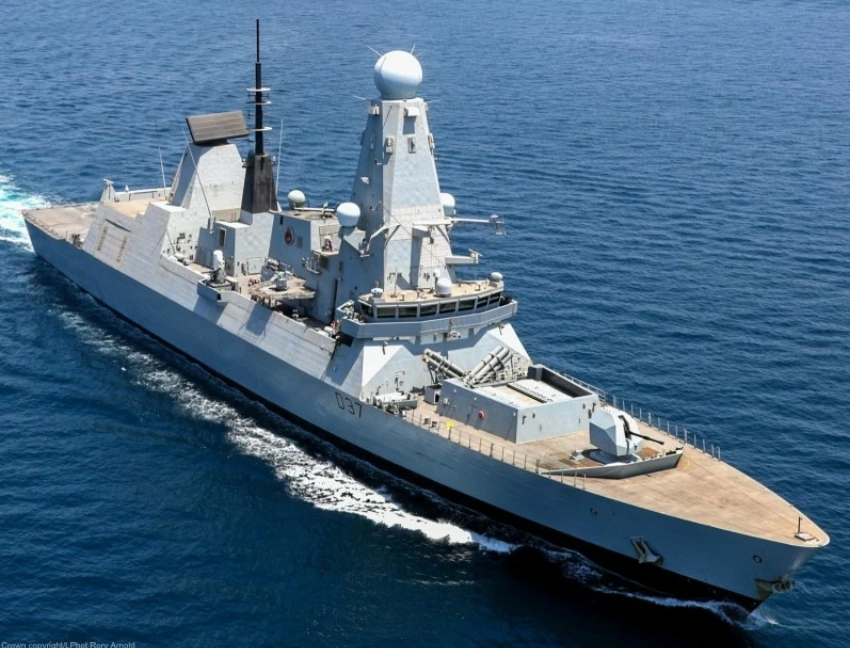
Minister Dendias described this rapid deployment as "an expression of full and absolute solidarity" with Nicosia, stressing in his statements that the attack not only targeted the British base, but also represented "a dangerous escalation" that threatens the security and stability of the entire island and the vital Eastern Mediterranean region.
The strategic importance of the Akrotiri base
To understand the dimensions of this event, it is worth noting that the Akrotiri base is not just an ordinary military facility; it is one of two sovereign British bases in Cyprus (along with Dhekelia) that the United Kingdom retained under the 1960 Treaty of Independence. This base plays a pivotal role as a logistical and operational hub for Western forces in the Middle East, making its targeting by a drone a political and military message that transcends the geographical boundaries of the island, reaching Western influence in the region.
Repercussions of the escalation in the Eastern Mediterranean
This Greek move carries profound geopolitical implications, reaffirming the unspoken doctrine of joint defense between Greece and Cyprus. Amid the turmoil in the Middle East, Cyprus is seen as a forward bulwark for the European Union. Observers believe that the deployment of the Belkara-class frigates, among the most modern vessels in the Greek arsenal, sends a strong deterrent message to any regional actors attempting to exploit the security vacuum or test the patience of European alliances. This escalation could impose new rules of engagement in the region, necessitating increased international attention to ensure that the situation does not spiral into wider confrontations.
Politics
Iranian attacks on Qatar and Bahrain: Hamad Airport targeted, and the Gulf response
The Qatari Foreign Ministry announced the thwarting of Iranian attacks targeting Hamad International Airport and the downing of hostile aircraft, while Bahrain sounded its air raid sirens. Details of the Iranian escalation against the Gulf states.

In a dangerous escalation threatening the security and stability of the Arabian Gulf region, Iran has continued its blatant violations of international laws and norms through a series of flagrant attacks targeting vital civilian infrastructure in the Gulf Cooperation Council (GCC) countries. The Qatari Ministry of Foreign Affairs revealed today (Tuesday) details of a series of malicious attacks targeting Hamad International Airport, one of the world's most important air transport hubs, confirming that Qatari defenses successfully thwarted these hostile plots.
Details of the attacks on Qatari territory
The official spokesperson for the Qatari Ministry of Foreign Affairs, Dr. Majid Al-Ansari, stated that the Iranian attacks were not limited to military targets, but had taken a dangerous turn by encompassing the entire Qatari territory and targeting civilian facilities crowded with civilians and travelers. In his statement, Al-Ansari explained that Qatari authorities dealt firmly and efficiently with the Iranian aircraft that violated the country's airspace on Monday, issuing direct warnings before shooting them down to ensure the safety and security of Qatari airspace.
The spokesperson emphasized the readiness of Qatar's defense system to deal with any emergency, noting that Doha's stockpile of interceptor missiles remains undiminished and is capable of repelling any potential aggression. He concluded by firmly affirming that the State of Qatar reserves its full right to respond to these blatant attacks at the appropriate time and place, in a manner that guarantees the protection of its sovereignty and the security of its citizens and residents.
Security alert in the Kingdom of Bahrain
In conjunction with the rapidly unfolding events in Doha, the Kingdom of Bahrain experienced a state of high alert, with the Bahraini Ministry of Interior announcing the sounding of sirens throughout the country. The Ministry urged citizens and residents, through its official channels, to exercise caution and immediately seek shelter in safe locations, a clear indication of the seriousness of the threats affecting the region and the widening scope of the escalation.
Regional context and the importance of stability in the Gulf
These rapid developments come at a time of escalating geopolitical tensions in the Middle East, casting a shadow over the regional security landscape. The Arabian Gulf region holds paramount strategic importance for the entire world, not only as a major source of global energy but also as a vital artery for international trade, maritime navigation, and air traffic. The Gulf states have long been a pillar of stability in the region and have consistently strived to spare their people the ravages of conflict.
Violation of international conventions and threats to civilians
Targeting civilian facilities and vital infrastructure such as airports is a clear and blatant violation of international humanitarian law, UN charters, and the Geneva Conventions, which criminalize endangering civilians during conflicts or political tensions. Observers and political analysts believe that this unjustified Iranian escalation against neighboring countries could drag the region into disastrous scenarios, necessitating a firm and unified international stance to deter such practices that undermine regional and international peace and security and threaten the safety of civilian air navigation.
Politics
Netanyahu: War with Iran will not be eternal and a dangerous escalation of the confrontation
Netanyahu tells Fox News that the war against Iran will not be endless, amid mutual shelling that has reached Tel Aviv and Tehran and the conflict has expanded to include Lebanon and the Gulf on its fourth day.

In pivotal remarks reflecting the evolving military landscape in the Middle East, Israeli Prime Minister Benjamin Netanyahu asserted that the current war against Iran "will not last years," dismissing speculations that likened the present confrontation to previous protracted regional conflicts of attrition. These statements come at a highly sensitive time, as the conflict expands to encompass multiple fronts, from Lebanon to the Gulf states, foreshadowing major geopolitical shifts in the region.
Netanyahu's messages via American media
In an exclusive interview with Hannity on Fox News, Netanyahu was careful to send dual messages to both the Israeli public and the international community. He explained that the military operation might "take some time" to achieve its strategic objectives, but stressed that it "will not be an endless war." Analysts suggest that this statement aims to reassure Western allies concerned about the region sliding into a full-blown war, while simultaneously maintaining high expectations for the Israeli military.
Day Four: Tel Aviv Under Fire
On the ground, the confrontation entered its fourth day with unprecedented intensity (Tuesday), as Tel Aviv and its surrounding areas endured harrowing hours as explosions rocked the city center. Israel activated its advanced air defense systems to intercept volleys of Iranian missiles, a development that reshapes the traditional rules of engagement between the two sides and shifts the conflict from a proxy war to a direct and open confrontation deep within Israel's territory.
The target bank has expanded: from Tehran to Beirut
In a significant development reflecting the widening scope of operations, Israel launched a series of precise and daring airstrikes targeting a complex housing the Iranian state broadcaster in Tehran, a major symbolic and military escalation targeting symbols of Iranian sovereignty. Simultaneously, the northern front remained active, with the Israeli army targeting Hezbollah elements and infrastructure in several Lebanese towns, underscoring the interconnectedness of the various fronts in this complex conflict.
Regional and international dimensions of the conflict
These events cannot be understood in isolation from the broader regional context. The involvement of Gulf states in the crisis—whether through direct impact or political stances—places the entire region at a historical crossroads. Talk of the war spreading to the Gulf raises global concerns about energy security and international navigation, necessitating intensive diplomatic efforts. In this context, Arab positions, including the Saudi stance, emerge as a vital balancing force seeking to spare the region the devastation of a comprehensive war that could consume everything.
-

 Local News 3 days ago
Jeddah Airport alerts for travelers due to airspace closure and flight disruptions
-
Local News 5 days ago
Saudi Arabia approves regulations for the continued presence of Gulf vehicles: duration and penalties
-
Local news one week ago
The Ministry of Interior begins procedures for a royal pardon for common law prisoners
-
Local news one week ago
The deadline for property registration in Hail and Riyadh is Thursday
-
Sports one week ago
Tickets for the Al-Ahli vs. Al-Hilal King's Cup match postponed: New date
-
Local news one week ago
Under the patronage of the Minister of Information, an agreement was signed between the Ministry of Information and Waves Marketing Company
-
Local news one week ago
Saleh Al-Maghamsi appointed Imam of the Prophet's Mosque: Details of the Royal Decree
-
Culture and Art 6 days ago
The Devil's Prisons series was halted: The full story of "The Emperor's" being moved to YouTube