Politics
The Attorney General heads the delegation participating in the International Association of Prosecutors conference in Azerbaijan and holds meetings with his counterparts
Attorney General Sheikh Saud bin Abdullah Al-Muajab headed the delegation participating in the 29th International Association of Prosecutors Conference

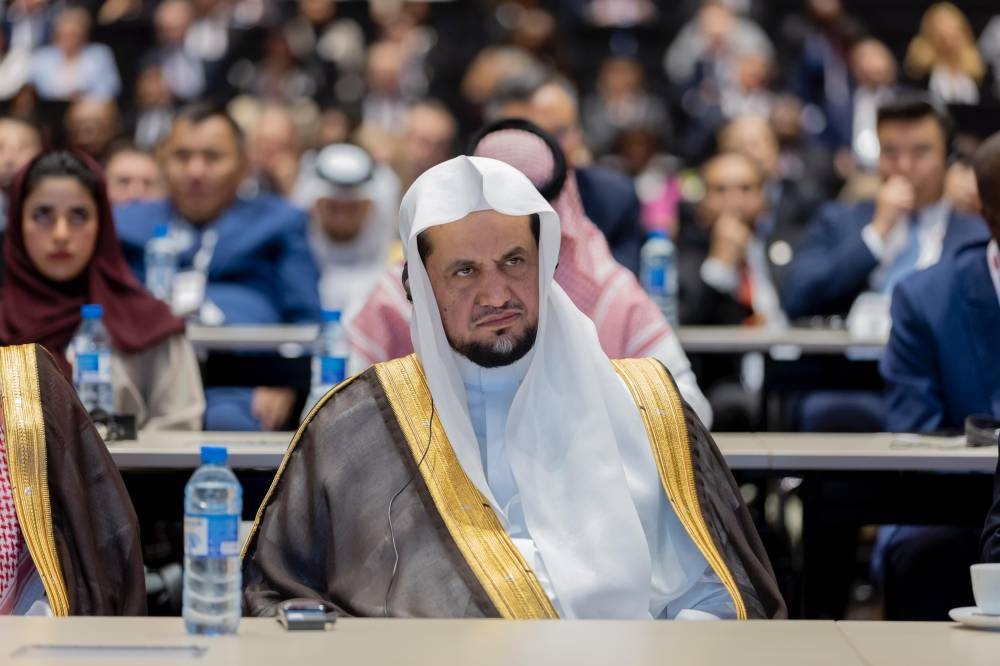
The Attorney General, Sheikh Saud bin Abdullah Al-Muajab, headed the delegation participating in the 29th International Association of Prosecutors Conference, which kicked off in the Azerbaijani capital, Baku, and will last for 3 days. The delegation includes a number of officials from the Public Prosecution and the Oversight and Anti-Corruption Authority in the Kingdom of Saudi Arabia.
The conference is attended by a number of public prosecutors and prosecution authorities from around the world, in addition to international organizations and associations concerned with human rights, combating transnational crimes and terrorism, human trafficking crimes, mutual legal assistance procedures, ways to develop them, extradition requests, and information exchange.
As part of the conference, Al-Muajeb held a series of bilateral meetings with a number of his counterparts from the participating countries, namely the Attorney General of the Republic of Austria, Ms. Margit Wachberger, the Attorney General of the Republic of Croatia, Mr. Ivan Torodic, the Attorney General of the Republic of Turkey, Mr. Muhsin Senturk, the Prosecutor General of Georgia, Mr. Giorgi Jabashvili, the Attorney General of the Republic of Malta, Dr. Victoria Buttigieg, the Attorney General of the Republic of Kenya, Mr. Renson M. Ngunga, and the Attorney General of the Democratic Republic of Nepal, Mr. Ramesh Badal.
Meanwhile, the delegation accompanying the Attorney General met with a high-level delegation from the Public Prosecution Service of the Republic of South Korea.
These meetings are part of the Kingdom’s ongoing efforts to promote international cooperation in the field of criminal justice, which contributes to supporting regional and international security, and enhances the ability of countries to address common challenges in the areas of combating crime, especially transnational crime, and to exchange knowledge about the latest technologies used in criminal investigations and criminal justice.






Politics
Israel assassinates Reza Khazai, Hezbollah's military buildup chief
The Israeli army announces the assassination of Reza Khazaee, Hezbollah’s military buildup chief and a Quds Force commander, in a raid on Beirut that targeted Iranian supply lines.

The Israeli army officially announced today (Tuesday) the success of the assassination operation of Reza Khazaee, who is considered one of the most prominent pivotal figures in the military structure of Hezbollah, describing him as the official in charge of the “military build-up” file in the party, and the field representative of the Quds Force of the Iranian Revolutionary Guard in Lebanon.
In detailing the operation, the army statement explained that the Israeli Navy, in close coordination with Military Intelligence (Aman), carried out a focused airstrike yesterday (Monday) on an area in the Lebanese capital, Beirut. This strike resulted in the death of Khazaee, whom the statement revealed also held another sensitive position: Chief of Staff of the Iranian-backed "Lebanon Corps," making him a strategic target in Israel's target bank.
According to the intelligence cited in the statement, Khaza'i was considered the "right-hand man" of the commander of the Lebanese Corps and an indispensable central figure in Hezbollah's military buildup. His tasks focused primarily on logistical and strategic coordination between the party and Tehran, particularly regarding aligning the party's field military needs with the resources and technologies provided by Iran—a process known as "military buildup.".
Context of escalation and targeting of shadow leaders
This operation comes within the context of an intensive Israeli military and security campaign against Hezbollah's command structure and Iranian supply networks in the region. The term "military buildup" typically refers in Israeli military parlance to efforts to transfer and develop advanced weaponry, such as precision missiles, drones, and air defense systems—issues that Tel Aviv considers a red line that threatens the regional balance of power.
The targeting of a figure as influential as Reza Khazaee, who serves as a direct link to the Revolutionary Guard, reflects Israel's determination to strike at the "vital artery" that sustains Hezbollah's military capabilities. By eliminating key figures involved in liaison and military logistics, Israel seeks to cripple supply chains and disrupt military modernization plans that rely heavily on Iranian expertise and funding.
Regional dimensions of the operation
This assassination cannot be separated from the broader regional context, where a covert and overt war is being waged between Israel and the Iranian-led axis. Khazaee exemplifies the kind of commanders who operate behind the scenes to consolidate fronts and unify military efforts between Tehran and its proxies in the region. The Quds Force, which Khazaee represented, is the external arm of the Islamic Revolutionary Guard Corps (IRGC) responsible for operations outside Iran's borders, thus giving his assassination a dimension that extends beyond the Lebanese arena to the very heart of Tehran's strategic calculations.
Observers believe that intensifying the strikes in Beirut and targeting figures responsible for coordination, financing, and arming is aimed at putting military and political pressure on Hezbollah, in light of the ongoing confrontations on the northern border, and an attempt to reduce the party’s ability to replenish its strategic stockpile of weapons in the event of a full-scale confrontation.
Politics
Why did Iran reject Trump's nuclear deal? Details of the Wytkopf negotiations
US envoy Steve Wittkopf revealed the behind-the-scenes details of the failure of nuclear negotiations with Iran, and Tehran's rejection of Trump's offer to provide nuclear fuel in exchange for halting enrichment before the latest escalation.

Amid the rapidly evolving situation in the Middle East, and as the joint US-Israeli military operations against targets in Iran entered their fourth day, new and sensitive details have emerged regarding the diplomatic maneuvering that preceded this dangerous escalation. US Special Envoy Steve Wittkopf revealed the behind-the-scenes events of the final hours of the stalled nuclear negotiations between Washington and Tehran during an exclusive interview with Fox News on Tuesday.
Enrichment node and external fuel supply
Wittkopf explained that the core point of contention that led to the collapse of the talks centered on the "right to enrichment." According to the US envoy, the Iranian negotiators began the sessions by firmly asserting their country's sovereign right to enrich uranium domestically. In response, the US delivered a resolute message from President Donald Trump stating that he possessed the right and the capability to halt this process if it threatened international security.
Witkoff revealed that the US administration, in a last-ditch effort to defuse the crisis, presented what it called a "fair deal." The offer included allowing Iran to obtain all its nuclear fuel needs for peaceful purposes and energy generation from reliable external sources, in exchange for abandoning enrichment activities within Iranian territory. However, Tehran categorically rejected this offer, leading the US side to conclude that the other party had no genuine intention of making substantial concessions.
The historical roots of the nuclear file crisis
To understand the dimensions of this rejection, one must consider the historical context of the Iranian nuclear conflict, which has persisted for over two decades. Tehran has consistently argued that abandoning domestic enrichment would make it beholden to the political will of fuel-supplying nations, citing past experiences where energy supplies were disrupted. Conversely, the international community, led by the United States, believes that Iran's possession of a complete nuclear fuel cycle (uranium enrichment) would significantly reduce the "breakout time" required to produce a nuclear weapon—a red line that Washington and Tel Aviv seek to prevent.
The withdrawal of the United States from the nuclear agreement (JCPOA) in 2018 marked a turning point, as Tehran gradually increased enrichment levels beyond previously permitted limits, further complicating the negotiating landscape and making a return to square one extremely difficult.
Regional and international repercussions of the failure of negotiations
The failure of this round of negotiations and the rejection of the American "deal" was not merely a passing diplomatic event, but rather the spark that paved the way for the current military escalation. This development carries serious implications for regional security, as Israel views the Iranian nuclear program as an existential threat with which it cannot coexist. Furthermore, the failure of diplomatic solutions reinforces the likelihood of a nuclear arms race in the region, as other countries may seek to acquire similar capabilities to ensure a balance of power.
Analysts assert that the deadlock in negotiations reflects a deep trust gap between the two sides, and presents the region with open scenarios ranging from the continuation of limited military operations to a slide towards a comprehensive confrontation that could redraw the geopolitical map of the Middle East.
Politics
The US is urging its citizens to leave 12 Middle Eastern countries immediately
Washington orders its citizens to leave 12 Middle Eastern countries and closes its embassies in Saudi Arabia and Kuwait, amid military escalation, fears of a wider regional war, and disruption to energy supplies.

In a rapidly evolving geopolitical situation in the region, the US State Department issued an urgent and decisive directive for its citizens to immediately leave more than 12 countries in the Middle East. This decision comes amid an unprecedented escalation of direct military confrontation between the United States and Israel on one side, and Iran on the other, threatening to expand the conflict to multiple fronts.
Details of warnings and evacuation procedures
Assistant Secretary of State for Consular Affairs Maura Namdar explained that the increased security risks necessitate the immediate departure of American citizens using available commercial transportation. The list of countries included in the warnings comprised Bahrain, Egypt, Iran, Iraq, Israel, the West Bank, Gaza, Jordan, Kuwait, Lebanon, Oman, Qatar, Saudi Arabia, Syria, the United Arab Emirates, and Yemen. Simultaneously, the State Department ordered the departure of non-essential government personnel and their families from its missions in Bahrain, Iraq, and Jordan as a precautionary measure for their protection.
In a move reflecting the seriousness of the situation, the United States announced the closure of several of its embassies in Arab countries until further notice, specifically in Kuwait and Saudi Arabia. The US embassy in Amman, Jordan, also saw its staff temporarily evacuated due to a “security threat,” the nature of which was not disclosed. Meanwhile, an interagency emergency task force was activated in Washington to manage the crisis and coordinate responses.
Background of the conflict and its regional effects
This diplomatic and security mobilization follows a series of airstrikes launched by the United States and Israel last Saturday against strategic targets inside Iran, which, according to sources, resulted in the deaths of several senior Iranian leaders, including Supreme Leader Ali Khamenei. Tehran responded by targeting American and Israeli sites and interests, as well as targets in Iraq and the Gulf Cooperation Council countries, putting the entire region on a knife's edge.
Economic repercussions and global concerns
The repercussions of this escalation are not limited to the military and political spheres; they extend to the global economy. Energy markets have witnessed a significant price surge, driven by fears of disruptions to oil supplies. These fears are amplified by threats from Iranian officials to close the Strait of Hormuz or target ships transiting it. The Strait of Hormuz is a vital artery for the global economy, with millions of barrels of crude oil passing through it daily, and any disruption to navigation there could lead to a severe global energy crisis.
For his part, US President Donald Trump stated that this conflict could last for a period of four to five weeks, with the possibility of it continuing for a longer period, indicating that the region is heading towards a phase of instability that could reshape the political and security map of the Middle East.
-

 Local News 3 days ago
Jeddah Airport alerts for travelers due to airspace closure and flight disruptions
-
Local News 5 days ago
Saudi Arabia approves regulations for the continued presence of Gulf vehicles: duration and penalties
-
Local news one week ago
The Ministry of Interior begins procedures for a royal pardon for common law prisoners
-
Local news one week ago
The deadline for property registration in Hail and Riyadh is Thursday
-
Sports one week ago
Tickets for the Al-Ahli vs. Al-Hilal King's Cup match postponed: New date
-
Local news one week ago
Under the patronage of the Minister of Information, an agreement was signed between the Ministry of Information and Waves Marketing Company
-
Culture and Art 6 days ago
The Devil's Prisons series was halted: The full story of "The Emperor's" being moved to YouTube
-
Local news one week ago
Saleh Al-Maghamsi appointed Imam of the Prophet's Mosque: Details of the Royal Decree