Politics
Trump replaces “defense” with “war”: strength or international provocation?
Trump sparks controversy by changing the name of the Department of Defense to War Department: a move that reflects strength or international provocation? Discover the historical and political background behind the decision.


Changing the name of the US Department of Defense: A controversial move
US President Donald Trump sparked widespread controversy after signing an executive order changing the name of the Department of Defense to the Department of War. Trump described the move as a message of strength and victory to the world, arguing that the new name more clearly reflects America's military role.
Historical and political background
The name War Department dates back to 1789, when the department was known by that name before it was renamed the Department of Defense in 1947. This change came in the aftermath of World War II, as part of efforts to make American military policy more peaceful after a series of major world conflicts.
Trump believes that changing the previous name had a negative impact on US defense policy, describing it as contributing to what he considers a series of failures. He believes that reverting to the original name better reflects the military strength of the United States.
Reactions within Congress
The decision sparked widespread objections within the US Congress. Legal experts emphasized that the authority to officially change the department's name rests with the legislative branch, not solely with the president. Democrats expressed concern that the move might be a costly political maneuver, noting that the restructuring and rebranding could cost over $1 billion.
Analysis and potential repercussions
Legally, changing the name of a government agency as large as the Department of Defense requires congressional approval, placing Trump's executive order under intense legal and political scrutiny. The decision also raises questions about the current administration's strategic priorities and its potential impact on international relations.
In light of these developments, the importance of the Saudi position, which is considered supportive of regional and international stability, becomes clear. The Kingdom of Saudi Arabia consistently demonstrates high diplomatic skill in dealing with global political shifts in a way that advances its strategic interests and ensures the stability of the region.
Different points of view
Supporters:
- Trump's vision: Supporters believe that Trump's move enhances the image of the United States as a military superpower and restores its historical role in maintaining global security.
- Emphasis on strength: They believe the new name more clearly reflects the true role of the U.S. military in protecting national interests and confronting growing security challenges.
Opponents:
- Legal criticism: Opponents point out that the decision exceeds the president's powers and requires formal legislative approval to change it.
- Financial cost: Critics warn of the high cost of restructuring corporate identity, which could negatively impact the state's general budget.
- Diplomatic impact: Some fear the repercussions of this change on international relations and existing political balances, especially with traditional allies who may see it as a shift towards a more aggressive approach.
This article provides an objective analysis of current events without bias towards any particular side.




Politics
The book "The Neighbor Before the House": An Analysis of Saudi-Yemeni Relations
The book “The Neighbor Before the House” by researcher Mohammed Al-Faqih reviews the history of Saudi-Yemeni relations, documenting the Saudi role in supporting legitimacy and presenting a future vision for the partnership between the two countries.

In a new publication aimed at documenting and analyzing one of the most important and complex Arab relationships, Yemeni writer and researcher Mohammed al-Faqih has released a book titled "Yemen and Saudi Arabia: Neighbor Before Home." The 523-page book, divided into eight chapters, offers an in-depth political and historical analysis of the fraternal relations between the Kingdom of Saudi Arabia and the Republic of Yemen, emphasizing that these relations transcend current political circumstances and are based on solid foundations of geography, history, and shared destiny.
Historical background and general context
The relationship between Saudi Arabia and Yemen has deep historical roots, as the two countries share a long geographical border and strong tribal, cultural, and social ties. This relationship has witnessed pivotal moments throughout history, most notably the Treaty of Taif in 1934, which demarcated the border and established a framework for cooperation. Over the decades, the Kingdom has played a central role in supporting Yemen's economic and political stability and has hosted millions of Yemenis who have contributed to its development. This book comes at a critical juncture for Yemen and the region, as current challenges have created a new reality that necessitates a re-examination of this relationship from a strategic perspective that ensures the security and stability of both countries.
The book's content and its analytical dimensions
In his book, the author emphasizes that the relationship between the two countries cannot be reduced to mere geographical proximity, but rather is akin to "two inseparable bodies" whose security and stability constitute an indivisible unity. The book analytically examines the Saudi role in supporting the legitimate Yemeni government and state institutions since the outbreak of the recent crisis, documenting relief and development efforts and reconstruction projects. It also sheds light on external attempts and destabilizing agendas that have sought, and continue to seek, to target this shared strategic depth with the aim of destabilizing the entire region.
Importance and expected impact
This publication is of paramount importance on several levels. Domestically, it provides the Yemeni people with documentation that reinforces confidence in Saudi Arabia's role as a sincere strategic partner striving for Yemen's prosperity. Regionally, the book represents a valuable addition to the Arab political library, offering an analytical perspective that counters narratives seeking to distort the nature of the relationship, emphasizing that Yemen's stability is the first line of defense for the security of the Arabian Peninsula. Internationally, the book is considered an important reference for researchers and decision-makers interested in Yemeni affairs, as it presents a comprehensive perspective linking historical roots with contemporary challenges and proposes a future vision based on full partnership, respect for sovereignty, and the building of a strong and stable Yemen that supports its neighbors, embodying the saying, "The neighbor comes before the house.".
In a statement to Okaz, Al-Faqih explained that his work is not limited to narrating events, but aims to be a real addition to the public discussion about the future of Yemen and its relationship with its surroundings, foremost among them the Kingdom of Saudi Arabia, which Yemenis view as a major supporter that has not hesitated to offer everything precious for the stability and progress of their country.
Politics
Saudi medical team evacuates wounded Yemenis from Aden following a security attack
A Saudi medical evacuation plane transported wounded Yemeni soldiers from Aden for treatment after they were injured in an assassination attempt, in a move that reflects Saudi Arabia’s continued humanitarian support in Yemen.
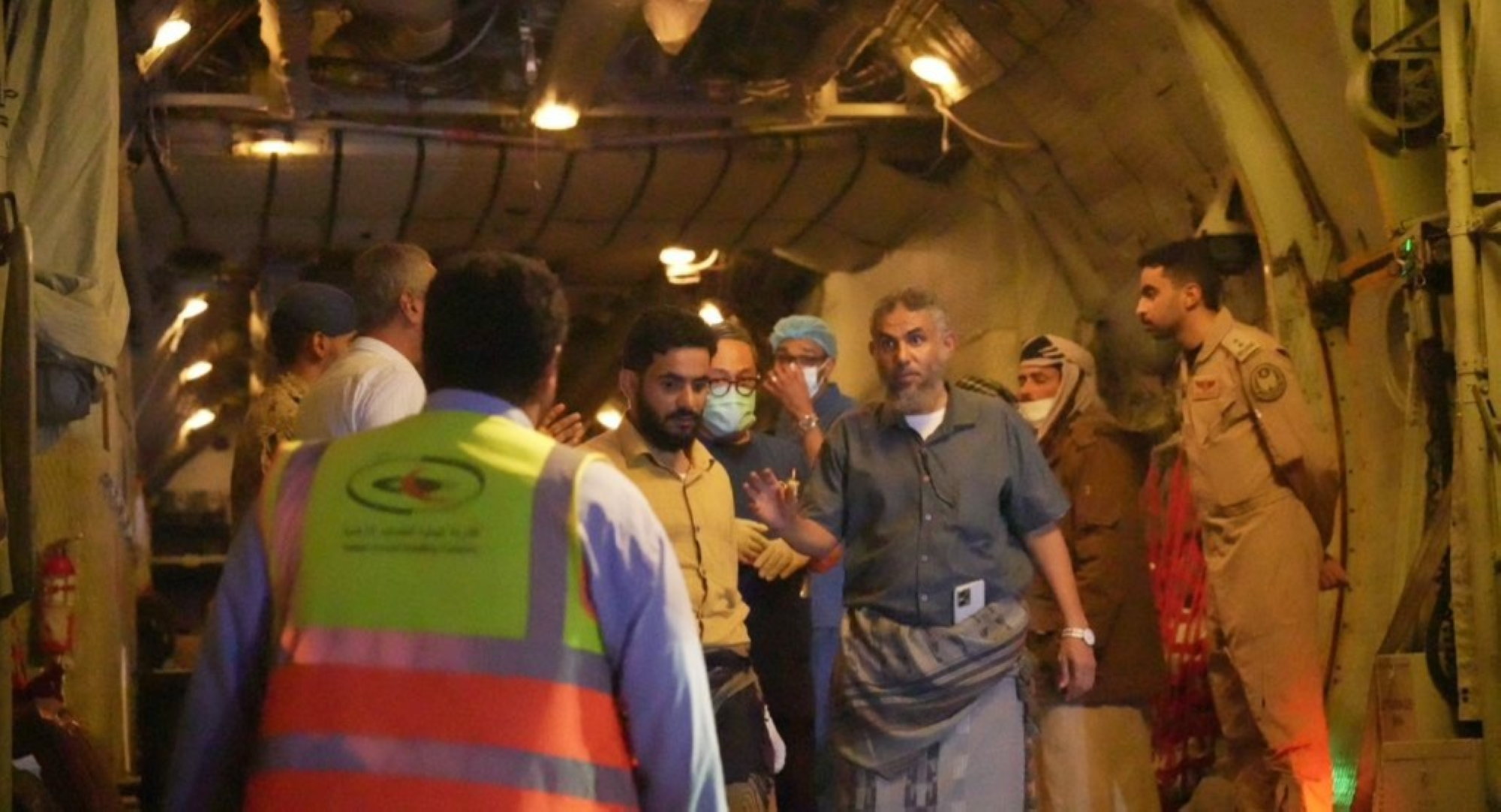
In a humanitarian gesture underscoring the depth of relations and ongoing support, the Kingdom of Saudi Arabia evacuated a number of wounded Yemeni soldiers and their companions from Yemen's interim capital, Aden, via a specialized medical evacuation aircraft. The "Shield of the Homeland" forces explained in a statement that these wounded individuals had been injured in the unfortunate security incident that targeted prominent military commander Hamdi Shukri of the Giants Brigades several days prior.
General context and historical background
This initiative comes amid the ongoing conflict in Yemen, which began years ago and has led to a complex humanitarian crisis. Saudi Arabia plays a pivotal role as the leader of the Arab Coalition to Support Legitimacy in Yemen, which aims to restore stability and support the internationally recognized government. The interim capital, Aden, is the scene of complex security operations, where authorities face numerous challenges in establishing security and stability, including confronting terrorist cells and assassination attempts targeting influential military and political leaders on the ground. The city has witnessed similar incidents in the past, highlighting the fragility of the security situation and the urgent need for continued international and regional support.
The importance of the event and its expected impact
Domestically, the rapid medical evacuation sends a powerful message of support and boosts the morale of Yemeni forces fighting on the ground, affirming that their sacrifices are appreciated and valued. It also reflects the high level of coordination between the coalition forces and the Yemeni forces. Regionally, this step reinforces the humanitarian role of the Kingdom of Saudi Arabia, which extends far beyond military and political support. Through its humanitarian arms, such as the King Salman Humanitarian Aid and Relief Center, the Kingdom provides extensive medical, food, and shelter assistance across various Yemeni governorates, and this operation falls within this broader context.
Details of the operation and its implications
A statement from the Homeland Shield Forces indicated that the transfer of the wounded and the completion of necessary procedures were carried out smoothly and with exceptional organization, reflecting the Kingdom's high level of preparedness and advanced logistical capabilities in responding to emergencies. The statement added that "this step comes within the framework of the Kingdom's humanitarian role, reflecting its unwavering commitment to prioritizing human life above all other considerations." It is worth noting that the assassination attempt against Commander Hamdi Shukri, which security authorities in Aden announced had failed, resulted in a number of deaths and injuries, necessitating this urgent medical response.
Politics
King Abdullah II orders restructuring of the Jordanian army
King Abdullah II issued directives to restructure the Jordanian army within 3 years to enhance its capabilities and confront modern threats, stressing the importance of building a lean and flexible force.

On Saturday, King Abdullah II, the Supreme Commander of the Armed Forces, directed the Chairman of the Joint Chiefs of Staff to prepare a comprehensive strategy and a clearly defined roadmap aimed at achieving a structural transformation of the Jordanian Armed Forces – the Arab Army – over the next three years. These royal directives reflect the ongoing commitment to developing and modernizing the military establishment to enable it to effectively and competently confront current and future challenges.
Historical background and vision for modernization
The Jordanian Armed Forces, whose roots trace back to the Arab Legion established in the 1920s, are a cornerstone of stability in the Hashemite Kingdom of Jordan and the region. Throughout its history, the army has faced numerous challenges and demonstrated its ability to adapt and evolve. King Abdullah II's directives today are not issued in a vacuum, but rather are a continuation of a long process of modernization and development within the armed forces, aimed at transforming them from a traditional army into a modern military force capable of engaging with the unconventional and hybrid warfare tactics that have become characteristic of 21st-century conflicts.
Strategic importance and expected impacts
This restructuring process holds immense strategic importance both domestically and regionally. Domestically, it aims to bolster national security and protect the Kingdom's borders, situated in the heart of a volatile region, while countering emerging threats such as terrorism and the smuggling of drugs and weapons across borders. Regionally, a strong and modernized Jordanian army reinforces Jordan's role as a stabilizing force in the Middle East and sends a strategic deterrent message to any entity that might seek to threaten the Kingdom's security. Furthermore, developing military capabilities strengthens Jordan's international partnerships, particularly with strategic allies who participate in joint exercises and peacekeeping operations.
Towards agile and flexible armed forces
King Abdullah II expressed his ambition to build a “lean, flexible, and high-quality armed forces,” prepared, equipped, and trained according to the latest combat methods. He emphasized the need for the new organizational structure to align with the demands of combat in diverse operational environments, with a focus on the effective utilization of both defensive and offensive capabilities. His Majesty added, “It is imperative to consider the requirements related to modernizing, developing, and restructuring the armed forces… in a way that ensures mastery of modern warfare tactics.”.
The King emphasized the importance of possessing an effective, reliable, and secure command, control, and communications system, and employing modern defense technologies in partnership with friendly local and international defense industries. In concluding his directives, King Abdullah II commended the members of the Jordanian Armed Forces, affirming that they will remain “a national institution of which every Jordanian is proud,” and will continue to serve their country with courage, dedication, and loyalty.
-

 Reports one week ago
Achievements of Saudi government sectors in 2025
-
Local News 3 weeks ago
FDA warns of contaminated Nestle infant formula | Recall details
-
Technology 3 weeks ago
Saudi Arabia launches the world's largest government data center, 'Hexagon'
-
Technology 4 weeks ago
Merging KSA Map and Baladi Plus: A step towards Saudi digital sovereignty
-
Technology 3 weeks ago
Hexagon: Saudi Arabia strengthens its data sovereignty with the world's largest government center
-
Technology 3 weeks ago
European banks and artificial intelligence: A plan to lay off 200,000 employees
-
Politics 4 weeks ago
The coalition destroys smuggled Emirati weapons in Mukalla in a qualitative strike
-
Local News 4 weeks ago
Saudi Arabia's 2026 Decisions: Major Transformations in Real Estate and Logistics