Politics
The Minister of Health inspects and inaugurates a number of health projects in Qassim
Health Minister Fahd bin Abdulrahman Al-Jalajel visited the Qassim region to inspect a number of health projects aimed at enhancing quality, efficiency, and comprehensiveness

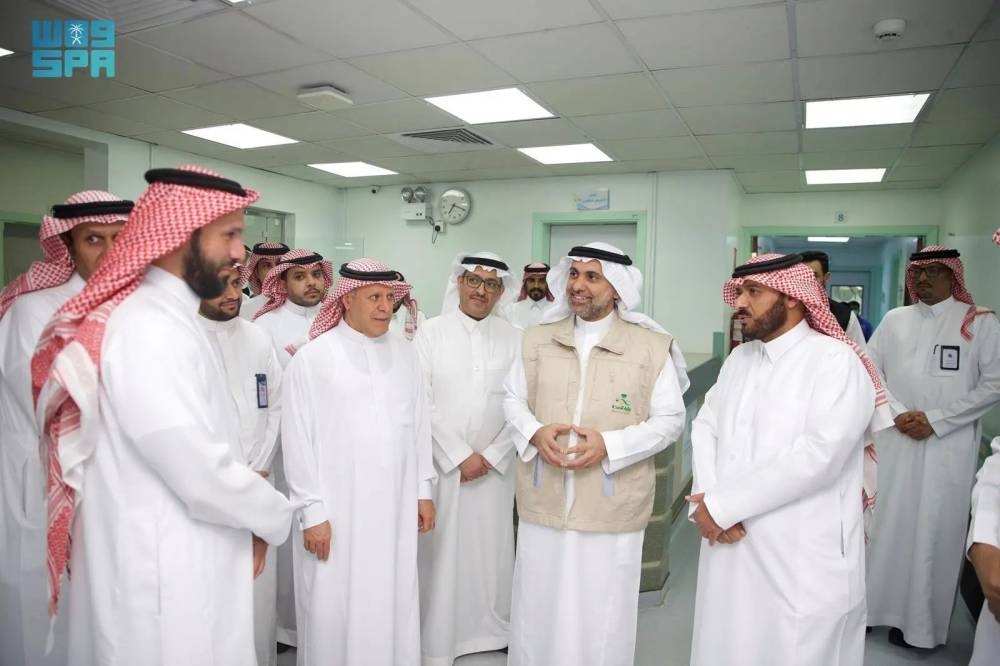
Minister of Health Fahd bin Abdulrahman Al-Jalajel visited the Qassim region to inspect several health projects aimed at enhancing the quality, efficiency, and comprehensiveness of health services provided to the region's residents, in line with the objectives of the Health Sector Transformation Program within the Kingdom's Vision 2030, which aims to build a vibrant society that enjoys a healthy and prosperous life.
The visit witnessed the inauguration of several health projects, totaling 54 projects with a value exceeding 448 million riyals. These included health projects for the Qassim Health Cluster, such as the dental center in Unaizah, and a number of community participation projects with a total value of approximately 102 million riyals. These included the Prince Faisal bin Mishaal Center for Assisted Reproduction in Buraidah, the Abdullah Al-Othaim Diabetes Treatment Center at Al-Rass General Hospital, the Al Rajhi Bank Cardiac Catheterization Center, and other specialized centers.
During the visit, the Minister of Health met with a number of citizens to listen to their comments and address their needs and aspirations regarding health services, in line with the directives of the wise leadership to understand the needs of citizens and provide the best health services to beneficiaries in all regions of the Kingdom.
The visit also included inspection tours of several health facilities in the region. The Minister of Health began his tour with a visit to Buraydah Central Hospital, where he reviewed the various departments and services provided. The tour also included a visit to the North Buraydah Hospital project, which is still under construction, where he reviewed the project's progress and discussed future work plans to ensure its completion according to the highest standards.
The inspection tours also included a visit to the Red Crescent Center to review its performance and average response time in the region, a number of upgraded primary care centers equipped with the latest technologies and medical equipment, and several private sector projects in the region. His Excellency also met with a number of investors to learn about their investment projects, seeking to support and enhance investment in the health sector in the region.
It is worth noting that this comes as a continuation of the Ministry of Health's efforts to achieve a qualitative transformation in the health sector, supporting the objectives of the health sector transformation program by enhancing the quality and efficiency of health services and facilitating access to them.




Politics
Operation Epic Wrath: America strikes Iran with stealth bombers for the fourth day
US forces continue Operation Epic Fury against Iran for the fourth day, with 50,000 troops and strategic bombers participating. Details of the destruction of 2,000 targets and air superiority.

The commander of U.S. Central Command, Brad Cooper, announced that U.S. forces are continuing their intensive military operations as part of Operation Epic Wrath, now in its fourth consecutive day, carrying out a series of airstrikes and strategic attacks described as the most extensive and intense against Iran in many years. This escalation comes amid an unprecedented military buildup that is reshaping the security landscape in the Middle East.
Details of the largest military buildup
In detailing the operation, Cooper explained that "Epic Fury" involves the direct involvement of more than 50,000 American troops, supported by a massive air and naval arsenal including some 200 fighter jets and two aircraft carriers stationed in the region. This deployment represents the largest American military buildup in the Middle East in recent years, reflecting the extent of American determination to decisively win the battle and achieve its strategic objectives with unprecedented speed.
Stealth bombers and air superiority
The military commander confirmed that the US Air Force used its most advanced weaponry, with B-2 Spirit stealth B-1 Lancer precise surgical strikes deep inside Iranian territory, targeting critical military infrastructure. Simultaneously, B-52 Stratofortress the task of destroying command and control centers, resulting in a near-total paralysis of Iran's military communications system.
The military report indicated that the strikes, carried out in close coordination with Israel, have targeted approximately 2,000 strategic targets since the start of the operation, using more than 2,000 precision-guided munitions of various types. These attacks have resulted in a significant and comprehensive weakening of Iranian air defense systems and the destruction of hundreds of ballistic missiles and their launchers before they could be used.
Iranian naval and air losses
On the naval front, Central Command announced the destruction of 17 Iranian warships, including a highly advanced submarine described as its most operationally ready, dealing a significant blow to the Iranian navy in the Gulf. In response, Cooper revealed that Iran had attempted to retaliate by launching over 500 ballistic missiles and 2,000 drones since the start of the confrontation, accusing Tehran of targeting civilian areas. However, US and Israeli air superiority limited the effectiveness of these attacks.
Strategic dimensions and battle course predictions
Operation Epic Wrath is of paramount strategic importance, as the United States and Israel now maintain near-total air superiority over Iran, while continuing to track and destroy remaining mobile ballistic missile launchers. Cooper concluded by emphasizing that the operational assessment clearly indicates that U.S. forces are ahead of schedule for this phase of the campaign, presenting Tehran with extremely difficult military and political choices in the coming days.
Politics
Ship hit near Fujairah; Trump orders security measures in place
A security incident targeted a ship off Fujairah, and Trump directed that security cover and military escort be provided for oil tankers to ensure the stability of global energy supplies through the Strait of Hormuz.


In a significant security development that underscores the geopolitical tensions in vital waterways, the United Kingdom Maritime Trade Operations (UKMTO) reported a security incident involving a commercial vessel just seven nautical miles east of the port of Fujairah in the United Arab Emirates. This incident raises renewed concerns about the safety of international shipping lanes in the Arabian Gulf region.
Details of the incident and crew safety
According to a statement issued by the authority, the ship's captain reported a direct hit from an "unidentified projectile," resulting in material damage to the ship's steel hull. Despite the alarming nature of the attack, field reports confirmed that no crew members were injured, and no fires or water ingress into the vessel were detected, thus preventing an environmental or humanitarian disaster in this sensitive area.
Urgent US move to secure energy
In a swift response aimed at containing the situation and ensuring market stability, US President Donald Trump unveiled a package of measures to safeguard trade. Trump announced directives to the US International Development Finance Corporation to provide insurance coverage against political risks, along with financial guarantees to reassure global shipping companies.
The American side did not stop at financial support, but Trump also hinted at preemptive military options, indicating the possibility of the US Navy escorting oil tankers as they cross the Strait of Hormuz if necessary, in a clear deterrent message to any parties that might try to threaten global energy security.
The strategic importance of the Strait of Hormuz and Fujairah
This incident cannot be understood in isolation from the paramount strategic importance of the location; the port of Fujairah is a vital artery for oil exports, situated outside the Strait of Hormuz, giving it a strategic advantage in circumventing any potential closure of the strait. The port is also one of the world's largest bunkering centers.
On the other hand, the Strait of Hormuz is the world's most important waterway for oil flows, with approximately one-fifth of the world's petroleum consumption passing through it daily. Historically, the safety of navigation in this strait has been a cornerstone of US and international national security, with international naval forces regularly present to ensure freedom of navigation.
Economic and geopolitical repercussions
Such incidents cast a long shadow over the global economy, typically leading to an immediate surge in marine insurance premiums, particularly those related to "war risk insurance." This increase, in turn, is reflected in higher shipping costs and subsequently in the prices of goods and energy for the end consumer.
Therefore, the American move to provide insurance cover and military escort is not only aimed at protecting ships, but also seeks to maintain the stability of oil prices and prevent supply shocks, confirming Washington’s commitment to protecting global economic interests in the Middle East region.
Politics
Saudi Arabia's defense forces intercepted and destroyed nine drones that breached its airspace
The Saudi Ministry of Defense announced the interception and destruction of 9 drones as soon as they entered the Kingdom's airspace, affirming its full right to protect its security and sovereignty and to respond to any aggression that threatens its stability.

The official spokesperson for the Saudi Ministry of Defense, Major General Turki al-Maliki, announced on Wednesday that the Royal Saudi Air Defense Forces successfully intercepted and destroyed nine drones immediately after they entered Saudi airspace. This successful operation underscores the high level of readiness and constant vigilance of the Saudi Armed Forces in protecting the nation's borders and assets from any potential aerial threats. The hostile targets were engaged with extreme precision and efficiency, preventing them from achieving their objectives.
This dangerous escalation comes just one day after Saudi Arabia, on Tuesday, expressed its categorical rejection and strongest condemnation of the brutal Iranian attack targeting the US embassy in Riyadh. Observers have linked the timing of the attempted airspace breach to the Kingdom's recent firm political stances against foreign interference in the region, suggesting a desperate attempt to undermine security and stability.
The context of regional tensions and the Saudi position
In a related context, the Kingdom stressed that the repetition of this blatant Iranian behavior constitutes a flagrant violation of international laws and norms. Official sources explained that this aggression comes despite the Iranian authorities' certain knowledge of the balanced Saudi position. The Kingdom has repeatedly affirmed that it will not allow its airspace or territory to be used as a platform to target Iran or any other country, in line with its consistent policy of non-aggression. However, it will not compromise in defending its sovereignty.
Strategic analysts believe that the aggressor's insistence on violating Saudi airspace, despite Saudi assurances that its territory would not be used for hostile acts, will push the entire region toward further escalation and undesirable tension. This incident underscores the Kingdom's crucial role as a stabilizing force in the region and its commitment to avoiding military adventures, while fully reserving its right to deter.
The right of reply and the protection of national sovereignty
The Kingdom concluded its statement by reaffirming its legitimate and absolute right to take all necessary measures to protect its national security. This includes preserving its territorial integrity, protecting its citizens and residents, and safeguarding vital interests and economic facilities. It clearly indicated that the option of responding to aggression remains available and guaranteed under international conventions that grant states the right to self-defense against any attack on their sovereignty, emphasizing that the Kingdom's security is a red line that cannot be crossed.
-

 Local News 6 days ago
Saudi Arabia approves regulations for the continued presence of Gulf vehicles: duration and penalties
-
Local news one week ago
The Ministry of Interior begins procedures for a royal pardon for common law prisoners
-
Local news one week ago
The deadline for property registration in Hail and Riyadh is Thursday
-
Local news one week ago
Under the patronage of the Minister of Information, an agreement was signed between the Ministry of Information and Waves Marketing Company
-
Culture and Art 7 days ago
The Devil's Prisons series was halted: The full story of "The Emperor's" being moved to YouTube
-
Local News 5 days ago
Saudi Energy: A new identity for electricity that aligns with Vision 2030
-
Local News 5 days ago
The Food and Drug Administration is recalling Bebelac and Aptamil milk due to potential contamination
-
Local news one week ago
Registration is now open for domestic pilgrims for the 1447 AH season: Dates and conditions via Nusuk