Politics
The Ministry of Environment: The Kingdom strengthens its leadership in date production with more than 1.6 million tons annually
The Ministry of Environment, Water and Agriculture confirmed that the Kingdom has achieved a self-sufficiency rate of 124% in dates, with an annual production exceeding 1.6 million

The Ministry of Environment, Water and Agriculture confirmed that the Kingdom has achieved a self-sufficiency rate of 124% in dates, with an annual production exceeding 1.6 million tons, through the expansion of palm tree cultivation. Its cultivation in the Kingdom covers a vast area of up to 165,000 hectares, in a step that reflects the great growth witnessed by the date industry in the Kingdom, which reflects the great expansion in this sector in accordance with the objectives of Saudi Vision 2030.
The Ministry explained, as part of its “Harvest Season” campaign launched to spread knowledge about agricultural products, increase awareness of the diverse options for seasonal fruits, and raise the efficiency of the local fruit marketing system to support local farmers, that the Riyadh region is the largest producer of dates in the Kingdom, contributing 436,112 tons of annual production, followed by the Qassim region with 390,698 tons, reflecting the strength of this sector in these two main regions. As for Madinah, it contributes 263,283 tons, while the Eastern Province produces 203,069 tons.
She noted that other regions contribute to the production of dates in the Kingdom as follows: Hail with 73,298 tons, Al-Jawf with 65,020 tons, Makkah with 64,095 tons, Asir with 55,225 tons, Tabuk with 52,792 tons, Najran with 9,837 tons, Al-Baha with 2,969 tons, the Northern Borders with 1,314 tons, and Jazan with 111 tons.
She noted that this success in date production enhances the Kingdom’s ability to achieve self-sufficiency in this field, and reflects the efforts made by the Ministry’s sectors and affiliated bodies in the Kingdom to develop and promote the palm industry, through innovation in agricultural technologies, improving the quality of production and raising the Kingdom’s GDP.
It is worth mentioning that the “Harvest Season” campaign aims to introduce the various types of local fruit and the times of their availability in different seasons throughout the year, in order to achieve several goals that fall within the Ministry’s policy to promote the production and use of local produce, raise its quality and safety standards, spread knowledge about agricultural products, and increase awareness of the diverse options of seasonal fruits that the Kingdom enjoys, as well as raising the efficiency of the marketing system for locally produced fruit in its production season to support local farmers and increase their financial returns.








Politics
Washington warns its citizens: Leave the Middle East immediately
The US State Department is urging its citizens to leave 15 Middle Eastern countries immediately due to security tensions and ongoing attacks. See which countries are included in the warning.

In a significant development reflecting escalating geopolitical tensions in the region, the US State Department issued an urgent and strongly worded warning yesterday (Monday), urging American citizens in more than 14 Middle Eastern countries to leave "immediately." The warning, published on the "X" platform, emphasized the need to utilize currently available commercial transportation options before it is too late, citing "serious security risks" that could threaten the safety of American citizens.
Warning details and immediate action
Assistant Secretary of State for Consular Affairs Maura Namdar emphasized the seriousness of the situation, stating that the State Department strongly urges Americans not to wait and to leave the affected countries immediately via commercial flights that are still operating. Namdar stressed the importance of acting quickly in anticipation of any sudden developments on the ground that could lead to airspace closures or travel disruptions, which could later make government evacuations difficult or impossible.
Context of escalating regional tensions
This strong warning comes amid a highly complex security situation, as the report noted the continuation of US-Israeli strikes against targets linked to Iran, and the accompanying escalating security tensions that are casting a shadow over the stability of the entire region. This action reflects growing US concern about the potential for the conflict to expand to multiple fronts, exposing Western interests and foreign nationals to the risks of retaliation or being caught in the crossfire.
List of countries and regions included
The warning included a broad list of countries and regions considered hotspots or near flashpoints, including Bahrain, Egypt, Iran, Iraq, Israel, and the West Bank and Gaza Strip. The inclusion of relatively stable countries on the list indicates that the US security assessment views the region as a single, interconnected entity directly affected by any potential military escalation.
Background and consular procedures
Historically, the U.S. State Department issues such Level 4 travel warnings (do not travel or leave immediately) when the ability to provide emergency consular assistance is extremely limited. U.S. citizens who choose to remain despite the warning are advised to exercise extreme caution, monitor local news, and enroll in the Smart Traveler Enrollment Program (STEP) to receive security updates and facilitate their location in case of an emergency. This measure underscores that Washington anticipates a potentially prolonged period of instability, necessitating the utmost vigilance.
Politics
Kuwait: 27 soldiers injured in Iranian strikes; hundreds of missiles detected
The Kuwaiti Ministry of Defense announced that 27 members of the army were injured as a result of the Iranian attacks, with 178 missiles and 384 drones detected, confirming the readiness of the armed forces to deal with the threats.

The Kuwaiti Ministry of Defense, in a detailed official statement, announced the initial casualty figures and the extent of the aerial threats the country faced following the recent military escalation. The ministry's official spokesperson, Colonel Saud Al-Atwan, revealed precise details regarding the scale of the Iranian aggression targeting Kuwaiti airspace, noting the intensity of the fire and the variety of attack methods employed, including ballistic missiles and explosive-laden drones.
In the military announcement, Colonel Al-Atwan explained that a total of 178 ballistic missiles and 384 drones were detected from the very first moments of the hostile operations across Kuwait's airspace. These staggering figures reflect the scale of the security challenge and the intensity of the attacks countered by the defense systems, indicating an unprecedented escalation in the pace of military operations targeting the security and territorial integrity of Kuwait.
Regarding casualties, the official spokesperson confirmed that 27 members of the Kuwaiti armed forces have been wounded since the start of operations. Al-Atwan reassured the public about the health of the wounded, explaining that the vast majority are in stable condition and receiving the necessary care, while only two are undergoing intensive medical treatment. This reflects the effectiveness of the safety and medical evacuation procedures implemented in the field.
In emphasizing combat readiness, Colonel Saud Al-Atwan stressed that the Kuwaiti Armed Forces are currently at the highest levels of preparedness and are operating with high operational efficiency around the clock to defend the homeland. He noted that there is close, continuous, and real-time monitoring of any developments on the ground, affirming that the Kuwaiti Army possesses the necessary capabilities to deal with all possible scenarios.
This announcement carries significant strategic implications both domestically and regionally. Militarily, the successful early detection of this large number of missiles and drones (exceeding 500 aerial targets) demonstrates the effectiveness of early warning and air defense systems. Furthermore, transparency in reporting casualties and the scale of the threats strengthens the home front's confidence in the military establishment and underscores the international community's responsibility towards regional stability and the security of the Arabian Gulf, particularly in light of escalating tensions that directly impact energy security and international navigation.
Politics
UAE intercepts Iranian ballistic missiles: Ministry of Defense statement
The UAE Ministry of Defense announces that it intercepted a barrage of Iranian ballistic missiles and confirms the readiness of its air defenses to protect the country and the safety of citizens and residents.

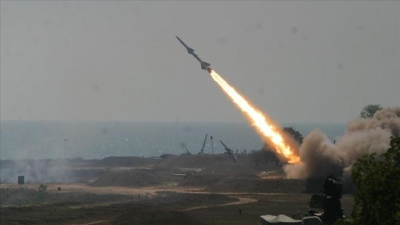
The UAE Ministry of Defense announced in an urgent statement that its air defenses are currently dealing with a barrage of ballistic missiles coming from Iranian territory with high efficiency, noting that the monitoring and tracking systems were able to identify the hostile targets and deal with them as soon as they entered the country's airspace.
The Ministry confirmed in its official statement the complete readiness of the UAE Armed Forces to deal with all security threats, stressing that protecting the country’s territory and the safety of citizens and residents is its top priority, and that it will not hesitate to take all necessary measures to deter any attack that affects the security and stability of the country.
Advanced air defense system
This successful interception reflects the efficiency of the advanced defense system possessed by the United Arab Emirates. Over the past years, the country has invested in building a robust missile shield based on the latest global technologies, including the American THAAD and Patriot systems, which are specifically designed to intercept ballistic missiles at various altitudes, making Emirati airspace among the most secure in the region.
Regional context and geopolitical tensions
This incident falls within a broader context of geopolitical tensions in the Middle East and the Arabian Gulf. Missile programs in the region have long been a source of concern for the international community and neighboring countries, as the use of ballistic missiles is seen as a tool for regional instability and a threat to international shipping lanes and global energy security.
International influences and positions
This attack is expected to draw widespread condemnation from the international community and UN organizations, given its violation of international law and the threat it poses to civilians. Such incidents typically underscore the importance of security and military cooperation between the Gulf Cooperation Council (GCC) states and their international allies to ensure regional stability.
Domestically, the relevant authorities in the UAE continue to reassure the public, stressing that life is proceeding normally and that the country has the full capabilities to protect its national achievements and advanced infrastructure against any potential risks.
-

 Local News 3 days ago
Jeddah Airport alerts for travelers due to airspace closure and flight disruptions
-
Local News 5 days ago
Saudi Arabia approves regulations for the continued presence of Gulf vehicles: duration and penalties
-
Local news one week ago
The Ministry of Interior begins procedures for a royal pardon for common law prisoners
-
Local News 7 days ago
The deadline for property registration in Hail and Riyadh is Thursday
-
Sports one week ago
Tickets for the Al-Ahli vs. Al-Hilal King's Cup match postponed: New date
-
Local News 7 days ago
Under the patronage of the Minister of Information, an agreement was signed between the Ministry of Information and Waves Marketing Company
-
Local news one week ago
Saleh Al-Maghamsi appointed Imam of the Prophet's Mosque: Details of the Royal Decree
-
Culture and Art 5 days ago
The Devil's Prisons series was halted: The full story of "The Emperor's" being moved to YouTube