Politics
Sharia law in Paris: Will France launch a "roadmap" to lift sanctions on Syria?
In his first official visit to Europe since taking office, Syrian President Ahmed al-Sharaa arrived in the French capital, Paris

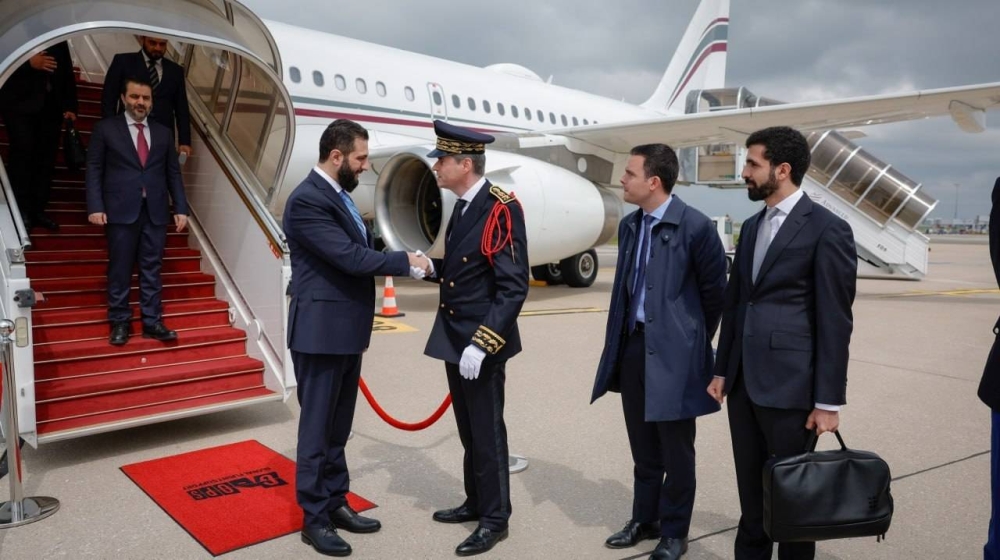
In his first official visit to Europe since taking office, Syrian President Ahmed al-Sharaa arrived in the French capital, Paris, in a diplomatic stop described as pivotal in the course of relations between Damascus and Europe.
The visit comes at the official invitation of French President Emmanuel Macron, amid signs of a cautious European openness towards the new Syrian government.
According to the official Syrian news agency SANA, the visit aims to discuss a number of sensitive issues, foremost among them the reconstruction efforts in Syria, which has been exhausted by a 14-year war, as well as discussing prospects for economic cooperation between the two countries, particularly in the fields of energy and civil aviation.
A Syrian diplomatic source, in press statements, considered the visit to be an important turning point, as it is the first visit by a Syrian president to a European country since the fall of Bashar al-Assad’s regime, noting that security and economic files will top the talks, in addition to discussing regional challenges, most notably the repeated Israeli bombing of Syrian territory, and relations with neighboring countries, especially Lebanon.
This visit comes after a period of political estrangement between Syria and European countries, which lasted since the outbreak of the Syrian conflict in 2011. France was one of the most prominent countries that supported the Syrian opposition, but recent developments, especially with the collapse of the Assad regime, have prompted Paris to reconsider its approach towards Damascus.
The Elysee Palace confirmed that the meeting aims to contribute to building a free, independent and sovereign Syria that respects all its components.
Al-Sharaa seeks to address one of the most prominent issues, namely the European sanctions imposed on Syria since 2011. According to United Nations estimates, about 90% of Syrians live below the poverty line, which increases the pressure on the new government to alleviate the economic burdens.
Related News
Analysts confirm that during his visit, al-Sharaa will request a clear "roadmap" for lifting or easing sanctions, in exchange for clear commitments on the ground regarding human rights and restoring stability, as indicated in a recent report published by the Carnegie Middle East Institute.
In a move described as a prelude to restoring full diplomatic relations, France last month appointed a chargé d'affaires in Damascus, along with a team of diplomats, marking the first official French diplomatic mission since the embassy's closure in 2012.
Macron recently held a three-way video conference with President al-Sharaa and Lebanese President Joseph Aoun to discuss ways to ease tensions on the Syrian-Lebanese border, according to the French newspaper Le Monde.
In this context, a European diplomat said that Paris is adopting a realistic policy towards the new Syria, and is seeking a partnership that guarantees the region’s security and stability, without compromising on human rights issues.
European decision-making capitals are carefully monitoring the results of this visit, as reports in the Financial Times indicate that some countries, such as Germany and the Netherlands, still maintain a cautious stance towards full normalization with Damascus, linking any openness to radical political reforms that guarantee that the problems Syria witnessed in past decades will not be repeated.
In contrast, Russia and China welcomed the visit, considering it “an important step towards reintegrating Syria into the international system,” according to statements carried by the Russian news agency TASS.




Politics
The Pentagon is accelerating weapons production, betting on Iran running out of missiles
The Pentagon is pressuring defense companies to accelerate production amid US bets that Iran's missile stockpile will run out. A meeting is expected at the White House, and contractors face a strict deadline.

In a significant development in the escalating military operations, the US Central Command revealed a new strategy aimed at depleting Tehran's missile capabilities, coinciding with intensive efforts within Washington to restructure its weapons production lines. Admiral Brad Cooper, commander of US Central Command in the Middle East, disclosed military assessments indicating that Tehran's ability to launch attacks has begun to diminish considerably, emphasizing that the current US strategy hinges on the depletion of Iranian forces' missile and drone stockpiles after days of intense clashes.
In a televised briefing, Cooper explained that intelligence and field data had detected Iran launching more than 500 ballistic missiles and over 2,000 drones—an extremely high rate of deployment that raises questions about Tehran's ability to sustain this momentum. These statements come as the United States launched a series of targeted offensive operations on February 28, employing its most advanced military arsenal, including Tomahawk missiles, F-35 stealth fighters, and low-cost attack drones, to strike Iranian military centers of gravity.
On the political and economic front, and in anticipation of any potential ammunition shortages, informed sources revealed that the Trump administration is urgently planning an extraordinary meeting at the White House this coming Friday. The meeting will include top executives from defense industry giants such as Lockheed Martin and RTX (the parent company of Raytheon). The aim of this meeting is to develop a roadmap for accelerating military production, given concerns about the depletion of the US strategic stockpile, which has been under immense pressure due to continued support for Ukraine since 2012, Israeli military operations in Gaza, and the current escalation with Iran.
In an unprecedented move reflecting a firm stance on arms procurement, the Pentagon intends to issue a blacklist of contractors deemed "poor performers." According to the new directives, these companies will be given no more than 15 days to submit corrective action plans approved by their boards of directors, or face the risk of contract cancellation. This pressure coincides with efforts led by Deputy Secretary of Defense Steve Feinberg to secure a supplemental budget of $50 billion, earmarked for replacing expended munitions and modernizing the military arsenal to ensure readiness for any long-term future scenarios, despite Trump's assurances on social media that there are "unlimited supplies.".
Politics
Behind the scenes of the war: How did the Trump-Netanyahu phone call ignite the attack on Iran?
Details of the secret call between Trump and Netanyahu that led to the strike on Iran and the assassination of Khamenei after diplomacy failed and US intelligence confirmed the sensitive information.

Press reports, citing informed sources, have revealed details of a "secret phone call" that took place between US President Donald Trump and Israeli Prime Minister Benjamin Netanyahu on February 23, which proved to be a major turning point that ignited the potential for direct conflict with Iran. According to Axios, this call was not merely a routine consultation, but included an exchange of highly sensitive intelligence that altered the course of events in the Middle East.
Golden intelligence and a valuable catch
On that fateful day, Netanyahu initiated a call to Trump to reveal precise intelligence indicating that Iranian Supreme Leader Ali Khamenei, along with his top advisors and inner circle, planned to meet at a single location in the heart of Tehran on the morning of February 28. Netanyahu described this rare gathering as an irreplaceable "historic opportunity" to deliver a decisive blow to the Iranian regime with a single, devastating airstrike—a prospect both sides considered too tempting to miss.
Background of security coordination and intelligence verification
The US president not only made his decision immediately based on the call, but also ordered an urgent security review. According to sources, Trump directed the CIA to verify the accuracy of the Israeli intelligence. This action comes within the context of a long history of close intelligence cooperation between Washington and Tel Aviv, where shared information forms the cornerstone of both countries' security strategies regarding regional threats. Indeed, the CIA later confirmed the accuracy of the information regarding the "simultaneous presence" of the Iranian leadership at the specified location, reinforcing the conviction that action was necessary.
The diplomatic track failed, and strategic camouflage was employed
Despite his inclination towards a military strike, Trump insisted on exhausting all diplomatic avenues first. In this context, his envoys, Jared Kushner and Steve Wittkopf, delivered an assessment from Geneva indicating that talks with Iranian officials had reached an impasse. To ensure the success of any military action, Trump deliberately avoided focusing on Iran in his State of the Union address on February 25, a shrewd tactical move intended to create strategic deception and avoid arousing Tehran's suspicions, which might have prompted its leaders to alter their course of action.
Zero hour and the repercussions of the event
By February 26, with intelligence confirmed and diplomacy failing, the final decision had been made. At 3:38 p.m. Eastern Time on February 27, Trump ordered the attack. Just 11 hours later, bombs fell on Tehran, killing Khamenei and igniting war. This event not only represents a change in the rules of engagement but is also expected to cast a long shadow over the geopolitical landscape of the entire region, ending an era of proxy wars and ushering in a new phase of direct confrontation that could redraw the map of influence in the Middle East.
Politics
Macron sends aircraft carrier Charles de Gaulle to the Mediterranean: details and dimensions
France is bolstering its military presence by deploying the aircraft carrier Charles de Gaulle to the eastern Mediterranean. Macron criticizes US and Israeli operations and warns Iran against regional escalation.

In a significant development reflecting escalating tensions in the Middle East, French President Emmanuel Macron announced on Tuesday a strategic decision to deploy the nuclear-powered aircraft carrier Charles de Gaulle and its accompanying battle group to the eastern Mediterranean. This move comes as part of Paris's efforts to bolster its military and diplomatic presence, protect French and European interests, and closely monitor the rapidly evolving situation on the ground.
Dual political messages: criticism of allies and a warning to adversaries
The French president did not limit himself to the military announcement; in his televised address, he delivered sharp yet balanced political messages. Macron explicitly criticized the military operations carried out by the United States and Israel, describing them as being conducted "outside the framework of international law," and emphasizing that France could not condone such transgressions. This stance reflects Paris's desire to maintain its political independence and differentiate itself from the unequivocal American position.
In contrast, Macron did not neglect to point the finger at Tehran, holding Iran primarily responsible for the state of tension and instability in the region, pointing to its role in fueling conflicts through its proxies.
Comprehensive military reinforcements in Cyprus and the Mediterranean
The French president explained that the decision to deploy the Charles de Gaulle, the crown jewel of the French navy and the only nuclear-powered warship in Western Europe, came amid an "unstable situation" and uncertainty surrounding the region's future. He indicated that this naval deployment aims to achieve two main objectives: enhancing combat readiness and establishing a deterrent capability.
Macron unveiled a package of parallel military measures to strengthen the eastern Mediterranean front, including:
- Sending advanced defense systems to the island of Cyprus.
- Deployment of Rafale fighter jets to reinforce air cover.
- Deployment of advanced radars and air defense systems to enhance reconnaissance and defense capabilities.
Strategic context and geopolitical importance
This move is particularly significant given the historical and geographical context; the Eastern Mediterranean is a traditional sphere of influence for France, and Paris considers the security of this region an integral part of European national security. While the aircraft carrier Charles de Gaulle typically participates in major missions such as Operation Chammal, the counter-terrorism operation, its deployment now carries a geopolitical dimension related to preventing the current conflict from escalating.
Macron also announced his country's intention to work on forming an international coalition aimed at reopening and securing maritime shipping lanes, reflecting growing international concern about threats to global trade routes. With this move, Paris positions itself at the heart of the regional equation, amidst a military and diplomatic race open to all possibilities, attempting to play the role of a powerful mediator capable of deterrence and intervention when necessary.
-

 Local News 6 days ago
Saudi Arabia approves regulations for the continued presence of Gulf vehicles: duration and penalties
-
Local news one week ago
The Ministry of Interior begins procedures for a royal pardon for common law prisoners
-
Local news one week ago
The deadline for property registration in Hail and Riyadh is Thursday
-
Culture and Art 7 days ago
The Devil's Prisons series was halted: The full story of "The Emperor's" being moved to YouTube
-
Local news one week ago
Under the patronage of the Minister of Information, an agreement was signed between the Ministry of Information and Waves Marketing Company
-
Local News 6 days ago
Saudi Energy: A new identity for electricity that aligns with Vision 2030
-
Local News 5 days ago
The Food and Drug Administration is recalling Bebelac and Aptamil milk due to potential contamination
-
Local news one week ago
Registration is now open for domestic pilgrims for the 1447 AH season: Dates and conditions via Nusuk