
Politics
Israel announces the killing of Ali Shamkhani and Mohammad Pakpour in an operation in Tehran
Details of Operation Lion's Roar, during which Israel announced the killing of 7 Iranian leaders, including Ali Shamkhani and Mohammad Pakpour, and Tehran's response, which described the announcement as psychological warfare.

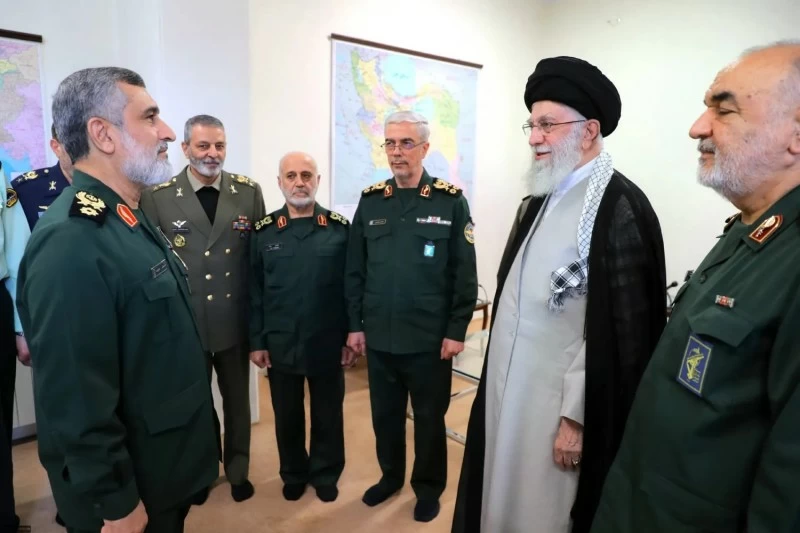
In a dramatic development that threatens an unprecedented escalation in the Middle East, the Israeli army announced today (Saturday) that it had carried out a high-profile military operation in the heart of the Iranian capital, Tehran, resulting in the deaths of seven senior Iranian military and security officials. This announcement further heightens existing tensions, while Tehran quickly denied the reports, dismissing them as "psychological warfare.".
Details of Operation "Lion's Roar"
According to Avichai Adraee, the Israeli military spokesperson for Arabic media, the operation, dubbed "Roar of the Lion," was the result of a meticulous and complex intelligence effort. Adraee explained that Military Intelligence had identified two secret locations in Tehran where a high-level meeting of senior Iranian security officials was taking place. The Israeli statement confirmed that the surprise attack resulted in the elimination of key figures, most notably Ali Shamkhani, Secretary of the Supreme National Defense Council, and Mohammad Pakpour, commander of the Islamic Revolutionary Guard Corps' Ground Forces.
Who are the targets? Background on the leaders mentioned
Ali Shamkhani is one of the most prominent security and political figures in the history of the Islamic Republic. He served for many years as Secretary of the Supreme National Security Council and played a pivotal role in shaping Iran's defense and foreign policies, including the recent agreement to restore relations with Saudi Arabia. The Israeli statement described him as "one of the most important security decision-makers" and the Supreme Leader's personal advisor on security affairs, making his targeting—if true—a devastating blow to the security establishment in Tehran.
Mohammad Pakpour , commander of the Iranian Revolutionary Guard's ground forces, was a highly experienced field commander, described in the Israeli statement as the "mastermind" behind major offensive plans. Pakpour was responsible for numerous military operations and strategic exercises for the Revolutionary Guard, and his assassination represents a significant challenge to the operational capabilities of the Iranian ground forces.
The Iranian response: psychological warfare and a call for vigilance
In contrast, Tehran downplayed the significance of these announcements. Iranian media quoted the director of Supreme Leader Ali Khamenei's office as implicitly denying the occurrence of this major breach, suggesting that Israel resorts to "psychological warfare" to cover up its failures or to destabilize the Iranian home front. The Iranian official stressed the need for the people and armed forces to be aware and vigilant regarding the news disseminated by the Israeli media machine, which aims to undermine morale.
Repercussions of the event on the regional landscape
This announcement, regardless of the accuracy of its field details, carries serious implications for the Israeli-Iranian conflict. On the one hand, it indicates that the confrontation has shifted from a "shadow war" and proxies to the direct targeting of key figures within Iranian territory. On the other hand, it places the entire region on the brink of disaster, as the confirmation of the deaths of figures as prominent as Shamkhani and Pakpour could prompt Tehran to launch a direct and forceful military response, opening the door to a range of scenarios that could include a full-scale regional war.




Politics
Regional war in the Middle East: Iran bombs the Gulf and the confrontation widens
Comprehensive coverage of the first day of the regional war in the Middle East. Iran launches missile strikes against five Gulf states with US and Israeli involvement in an escalation that surpasses the events of 2025.
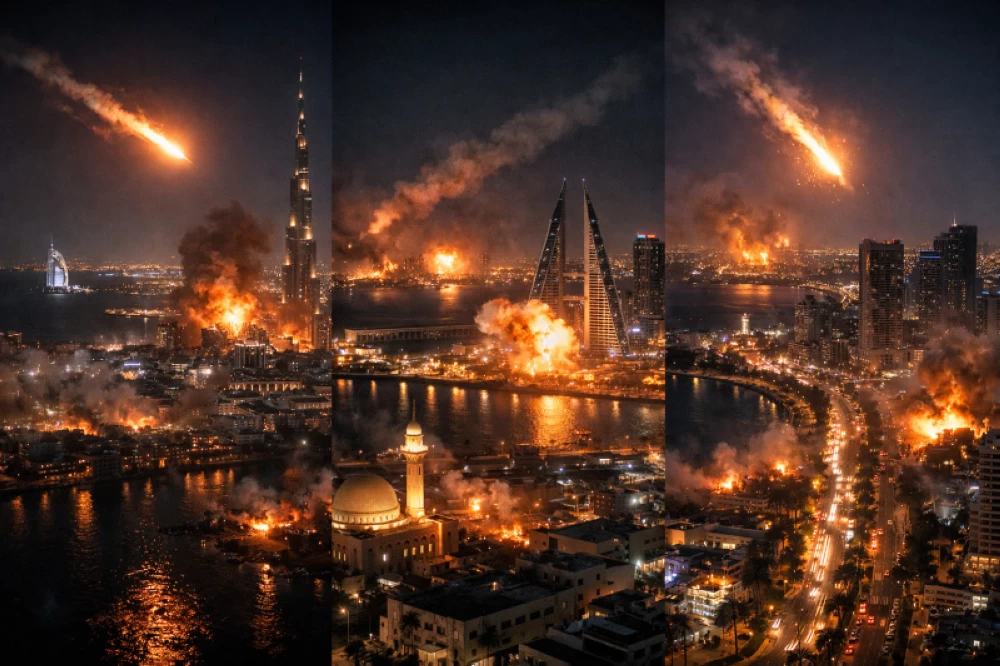
With the first hours of the new military confrontation in the Middle East, the region entered a pivotal phase, described as the most extensive and dangerous in many years. Field data and initial indicators suggest that the region is on the brink of an open confrontation that could extend for weeks, according to strategic sources monitoring the rapidly escalating situation. The conflict is no longer confined to the usual skirmishes; on its first day, the war took on a clear and comprehensive regional character, with the flames spreading to ten major countries: the United States, Israel, Iran, Iraq, Jordan, Saudi Arabia, the United Arab Emirates, Kuwait, Bahrain, and Qatar.
A qualitative shift in the rules of engagement
The most significant and dangerous development on the first day was Iran's direct missile strikes against five Gulf states, a move considered a radical shift in the rules of engagement and the context of the open confrontation with Israel and the United States. This direct Iranian escalation against the Gulf states moves the conflict from a phase of proxy wars or limited border skirmishes to a phase of full-scale war that threatens global energy security and the stability of the entire region.
Post-2025 context: Unprecedented escalation
This military escalation surpasses in intensity and scale all previous confrontations witnessed in 2025, as it appears that accumulated tensions and unresolved issues have reached a point of no return. The direct entry of the United States into this complex equation, alongside Israel and the Gulf states in confronting the Iranian axis, is redrawing the geopolitical map of the region. Analysts indicate that this broad military alignment reflects the failure of previous diplomatic solutions to contain the expansionist ambitions and mutual security concerns among regional powers.
Potential regional and international repercussions
This conflict is expected to cast a dark shadow over the global economy, particularly given the targeting of Gulf states that serve as the world's energy lifeline. The involvement of countries like Iraq and Jordan in the conflict expands the geographical scope of the confrontation, leaving the region facing a range of possible scenarios. Sources confirm that initial assessments indicate the military operations will not be swift but rather protracted, necessitating international mobilization to contain the crisis before it spirals completely out of control, amid fears of catastrophic consequences for international peace and security.
Politics
Saudi sovereignty: A statement of strength and the right to defend the homeland
An analytical reading of the Kingdom's statement on protecting its airspace and territory. Saudi Arabia asserts its sovereignty and rejects any infringement on its national security amidst escalating regional tensions.

The recent Saudi statement came as a declaration of a firm sovereign stance at a moment of widespread regional escalation. With the rise in military tensions, the recent transgressions have placed Saudi territory within the scope of the repercussions of military operations. At this critical juncture, the Kingdom's official discourse shifted from monitoring developments and calling for restraint to asserting its legitimate right to defend the state, its borders, and its airspace against any violation.
This shift takes on paramount importance when viewed within the context of the region's complex geopolitical landscape. Saudi Arabia, which has spearheaded intensive diplomatic efforts in recent years to resolve outstanding issues and focus on development within the framework of Vision 2030, now finds itself facing security challenges imposed by regional power struggles. The statement did not merely condemn the attack; it defined its nature as a direct aggression, a characterization carrying significant political and military weight in international law. It places the attack within the framework of a direct threat to national security, thus granting the Saudi leadership full legitimacy and the right to use all available means of force to protect its territory, population, and strategic and vital installations.
Historically, Riyadh has always sought to distance itself from direct military involvement in conflicts between regional powers (such as the Iranian-Israeli tensions), previously emphasizing the neutrality of Saudi airspace and territory from any military action. However, recent developments have demonstrated that neutrality does not equate to accepting violations of sovereignty. The state here speaks the language of sovereignty, the language of independent decision-making, and the language of organized power that will not compromise on the security of its citizens and residents.
On both regional and international levels, this stance sends multiple messages. Domestically, it reinforces confidence in the capabilities and readiness of the Saudi defense system. Regionally, it deters any party that might consider using Saudi airspace as a staging ground for settling scores, establishing a new deterrent equation: the Kingdom is not a corridor for military operations. Internationally, it reminds the international community of its responsibilities toward maintaining international peace and security, emphasizing that the Kingdom's stability is a cornerstone of the stability of energy supplies and the global economy, and that any threat to it will be met with a firm response guaranteed by international law.
Politics
Targeting Kuwait and Manama airports: Iran's claims about US targets fall apart
Details of the Iranian attacks on Kuwait Airport and Manama residential buildings, and how these strikes exposed the falsehood of Tehran’s claims that the response was limited to American targets.
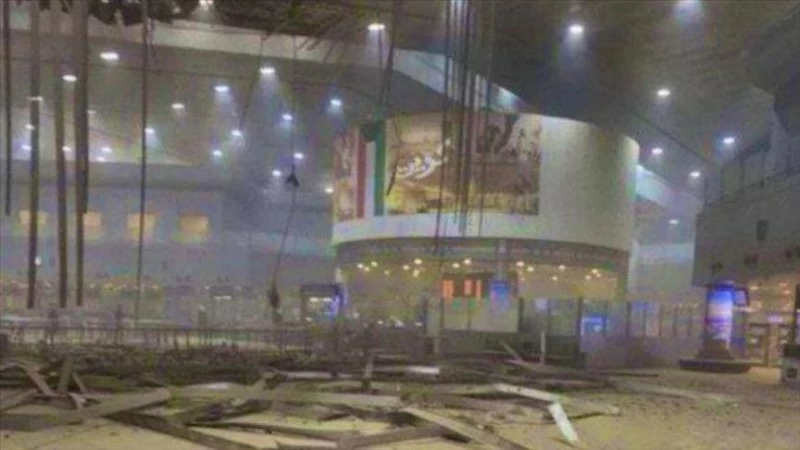
In a dangerous and alarming escalation that raises legitimate questions about the true nature of its stated goals and intentions, the recent Iranian strikes targeting several Gulf Arab states have revealed a stark contradiction and a wide gap between the declared political rhetoric and the tragic reality on the ground. While Tehran has consistently asserted in its official statements that its military operations target only "American sites and bases" in the region, the facts on the ground paint a completely different picture, with civilians finding themselves at the heart of the storm.
Targeting civilian infrastructure in Kuwait
In an incident that constitutes a blatant violation of international norms protecting civilian facilities from military conflicts, Kuwaiti civil aviation authorities officially announced that a drone targeted Kuwait International Airport. This attack resulted in minor injuries and material damage to Terminal 1 (T1). This targeting carries serious implications, as the airport is by its very nature a vital civilian lifeline and facility serving thousands of passengers daily from various nationalities. It cannot, under any circumstances, be classified as a military target or a foreign base, thus weakening the Iranian narrative and subjecting it to international accountability.
The danger extends to residential areas in Bahrain
In parallel with the events in Kuwait, the Bahraini capital, Manama, experienced a tense period, as the Bahraini Ministry of Interior confirmed that a number of residential buildings had been directly targeted. Civil defense teams and other relevant authorities immediately began their work to address the situation. Targeting densely populated residential areas in the heart of the capital represents a significant escalation, shifting the conflict from presumably strategic locations to the homes of civilians, thus increasing the potential human and material losses.
Regional context and repercussions of escalation
These events cannot be viewed in isolation from the broader context of tensions in the Middle East. While the Arabian Gulf region has long been an arena for political rivalries, the shift of these rivalries to the direct targeting of civilian infrastructure represents a dangerous escalation that threatens regional security and stability. The use of drones in cross-border attacks has become an increasing security challenge, not only for military targets but also for the safety of civil aviation and the security of urban communities.
Observers believe this pattern of attacks could drag the region into a new arms race focused on air defense systems, and negatively impacts the economic and investment climate in the Gulf states, a global hub for trade and energy. The international community is now called upon to take a firm stand to ensure the protection of civilians and vital infrastructure from any political or military conflicts, as these events demonstrate that the slogan "American targets only" has become nothing more than a cover for operations targeting the civilian infrastructure of neighboring countries.
-

 Local News 3 days ago
Saudi Arabia approves regulations for the continued presence of Gulf vehicles: duration and penalties
-
Local News 6 days ago
The Ministry of Interior begins procedures for a royal pardon for common law prisoners
-
Local news one week ago
19 requirements to reduce dust from projects in Riyadh and fines for violators
-
Politics, one week ago
Trump plans to create a $2 billion alternative to the World Health Organization
-
Culture and Art, 1 week ago
Amr Diab appears with his four sons and a highly anticipated concert in Türkiye
-
 Local news one week ago
Three billion riyals deposited as Ramadan aid for social security beneficiaries
-
Local News 5 days ago
The deadline for property registration in Hail and Riyadh is Thursday
-
Sports one week ago
Laporta attacks refereeing: A systematic conspiracy against Barcelona


