Politics
Khamenei and Mojtaba, the closest to the caliphate, are being buried amid Israeli threats
Details of the funeral of Iranian Supreme Leader Ali Khamenei and speculation that his son Mojtaba will succeed him. Israel threatens the new leader with assassination and targets the Assembly of Experts in Qom.


In a pivotal moment in the history of the Islamic Republic, two well-informed Iranian sources announced that Mojtaba Khamenei, son of the late Iranian Supreme Leader, survived a joint US-Israeli airstrike that targeted his father's compound and several influential military figures last Saturday. This news coincides with the start of the funeral procession for Supreme Leader Ali Khamenei, amid international and regional anticipation regarding the identity of his successor, with Mojtaba considered the most likely candidate to assume the highest office in the country.
Funeral and public mourning ceremonies begin
The head of Iran's Coordinating Council for Islamic Propagation, Mohammad Hossein Mousapour, announced the schedule for the final farewell ceremonies. According to official statements, the funeral procession for the late Supreme Leader will begin today, Wednesday, at 10:00 PM local time and is scheduled to continue for three consecutive days. Mousapour explained that the Imam Khomeini Mosque will open its doors to accommodate the large crowds of mourners, with ceremonies being held in the main prayer hall around the clock. This reflects the extensive logistical and security preparations undertaken to accommodate the expected large numbers for this momentous event.
Mojtaba Khamenei: The Road to Leadership
Reuters, citing informed sources, reported that the ruling establishment in Tehran views Mojtaba Khamenei as the likely successor to his father, especially after his survival of the recent assassination attempt. Mojtaba wields considerable influence within the regime, particularly due to his close ties with the leadership of the Revolutionary Guard and the Basij militia, making him a pivotal figure in ensuring the continuation of the current regime's approach. In this context, Iranian state television confirmed that the Assembly of Experts, the constitutional body tasked with selecting the Supreme Leader, is close to making its final decision, a move aimed at quickly filling the leadership vacuum and resolving the ongoing debate.
Unprecedented Israeli threats
In a striking development reflecting the intensity of the conflict, Israeli Defense Minister Yisrael Katz explicitly threatened to assassinate any figure who assumes the position of Supreme Leader following Khamenei if they continue the same policies. Katz wrote in a strongly worded statement on the “X” platform: “Any leader appointed by the Iranian regime to continue the plan to destroy Israel and threaten the United States and the free world will become a legitimate target for elimination without any conditions.” This verbal escalation presents the new Iranian leadership with existential security challenges from the outset.
Military escalation and targeting of decision-making centers
On the ground, military operations continued; on Tuesday, Israel launched an attack targeting the Assembly of Experts office in the holy city of Qom, a sensitive spiritual and political center in Iran. Although Iranian authorities confirmed that there were no casualties thanks to the building being evacuated beforehand, the strike carries a clear political message of penetrating deep into Iranian territory. An Israeli military spokesperson confirmed the attack, stating that an assessment of the results was still underway.
Context of open confrontation
These rapid developments follow a large-scale military operation launched by Israel and the United States on February 28, which resulted in the deaths of several of Iran's top leaders, including the Supreme Leader, the commander of the Revolutionary Guard's ground forces, Mohammad Pakpour, and the Chief of Staff of the Armed Forces, Abdolrahim Mousavi. This significant leadership vacuum in the military and political hierarchy presents Tehran with a historic test of its ability to maintain domestic cohesion and confront escalating external threats.




Politics
Egypt, Saudi Arabia, and the UAE: Arab national security is an indivisible unit
The foreign ministers of Egypt, Saudi Arabia, the UAE, Oman and Syria agree to unify the Arab voice and reject the attacks, warning of the dangers of military escalation to regional and international security.

As part of intensive diplomatic efforts to contain the escalating crises in the Middle East, Egyptian Foreign Minister Dr. Badr Abdel-Aty led a flurry of diplomatic activity on Wednesday, including a series of high-level telephone calls with his counterparts in several Arab states. These calls focused on reaffirming the unified Arab position on current challenges and emphasizing that Arab national security is indivisible.
High-level pentagonal format
According to the official statement issued by the Egyptian Ministry of Foreign Affairs, the consultations included calls with His Highness Prince Faisal bin Farhan, Minister of Foreign Affairs of the Kingdom of Saudi Arabia; His Highness Sheikh Abdullah bin Zayed, Deputy Prime Minister and Minister of Foreign Affairs of the United Arab Emirates; His Excellency Badr bin Hamad Al Busaidi, Minister of Foreign Affairs of the Sultanate of Oman; and His Excellency Asaad Al Shaibani, Minister of Foreign Affairs of Syria. The five ministers agreed on the necessity of continuing close consultations and coordination in the coming period, and intensifying discussions regarding future arrangements in the region to ensure the formulation of a unified and strong Arab position.
A tense regional context and the need for solidarity
These diplomatic moves come at a highly sensitive time, as the region witnesses unprecedented political and military turmoil. Observers note that this intensified Arab coordination reflects a profound understanding of the gravity of the situation, where threats are no longer confined to a single country but now affect the stability of the entire region. These consultations are of paramount strategic importance given attempts by some parties to impose new realities on the ground, necessitating the activation of mechanisms for joint Arab action to protect Arab interests and resources.
Dimensions of Arab national security and the challenges of the current stage
During his calls, Dr. Badr Abdel-Aty emphasized Egypt's full support for its sister Arab states, expressing its categorical rejection of any attacks targeting their territories or infringing upon their sovereignty under any pretext. This stance is based on a firm political doctrine that considers the security and stability of any Arab state an integral part of Egyptian and Arab national security. Historically, crises have proven that Arab solidarity is the first line of defense against external ambitions and schemes aimed at fragmenting the region, which underscores the importance of activating the concepts of joint defense and political integration in the face of existential threats.
Crucial messages to the international community
For his part, Ambassador Tamim Khallaf, the official spokesperson for the Egyptian Ministry of Foreign Affairs, explained that the discussions involved an exchange of views on the current regional situation. The foreign ministers expressed their deep concern regarding the dangerous military escalation and its potential repercussions on regional peace and security. This warning carries an implicit message to the international community and influential powers about the necessity of immediate intervention to halt the expansion of the conflict. They cautioned that the continuation of the current situation poses a direct threat not only to the region but also to international peace and security, thus requiring urgent action to prioritize dialogue and reason.
Politics
Iran refuses to negotiate: Informant reports continued war and destruction in Tehran
Iranian Supreme Leader’s advisor Mohammad Mokhbar confirms Tehran’s refusal to negotiate with Washington and its readiness for a long war, amid heavy Israeli bombing that targeted 2,000 targets and killed prominent leaders.

In a dangerous escalation of events in the rapidly unfolding Middle East, Mohammad Mokhbar, an advisor to the late Iranian Supreme Leader, announced a decisive stance regarding the future of the ongoing conflict, asserting that Tehran categorically refuses to enter into any negotiations with the United States and is fully prepared to continue the war, however long it may last. This fiery statement comes amidst a horrific scene in the capital, Tehran, which field reports describe as having been transformed into a "ghost town" as a result of the intense bombardment.
Tehran Under Fire: Mass Destruction and Strategic Targets
Tehran, the Iranian capital, was rocked by a series of explosions on Wednesday, causing widespread destruction to residential areas and vital infrastructure. Local sources and eyewitnesses reported that the strikes primarily targeted military bases in the Damavand area east of the capital, as well as command centers for the Basij militia and internal security forces. The military strategy appears aimed at crippling the regime's logistical capabilities, with the Israeli military confirming it targeted the "Logistics Directorate" and other key military installations.
Air superiority and the scale of military losses
In an official statement, the Israeli military announced the start of a wide-ranging wave of airstrikes, revealing precise operational details. The statement indicated the destruction of approximately 300 missile launchers since the beginning of the war, and the execution of 1,200 airstrikes targeting some 2,000 strategic targets associated with Iranian offensive capabilities. In a military first, the army revealed that an Israeli F-35 fighter jet shot down an Iranian fighter jet over Tehran, highlighting the technological gap in the air power balance. Israel vowed to continue the strikes until it "crushes the missile defenses and undermines the regime.".
Background to the conflict: First-tier assassinations and the collapse of diplomacy
These violent military developments come as aftershocks of the earthquake that struck on the first day of the war (February 28), which, according to sources, resulted in the deaths of Iranian Supreme Leader Ali Khamenei, Defense Minister Aziz Nasirzadeh, and Chief of Staff Abdolrahim Mousavi, along with some 40 other high-ranking commanders. This sudden leadership vacuum prompted the Iranian regime to adopt a scorched-earth policy, with Tehran responding by targeting US bases and embassies in Gulf states, as well as civilian infrastructure and hotels, thus widening the circle of conflict to encompass the entire region.
End of the diplomatic path
On the political front, Tehran and Washington traded accusations regarding the failure of de-escalation efforts. Iranian Foreign Minister Abbas Araqchi launched a scathing attack on US President Donald Trump, accusing him of "blowing up the negotiating table" that was being mediated by Oman, and describing the US approach to the nuclear issue as a "real estate deal." In response, President Trump definitively closed the door to any dialogue, declaring on his Truth Social platform that the Iranians had sought dialogue but it was "too late," thus leaving the region facing open scenarios for a protracted war of attrition that could redraw the map of the Middle East.
Politics
Washington threatens Iran with devastating military strikes, and Congress backs Trump
Washington is preparing to launch devastating strikes against Iran. US officials are assuring Congress that the Iranian regime is on its deathbed, amid Republican support for President Trump's military decisions and an unprecedented escalation.
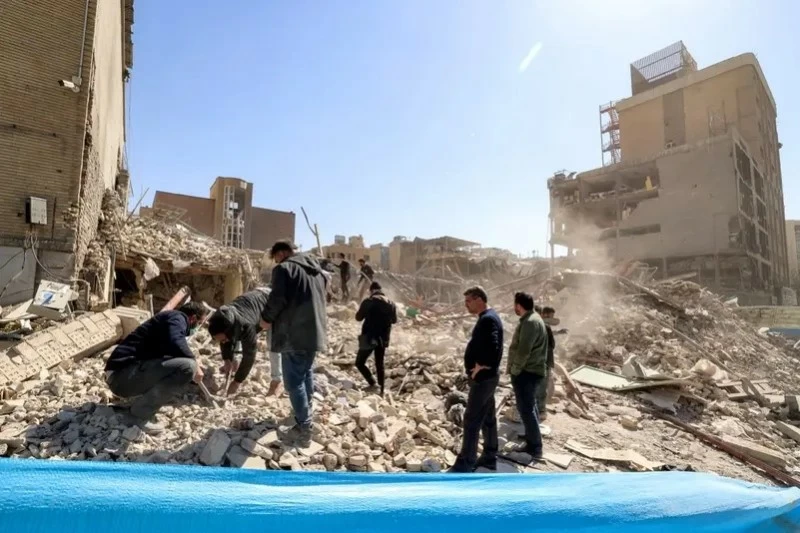
In an unprecedented escalation that threatens to radically alter the regional landscape, informed sources in Washington, D.C., revealed intensive military preparations for what officials described as a "devastating wave" of strikes against strategic targets in Iran. These developments coincide with legislative activity in Congress, where the House of Representatives and the Senate are preparing to vote on resolutions theoretically aimed at restricting President Donald Trump's military powers. However, indications suggest these efforts will fail given the strong Republican support for the current administration's policies.
Secret briefings and absolute Republican support
Following classified briefings from senior administration officials, including Secretary of State Marco Rubio and Secretary of Defense Pete Hagseth, US lawmakers reported that the coming days would bring military developments exceeding in scale and impact anything the region has recently witnessed. In this context, Republican Senator Lindsey Graham, a close ally of President Trump, stated that "the Iranian regime is dying," asserting that the firepower to be unleashed on Tehran in the next two days would be "overwhelming." He further claimed that the gateway to peace in the Middle East was about to open by neutralizing the Iranian threat.
Details of the military confrontation and the balance of power
The briefings were not limited to political threats; they also included military figures revealed by the US Central Command, indicating the destruction of 17 Iranian vessels in recent confrontations. Conversely, reports indicated that Tehran had depleted a significant portion of its arsenal by launching over 500 ballistic missiles and 2,000 drones, leading military officials to assert that Tehran's offensive capabilities were noticeably diminishing.
Congress and War Powers
Politically, attempts to limit the decision to go to war appear unlikely to succeed. With Republicans in control and supporting the "maximum pressure" approach, Senator Josh Hawley emphasized that the scope of the military operation is very broad and evolving rapidly, with the situation changing by the hour. Even Democratic voices, such as Senator Andy Kim, acknowledged that officials had informed them that what was happening was merely the beginning of a potentially long and complex operation, reflecting a tacit consensus in Washington on the inevitability of the current confrontation.
Unleashing American power
In press statements preceding the session, Secretary of State Marco Rubio pledged that the United States would "unleash" its capabilities against Iran in the coming hours and days, emphasizing that "the worst is yet to come." This rhetoric reflects a shift in American military doctrine toward launching devastating strikes aimed not only at deterrence but also at fundamentally undermining the Iranian regime's capabilities, placing the region at a pivotal juncture that could redraw the map of influence and power for years to come.
-

 Local News 6 days ago
Saudi Arabia approves regulations for the continued presence of Gulf vehicles: duration and penalties
-
Local news one week ago
The Ministry of Interior begins procedures for a royal pardon for common law prisoners
-
Local news one week ago
The deadline for property registration in Hail and Riyadh is Thursday
-
Culture and Art 7 days ago
The Devil's Prisons series was halted: The full story of "The Emperor's" being moved to YouTube
-
Local news one week ago
Under the patronage of the Minister of Information, an agreement was signed between the Ministry of Information and Waves Marketing Company
-
Local News 6 days ago
Saudi Energy: A new identity for electricity that aligns with Vision 2030
-
Local News 6 days ago
The Food and Drug Administration is recalling Bebelac and Aptamil milk due to potential contamination
-
Local news one week ago
Registration is now open for domestic pilgrims for the 1447 AH season: Dates and conditions via Nusuk