Politics
US Central Command denies targeting aircraft carrier Abraham Lincoln
The US Central Command denies Iran's claims of sinking the aircraft carrier Abraham Lincoln, confirms the safety of its forces and reveals details of the targeting of the Iranian ship Shahid Bagheri.

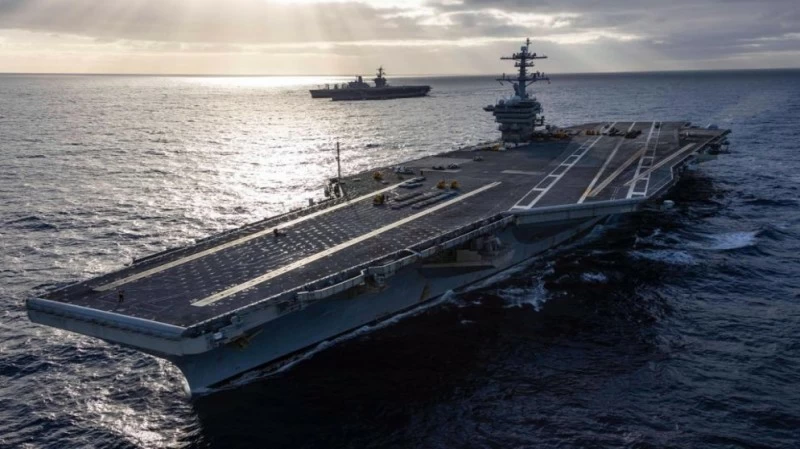
U.S. Central Command (CENTCOM) categorically denied reports and claims circulated by Iranian media outlets regarding the sinking or damaging of a U.S. aircraft carrier in the Arabian Gulf. In an official statement, CENTCOM asserted that these claims are part of a systematic disinformation campaign by the Iranian regime, describing the reports as "outright lies.".
The true field situation of the aircraft carrier Abraham Lincoln
In a statement released via its X platform, U.S. Central Command clarified that the aircraft carrier USS Abraham Lincoln sustained no damage and that the alleged missiles or threats never even approached its vicinity. The statement emphasized that the carrier is operating at full capacity, with its aircraft continuing routine takeoffs and landings in support of Central Command's ongoing missions, which are primarily aimed at protecting U.S. interests and defending regional security against Iranian threats and its proxies.
The story of “Martyr Bagheri” and the deliberate confusion
In refuting the Iranian narrative, the Central Command revealed a crucial military detail clarifying the true nature of the incident, stating that the only vessel actually struck was the Iranian ship "Shahid Bagheri." The Command explained that this vessel is not an aircraft carrier in the traditional sense, but rather an oil tanker that was converted and modified locally to serve as a drone launch platform. This reflects Tehran's attempts to exaggerate its military capabilities in the media by conflating strategic naval assets with modified vessels.
Strategic context and information warfare
This incident comes at a time of escalating tensions in the Middle East and a parallel psychological warfare campaign alongside the ground battles. American aircraft carriers, such as the nuclear-powered USS Abraham Lincoln (a Nimitz-class vessel), serve as floating air bases and symbols of global American military power. An attack on a vessel of this size is typically a major geopolitical event that cannot be ignored, given its crew size of over 5,000 sailors and the strict international monitoring of international waterways.
Observers believe that Tehran's resort to such claims falls within its asymmetric warfare strategy, seeking to boost domestic morale and send political messages to the region, even if these messages lack factual accuracy. The continued presence of the USS Abraham Lincoln in the region underscores the United States' commitment to maintaining freedom of navigation in vital waterways and deterring any attempts to destabilize the region.




Politics
Israeli airstrikes on Lebanon: Iranian official assassinated, southern suburbs bombed
A dangerous escalation in Lebanon: Israel launches violent raids on the southern suburbs of Beirut, assassinating an official in the Quds Force and a leader in Islamic Jihad, while targeting Al-Qard Al-Hasan centers.

The Lebanese arena witnessed a dramatic and dangerous shift in the course of military confrontations today (Monday), as Israeli operations reached their peak with attacks unprecedented in both their nature and targets. Specifically, Israeli warships targeted the old Iranian embassy building in Beirut, in a complex security and military operation that resulted in the assassination of the deputy commander of the Quds Force in Lebanon. According to available information, the targeted official was an Iranian national and is believed to have been directly responsible for managing and securing Hezbollah's precision missile depots, indicating an Israeli decision to target strategic links between Tehran and the group.
Targeting the financial and economic infrastructure
In parallel with the security operations, Israeli warplanes carried out a wide-ranging barrage of more than 70 airstrikes concentrated on Beirut's southern suburbs, as well as villages in southern Lebanon and the Bekaa Valley in eastern Lebanon. A notable aspect of this wave of raids was the expansion of the target bank to include Hezbollah's financial infrastructure, with the Al-Qard Al-Hasan Foundation's centers being intensively targeted. This foundation is considered the party's vital financial lifeline and support base, indicating that the Israeli escalation has shifted from direct military targeting to an attempt to cut off its financial resources and exert immense economic and social pressure on the Lebanese population.
Assassinations targeting Palestinian factions
In a related development, the assassinations were not limited to Iranian leaders or Hezbollah operatives. The Palestinian Islamic Jihad movement officially announced the assassination of Adham Adnan al-Othman, commander of its military wing, the Al-Quds Brigades, in Lebanon. This assassination resulted from a precise Israeli airstrike targeting his location in a Beirut suburb, confirming that Israeli intelligence is working to eliminate key leaders of Palestinian factions operating from Lebanese territory.
Implications of the escalation and its regional dimensions
This escalation carries serious implications for the region. Targeting a high-ranking Quds Force figure inside a former diplomatic building is a direct message to Tehran that it has crossed traditional red lines. Furthermore, the intensity of the airstrikes and the diversity of targets—military, financial, and leadership-related—reflect an Israeli strategy aimed at crippling Hezbollah and its allies' command and control capabilities. This development presents the region with a range of open-ended scenarios, as these operations are expected to have significant repercussions on the existing rules of engagement, amid international fears of a slide into a full-blown regional war that would be difficult to contain.
Politics
Kuwait: Individuals sympathetic to Iranian attacks and promoters of chaos arrested
The Kuwaiti Ministry of Interior announced the arrest of individuals who promoted chaos and expressed sympathy for Iranian attacks on social media. Learn more details and security warnings.

In a decisive security move aimed at protecting the home front and safeguarding society from the repercussions of regional tensions, the Kuwaiti Ministry of Interior announced that its Criminal Security Sector had identified and apprehended a number of individuals involved in activities that threaten national security and stability. These serious violations included the illegal filming and distribution of videos, as well as expressing sympathy for Iranian attacks and designated terrorist organizations on social media platforms.
Details of seizures and security violations
The Ministry explained in its official statement that those arrested had filmed and disseminated misleading information about security and field incidents, directly contributing to inciting chaos and spreading fear and anxiety among citizens and residents alike. The Ministry affirmed that the competent security agencies, represented by the Criminal Security Sector, successfully identified and apprehended these individuals after monitoring their online activities, which included publishing content that contradicts the supreme national interest and demonstrates sympathy for external entities that threaten the stability of the region.
A tense regional context and the need for firm security measures
These heightened security measures come at a time of escalating geopolitical tensions in the Middle East, compelling countries to take strict precautionary measures to prevent the spillover of external conflicts. Kuwait, by virtue of its geographical location and balanced foreign policy, is keen to distance itself from regional conflicts, emphasizing that it will not allow its territory or media platforms to be used as a mouthpiece for any external party or to undermine national unity. Maintaining the cohesion of Kuwaiti society is a top priority for the political and security leadership, especially under the current circumstances, which demand the highest levels of vigilance and awareness.
Legal responsibility and official warnings
The Ministry of Interior emphasized that its security services are continuing their close monitoring of all social media platforms and field operations, affirming that they will not tolerate any attempts to undermine the country's security and will apply the law firmly to all those who attempt to do so. All those apprehended have been referred to the relevant authorities to face the necessary legal action.
In closing, the Ministry reiterated its previous warnings to citizens and residents against being misled by rumors or sharing unverified videos, urging everyone to obtain information only from official state sources. It also emphasized the absolute necessity of refraining from filming security personnel while performing their duties or filming security operations, to avoid legal repercussions and to ensure that efforts to maintain security and safety in the country are not hindered.
Politics
Banning Hezbollah's military activities: A historic government decision led by Joseph Aoun
The Lebanese cabinet, headed by Joseph Aoun, has decided to ban Hezbollah's military activities. An analysis of the historic decision and its impact on state sovereignty and Lebanon's political future.

The decision taken by the Lebanese cabinet, headed by President Joseph Aoun, on Monday, to ban Hezbollah's military and security activities was not merely a knee-jerk reaction to a passing security incident. Rather, it was a deliberate and strategic political step in response to an escalating trend that began with the ceasefire agreement of November 2014. During this critical period, the state's authority has been subjected to continuous and severe testing, coinciding with Hezbollah's escalating and repeated rhetoric and its persistent insinuations that weapons outside the legitimate institutions constitute a guarantee of the state's survival. Faced with this complex reality, the government and its de facto head, constitutionally speaking, were presented with two options, and only two: either to practically establish the state's authority and enforce its sovereignty, or to accept its gradual and eventual erosion.
Historical context and the equation of the state
In this context, the Cabinet's decision acquires pivotal and historic significance. For the first time, a Lebanese government has taken a clear and direct decision to ban illegal armed displays, which recalls the essence of the Taif Agreement (1989), which explicitly stipulated the dissolution of militias and the monopoly of arms by the Lebanese state. The issue of illegal weapons has long been the most prominent obstacle in Lebanese politics, as the proliferation of arms has paralyzed political life and isolated Lebanon from its Arab and international environment for many years. This governmental move reaffirms the concept of the "state's monopoly on violence" as a fundamental pillar for building stable nations.
Political and strategic dimensions
This bold move, spearheaded by President Joseph Aoun, marks a turning point in the official approach to international resolutions, particularly Resolutions 1559 and 1701, which the international community has long demanded be fully implemented. The shift from a phase of "crisis management" and acquiescence to a phase of "decision-making" reflects a genuine desire to restore the prestige of the state and its military and security institutions. This decision sends a clear message, both domestically and internationally, that the Lebanese government has resolved to reclaim its sovereign decision-making power, independent of the regional influences that have dominated the scene for years.
Expected impacts locally and internationally
Domestically, this decision is expected to usher in a new era of security and stability, which could positively impact economic confidence and attract investments that fled the country due to security concerns and political uncertainty. Regionally and internationally, banning Hezbollah's military activities will reopen channels of diplomatic and financial support for Lebanon, as donor countries and the International Monetary Fund have long conditioned their aid on the state extending its full sovereignty over its territory and borders. This is a pivotal moment, presenting Lebanon with an existential choice: either to enshrine the rule of law and institutions, or to revert to chaos. It appears the government has made its choice in favor of the state.
-

 Local News 4 days ago
Saudi Arabia approves regulations for the continued presence of Gulf vehicles: duration and penalties
-
Local news two days ago
Jeddah Airport alerts for travelers due to airspace closure and flight disruptions
-
Local news one week ago
The Ministry of Interior begins procedures for a royal pardon for common law prisoners
-
Local News 6 days ago
The deadline for property registration in Hail and Riyadh is Thursday
-
Sports one week ago
Tickets for the Al-Ahli vs. Al-Hilal King's Cup match postponed: New date
-
Local News 7 days ago
Under the patronage of the Minister of Information, an agreement was signed between the Ministry of Information and Waves Marketing Company
-
Local news one week ago
Saleh Al-Maghamsi appointed Imam of the Prophet's Mosque: Details of the Royal Decree
-
Culture and Art 5 days ago
The Devil's Prisons series was halted: The full story of "The Emperor's" being moved to YouTube