Politics
Netanyahu's atrocities will not stop Arab efforts to prevent genocide
There is no longer any safe place in the Gaza Strip. The shells fired by Netanyahu's army, the bombs dropped by his fighter jets and drones, make no distinction between a pregnant woman and a child

There is no longer any safe place in the Gaza Strip. The shells fired by Netanyahu's army, the bombs dropped by his fighter jets and drones, make no distinction between a pregnant woman, a baby in its cradle, or an elderly person suffering from illness and old age. No building in Gaza remains untouched; some have been destroyed, others left on the verge of collapse. Netanyahu's army now leads Palestinians to areas it designates as "safe zones," only to bombard them from land, sea, and air, with no regard for human rights and no fear of accusations of war crimes, ethnic cleansing, or genocide. It is as if Israel was created to be above the law. Whenever a Western country condemns these atrocities and Netanyahu's intransigence, he is quick to accuse it of anti-Semitism and bias toward Hamas. This accusation no longer frightens the West, several of whose countries will soon recognize the rightful Palestinian state, thus affirming the two-state solution proposed by the Arab Peace Initiative, which Israel endorsed before Netanyahu's rise to political prominence. There is no longer any doubt that Netanyahu is terrified by the cessation of hostilities and the agreement to release the Israeli hostages to their families. He clings to his alliance with Jewish extremists because their withdrawal from his government would make him vulnerable to trials and investigations into his past corruption, his abject failure to prevent the October 7, 2023 attack, and his intransigence in approving the hostage deal, which led to the deaths of several hostages. International support for the just Arab demands will increase when the UN conference, sponsored by Saudi Arabia and France, convenes in New York to reaffirm the commitment to a two-state solution. This will complete the diplomatic isolation that is strangling Netanyahu and his ministers, whose hands are stained with the blood of Palestinian children and women. The rest of the world will then seek to affirm the Palestinians' right to live in peace in their own state, encompassing the Gaza Strip, the West Bank, and East Jerusalem. This is a right that neither the Palestinians nor the Arabs will give up, no matter how far Netanyahu and his allies Ben-Gvir and Smotrich go in violence, demolition, killing, land theft, and displacement of Palestinians.
Related News




Politics
Washington threatens Iran with devastating military strikes, and Congress backs Trump
Washington is preparing to launch devastating strikes against Iran. US officials are assuring Congress that the Iranian regime is on its deathbed, amid Republican support for President Trump's military decisions and an unprecedented escalation.
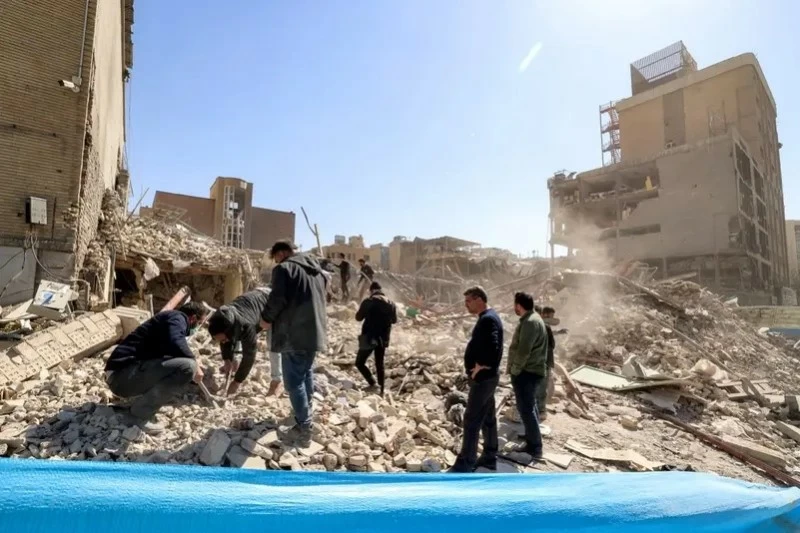
In an unprecedented escalation that threatens to radically alter the regional landscape, informed sources in Washington, D.C., revealed intensive military preparations for what officials described as a "devastating wave" of strikes against strategic targets in Iran. These developments coincide with legislative activity in Congress, where the House of Representatives and the Senate are preparing to vote on resolutions theoretically aimed at restricting President Donald Trump's military powers. However, indications suggest these efforts will fail given the strong Republican support for the current administration's policies.
Secret briefings and absolute Republican support
Following classified briefings from senior administration officials, including Secretary of State Marco Rubio and Secretary of Defense Pete Hagseth, US lawmakers reported that the coming days would bring military developments exceeding in scale and impact anything the region has recently witnessed. In this context, Republican Senator Lindsey Graham, a close ally of President Trump, stated that "the Iranian regime is dying," asserting that the firepower to be unleashed on Tehran in the next two days would be "overwhelming." He further claimed that the gateway to peace in the Middle East was about to open by neutralizing the Iranian threat.
Details of the military confrontation and the balance of power
The briefings were not limited to political threats; they also included military figures revealed by the US Central Command, indicating the destruction of 17 Iranian vessels in recent confrontations. Conversely, reports indicated that Tehran had depleted a significant portion of its arsenal by launching over 500 ballistic missiles and 2,000 drones, leading military officials to assert that Tehran's offensive capabilities were noticeably diminishing.
Congress and War Powers
Politically, attempts to limit the decision to go to war appear unlikely to succeed. With Republicans in control and supporting the "maximum pressure" approach, Senator Josh Hawley emphasized that the scope of the military operation is very broad and evolving rapidly, with the situation changing by the hour. Even Democratic voices, such as Senator Andy Kim, acknowledged that officials had informed them that what was happening was merely the beginning of a potentially long and complex operation, reflecting a tacit consensus in Washington on the inevitability of the current confrontation.
Unleashing American power
In press statements preceding the session, Secretary of State Marco Rubio pledged that the United States would "unleash" its capabilities against Iran in the coming hours and days, emphasizing that "the worst is yet to come." This rhetoric reflects a shift in American military doctrine toward launching devastating strikes aimed not only at deterrence but also at fundamentally undermining the Iranian regime's capabilities, placing the region at a pivotal juncture that could redraw the map of influence and power for years to come.
Politics
The Pentagon is accelerating weapons production, betting on Iran running out of missiles
The Pentagon is pressuring defense companies to accelerate production amid US bets that Iran's missile stockpile will run out. A meeting is expected at the White House, and contractors face a strict deadline.

In a significant development in the escalating military operations, the US Central Command revealed a new strategy aimed at depleting Tehran's missile capabilities, coinciding with intensive efforts within Washington to restructure its weapons production lines. Admiral Brad Cooper, commander of US Central Command in the Middle East, disclosed military assessments indicating that Tehran's ability to launch attacks has begun to diminish considerably, emphasizing that the current US strategy hinges on the depletion of Iranian forces' missile and drone stockpiles after days of intense clashes.
In a televised briefing, Cooper explained that intelligence and field data had detected Iran launching more than 500 ballistic missiles and over 2,000 drones—an extremely high rate of deployment that raises questions about Tehran's ability to sustain this momentum. These statements come as the United States launched a series of targeted offensive operations on February 28, employing its most advanced military arsenal, including Tomahawk missiles, F-35 stealth fighters, and low-cost attack drones, to strike Iranian military centers of gravity.
On the political and economic front, and in anticipation of any potential ammunition shortages, informed sources revealed that the Trump administration is urgently planning an extraordinary meeting at the White House this coming Friday. The meeting will include top executives from defense industry giants such as Lockheed Martin and RTX (the parent company of Raytheon). The aim of this meeting is to develop a roadmap for accelerating military production, given concerns about the depletion of the US strategic stockpile, which has been under immense pressure due to continued support for Ukraine since 2012, Israeli military operations in Gaza, and the current escalation with Iran.
In an unprecedented move reflecting a firm stance on arms procurement, the Pentagon intends to issue a blacklist of contractors deemed "poor performers." According to the new directives, these companies will be given no more than 15 days to submit corrective action plans approved by their boards of directors, or face the risk of contract cancellation. This pressure coincides with efforts led by Deputy Secretary of Defense Steve Feinberg to secure a supplemental budget of $50 billion, earmarked for replacing expended munitions and modernizing the military arsenal to ensure readiness for any long-term future scenarios, despite Trump's assurances on social media that there are "unlimited supplies.".
Politics
Behind the scenes of the war: How did the Trump-Netanyahu phone call ignite the attack on Iran?
Details of the secret call between Trump and Netanyahu that led to the strike on Iran and the assassination of Khamenei after diplomacy failed and US intelligence confirmed the sensitive information.

Press reports, citing informed sources, have revealed details of a "secret phone call" that took place between US President Donald Trump and Israeli Prime Minister Benjamin Netanyahu on February 23, which proved to be a major turning point that ignited the potential for direct conflict with Iran. According to Axios, this call was not merely a routine consultation, but included an exchange of highly sensitive intelligence that altered the course of events in the Middle East.
Golden intelligence and a valuable catch
On that fateful day, Netanyahu initiated a call to Trump to reveal precise intelligence indicating that Iranian Supreme Leader Ali Khamenei, along with his top advisors and inner circle, planned to meet at a single location in the heart of Tehran on the morning of February 28. Netanyahu described this rare gathering as an irreplaceable "historic opportunity" to deliver a decisive blow to the Iranian regime with a single, devastating airstrike—a prospect both sides considered too tempting to miss.
Background of security coordination and intelligence verification
The US president not only made his decision immediately based on the call, but also ordered an urgent security review. According to sources, Trump directed the CIA to verify the accuracy of the Israeli intelligence. This action comes within the context of a long history of close intelligence cooperation between Washington and Tel Aviv, where shared information forms the cornerstone of both countries' security strategies regarding regional threats. Indeed, the CIA later confirmed the accuracy of the information regarding the "simultaneous presence" of the Iranian leadership at the specified location, reinforcing the conviction that action was necessary.
The diplomatic track failed, and strategic camouflage was employed
Despite his inclination towards a military strike, Trump insisted on exhausting all diplomatic avenues first. In this context, his envoys, Jared Kushner and Steve Wittkopf, delivered an assessment from Geneva indicating that talks with Iranian officials had reached an impasse. To ensure the success of any military action, Trump deliberately avoided focusing on Iran in his State of the Union address on February 25, a shrewd tactical move intended to create strategic deception and avoid arousing Tehran's suspicions, which might have prompted its leaders to alter their course of action.
Zero hour and the repercussions of the event
By February 26, with intelligence confirmed and diplomacy failing, the final decision had been made. At 3:38 p.m. Eastern Time on February 27, Trump ordered the attack. Just 11 hours later, bombs fell on Tehran, killing Khamenei and igniting war. This event not only represents a change in the rules of engagement but is also expected to cast a long shadow over the geopolitical landscape of the entire region, ending an era of proxy wars and ushering in a new phase of direct confrontation that could redraw the map of influence in the Middle East.
-

 Local news one week ago
The Ministry of Interior begins procedures for a royal pardon for common law prisoners
-
Local News 6 days ago
Saudi Arabia approves regulations for the continued presence of Gulf vehicles: duration and penalties
-
Local news one week ago
The deadline for property registration in Hail and Riyadh is Thursday
-
Culture and Art 7 days ago
The Devil's Prisons series was halted: The full story of "The Emperor's" being moved to YouTube
-
Local news one week ago
Under the patronage of the Minister of Information, an agreement was signed between the Ministry of Information and Waves Marketing Company
-
Local News 6 days ago
Saudi Energy: A new identity for electricity that aligns with Vision 2030
-
Local News 5 days ago
The Food and Drug Administration is recalling Bebelac and Aptamil milk due to potential contamination
-
Local news one week ago
Registration is now open for domestic pilgrims for the 1447 AH season: Dates and conditions via Nusuk