
Politics
From an impregnable fortress to a deadly trap
The southern suburbs of Beirut have always been a strategic center for Hezbollah in social, military and political terms

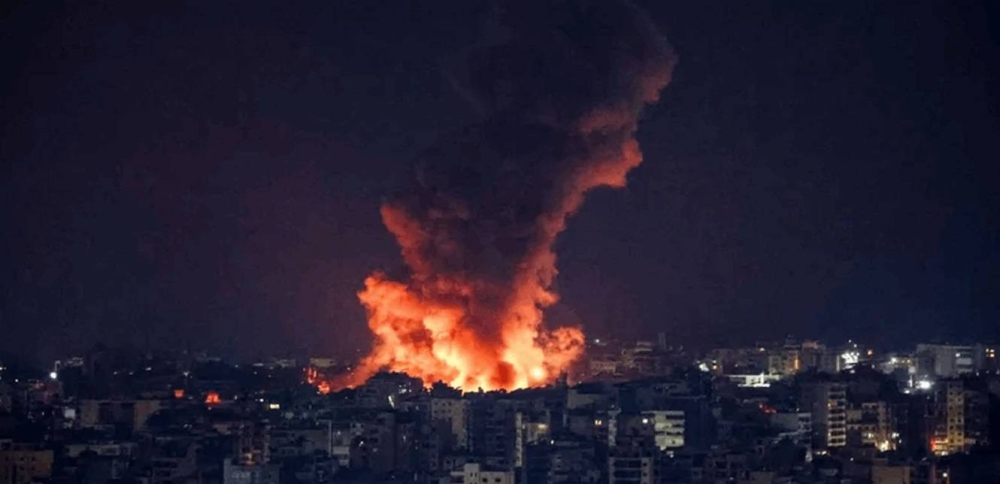
The southern suburbs of Beirut have always been a strategic center for Hezbollah in social, military and political terms, to the point that it has become the impregnable fortress and the main center of the party. Moreover, it was one of its most important strongholds on which it relied to ensure its influence, achieve its strategies and implement its agendas, as it was a human reservoir of supporters and fighters, and it contained the huge arsenal of weapons that was the “big stick” with which it intimidated its opponents, dominated the political scene and imposed its will on the inside and outside.
But the strike of September 27, 2024, which led to the assassination of (the party’s secretary and the suburb), revealed the fragility of that (fortress); which had imposed a strict, self-governing security rule for decades, and quickly turned into a (trap) for the invincible party, so that the next day the journey of radical changes began in the course of 18 years of (mutual deterrence).
How did the suburb turn into a trap?
The strategy of change in the attack: In recent years, Israel has developed different tactics to confront Hezbollah “potentially.” When the opportunity arose, it became clear that a radical shift had occurred in the military confrontation. Instead of launching direct and large-scale attacks on Hezbollah, as it did in the July 2006 war, Israel relied in the past few months – culminating in September 2024 – on precision attacks. Initially, it crippled Hezbollah’s ability to move or defend itself, targeting its most prominent leaders through successive assassinations of high-ranking and influential security figures. Later, it targeted its infrastructure and sensitive weapons and ammunition depots, until it was able to decapitate it in the “knockout blow.”.
Infiltration and trapping
It is a puzzle that analysts and experts are still trying to understand today: what happened and how these attacks occurred. In a quick and simplified overview, anyone who observes the new strategy of Israeli attacks on the southern suburbs of Beirut during the Gaza war, which reached its peak last month, must have discerned in its objectives that it was deliberately intended to reveal more than one message; the most prominent of which is that Hezbollah no longer possesses the same degree of sovereignty over its areas, and that Israeli intelligence has succeeded in penetrating and weakening Hezbollah, which presented itself as a unified and disciplined force with a first-rate counter-espionage capability within its ranks.
But with the assassination of the party’s Secretary-General Hassan Nasrallah and senior frontline leaders, we will not find for many years anyone who can answer the simplest and most important question at the same time: How did the party’s leaders become so confident that Israel was unable to reach them, given what they had built tens of meters deep in the reconstruction of the southern suburbs after the 2006 war?.
How could they trust staying in the suburb after the successive assassinations in the past few months and its transformation into an open arena for Israeli planes and drones?.
Popular shift from support to resentment
Israel is well aware that targeting all areas of influence of (Hezbollah) will not only destroy its strongholds, depots and vital infrastructure, but will also push civilians or its environment to diminish its ability to protect them.
This contradiction between the party’s stated goal of defending Lebanon, its ideology, or its environment, and the serious and significant damage to property and lives they suffered, put the party in a difficult position before its popular base, which will hold it accountable after it used them as human shields to protect itself, its centers, and its ammunition.
The party will remain for years facing a moral and military dilemma, because the fall of the suburb not only led to the military collapse of the stronghold, but also caused serious damage to its reputation as a “resistance movement” whose goal, as it claimed, was to protect its environment or community that provided it with all kinds of support.
Add to that the ongoing conflict within Lebanon itself and the economic and political pressures that have contributed to increasing the fragility of the situation between the party and its environment; the party, or what remains of it, which used to rely heavily on the support of its allies, found itself forced to leave its environment to face all kinds of internal challenges (displacement and destitution) that are no less serious than the external challenges.
The southern suburbs of Beirut, which deceived their surroundings into believing they were a symbol of strength and resistance, are now a scorched earth and remain vulnerable to repeated attacks. With the fall or demise of these suburbs, a journey of geopolitical and strategic shifts will begin across all levels and issues.
Information about the suburb
The number of displaced Shiites to the southern suburbs increased with the start of the Lebanese Civil War in 1975, as more than 150,000 residents of the eastern neighborhoods of the capital, Beirut, were forced to leave their areas after being harassed by Christian militias.
Near the suburb was the Burj al-Barajneh Palestinian refugee camp, which covered an area of about 750 square meters and had a population of about 25,000 people.
The number of commercial and economic institutions in the southern suburbs exceeds 37,000, the number of its hospitals reaches eight, and the number of bank branches exceeds one hundred, in addition to a network of schools and cultural and religious centers.




Politics
Saudi Arabia denies rumors of refusing to receive Sheikh Tahnoon bin Zayed
Information Minister Salman Al-Dossari confirms that what is being said about the Kingdom refusing to receive Sheikh Tahnoon bin Zayed is untrue, stressing the depth of the brotherly relations between the two countries.
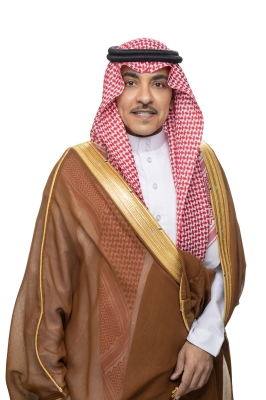
Saudi Minister of Information, Mr. Salman bin Yousef Al-Dossari, categorically confirmed that the news circulating on some media platforms and social media about the Kingdom of Saudi Arabia refusing to receive His Highness Sheikh Tahnoon bin Zayed Al Nahyan, National Security Advisor of the United Arab Emirates, is completely false and has no relation to reality.
In a statement aimed at dispelling rumors, Minister Al-Dossari clarified that Sheikh Tahnoon's relationship with the Kingdom transcends official protocols, emphasizing that "Sheikh Tahnoon bin Zayed comes to the Kingdom whenever he wishes without prior notice; it is his home and its leadership is his family." This statement reflects the depth of the personal and fraternal ties that bind the leadership of the two brotherly countries and puts an end to any attempt to cast doubt on the strength of this relationship.
Historical context of established relations
These rumors come at a time when Saudi-Emirati relations are at their strongest and most robust, with the strategic partnership between Riyadh and Abu Dhabi representing a cornerstone of stability in the Gulf region and the Middle East. This historic relationship is based on a long legacy of joint cooperation and coordination at the highest levels across various political, economic, and security fields, within the framework of the Gulf Cooperation Council and through advanced bilateral mechanisms such as the Saudi-Emirati Coordination Council, which aims to integrate visions and interests.
The importance of the event and its regional impact
His Highness Sheikh Tahnoun bin Zayed Al Nahyan is a pivotal figure in the UAE, holding the sensitive strategic position of National Security Advisor and playing a prominent role in shaping his country's foreign and economic policies. Given his position and the nature of the portfolios he oversees, his visits to the Kingdom and his meetings with Saudi officials carry particular significance. These visits are part of ongoing consultations and close coordination to address shared regional challenges and strengthen mutual interests. The aim of spreading such false information is to undermine trust and disrupt the robust alliance between the two countries, an alliance that has proven its effectiveness in dealing with numerous regional crises. Therefore, the swift and official Saudi denial underscores that this strategic relationship is immune to attempts to sow discord, and that communication channels between the two leaderships remain open, transparent, and characterized by absolute trust. This stance demonstrates the awareness of both countries regarding the importance of protecting their partnership from misleading media campaigns that target the security and stability of the entire region.
Politics
Putin and Sharaa in Moscow: The future of Russian-Syrian relations
Russian President Vladimir Putin and Syrian interim Prime Minister Ahmed al-Sharaa discussed the future of bilateral relations, the fate of Russian forces, and reconstruction in Moscow.
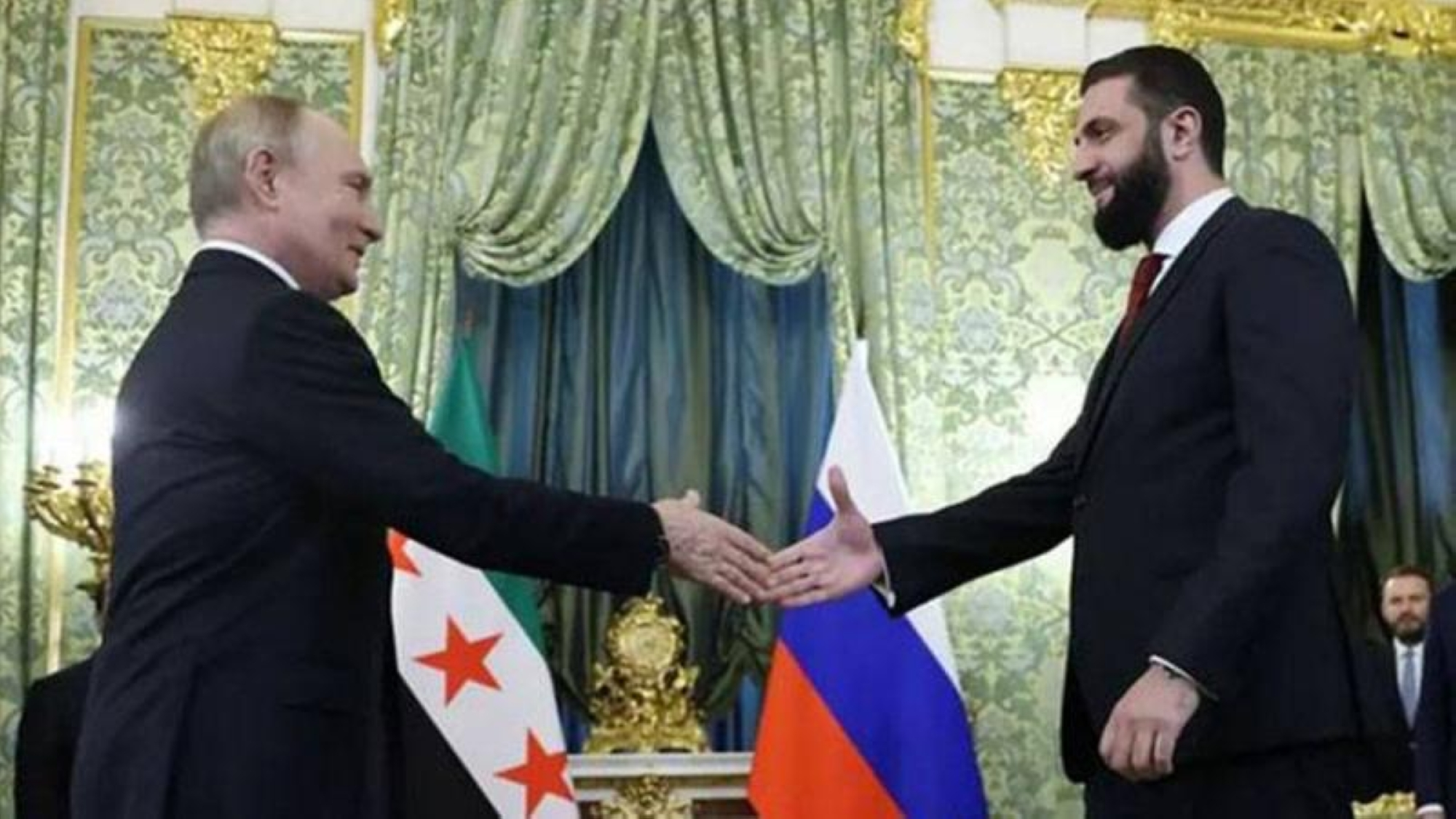
A strategic meeting in the Kremlin shapes the future
In a highly significant diplomatic move, Russian President Vladimir Putin received Syrian interim Prime Minister Ahmed al-Sharaa at the Kremlin on Wednesday. This meeting, the first of its kind since the recent radical political changes in Damascus, focused on the prospects for bilateral relations, the future of the Russian military presence in Syria, and the complex situation in the Middle East.
Historical background: From supporting the previous regime to engaging in dialogue with the new reality
This meeting is taking place against the backdrop of a historic shift in Syria, marked by the collapse of Bashar al-Assad's regime, whose most prominent international backer was Moscow. Since its military intervention in 2015, Russia has played a decisive role in tipping the balance of the conflict in favor of the former regime, establishing strategic military bases in Hmeimim and Tartus. Today, Putin's dialogue with al-Sharaa represents a pragmatic shift in Russian policy, an acknowledgment of the new reality on the ground, and an effort by Moscow to preserve its strategic interests and influence in Syria and the region.
The importance of the meeting and its potential effects
The meeting is of paramount importance to both sides. For the new Syrian government, this visit is a vital step toward gaining international legitimacy and securing the support of a major world power during the reconstruction and stabilization phase. For Russia, the goal is to ensure the continuity of its security and economic interests, safeguard the future of its military bases, and solidify its role as an indispensable mediator in any future political settlement in Syria.
Topics of discussion: From the economy to the military presence
During the meeting, President Putin praised al-Sharaa's efforts to develop relations, emphasizing the success in raising the level of economic cooperation between the two countries. Putin expressed a clear desire for Russian companies, particularly in the construction sector, to play a pivotal role in the reconstruction of Syria, which represents an economic opportunity for Moscow to recoup the costs of its military intervention. For his part, al-Sharaa commended Russia's role in achieving stability, expressing his hope that the Middle East region would witness a new phase of development and prosperity, and noting the numerous commonalities between Damascus and Moscow upon which further cooperation could be built.
The future of the Russian military presence was expected to feature prominently in the discussions, as the new Syrian government seeks to redefine its relationship with foreign forces on its territory, while Russia aims to secure an agreement that guarantees its long-term strategic presence.
Politics
Crown Prince receives Hillary Clinton: Meeting strengthens Saudi-American dialogue
Crown Prince Mohammed bin Salman received former US Secretary of State Hillary Clinton in Riyadh, in a friendly meeting that reflects the depth of Saudi-American relations and the importance of continued dialogue.
His Royal Highness Crown Prince Mohammed bin Salman bin Abdulaziz, Prime Minister, received former US Secretary of State Hillary Clinton at his office in Al-Yamamah Palace in Riyadh. The meeting included friendly exchanges, reflecting the ongoing communication between the Saudi leadership and prominent political figures on the international stage.
This meeting comes within the context of the historical and strategic relationship between the Kingdom of Saudi Arabia and the United States of America, a relationship that spans decades and has included close cooperation in the fields of energy, security, and counterterrorism. Hillary Clinton, who served as Secretary of State in the administration of President Barack Obama, is a pivotal figure in American diplomacy and has a long history of dealing with Middle Eastern issues, including her numerous visits to the Kingdom during her tenure, where she discussed pressing regional and international matters with Saudi leaders at the time.
Although Clinton does not currently hold an official position in the US government, she remains an influential figure in the Democratic Party and maintains a broad network of international contacts. The significance of this meeting lies in its role as an informal diplomatic channel, allowing for an exchange of views outside the constraints of strict formal protocols. It also underscores the Kingdom's commitment to building bridges with diverse political factions in the United States, an approach that fosters understanding of shared interests and contributes to shaping the future of bilateral relations.
On both regional and international levels, the meeting carries significant implications. It highlights the pivotal role the Kingdom plays as a stabilizing force in the Middle East and its commitment to consulting with international experts and policymakers on current challenges. The meeting also reflects the Kingdom's openness under Vision 2030, which encompasses not only economic and social transformation but also strengthening the Kingdom's diplomatic presence and expanding its dialogue with the world. Such meetings contribute to providing a firsthand look at the developments and reforms led by the Kingdom and offer an opportunity to discuss global issues from a Saudi perspective.
-

 Local News 4 days ago
Landslide in Riyadh: Details of the incident in Al-Sahafa neighborhood and containment efforts
-
 Local News 5 days ago
The death penalty was carried out against a citizen who stabbed another to death in Tabuk
-

 Culture and Art, 1 week ago
Ramez Galal in Ramadan 2026: Details of the bloody prank show
-
 Local News 6 days ago
First birth on the Riyadh train: A heartwarming story at Andalus station
-

 Local News 3 days ago
Riyadh collapse: Emergency plans to secure water after a main pipeline burst
-

 Culture and Art 3 days ago
Haifa Wehbe's absence in Riyadh: A photo crisis or a strained relationship with the media?
-
 Culture and Art 3 days ago
City Kitchen series: A drama of conflict and the middle class during Ramadan
-

 Culture and Art 3 days ago
The series "Kasra": Dawood Hussein in a moving social drama this Ramadan