Politics
After 12 days of war, the Israeli-Iranian ceasefire comes into effect
The ceasefire agreement between Israel and Iran came into effect this morning (Tuesday) at 7:00 AM local time

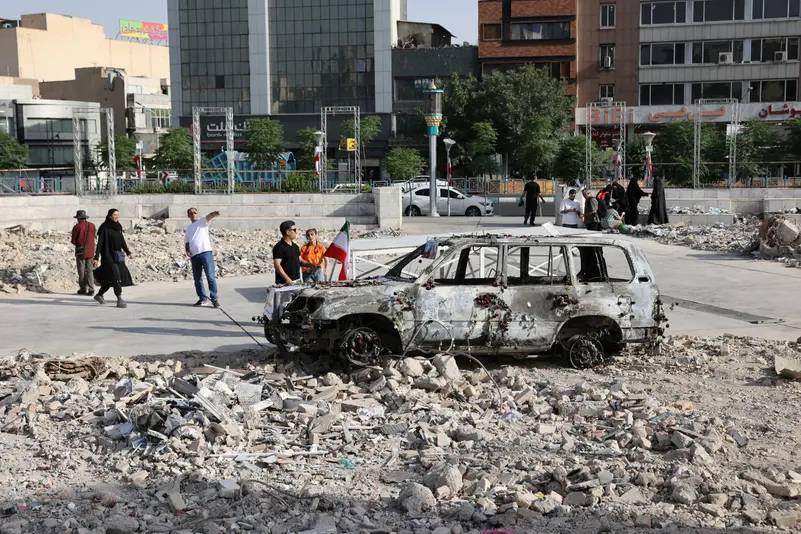
The ceasefire agreement between Israel and Iran came into effect this morning (Tuesday), at 7:00 AM Jerusalem time, after 12 days of war that erupted at dawn on Friday, June 13, with a large-scale Israeli attack targeting nuclear facilities and military sites inside Iran.
In the last hour, Iran bombed cities and strategic sites inside Israel, killing at least 6 Israelis in Beersheba and injuring more than 30 others, including critical cases, according to the Israeli ambulance service and Hebrew media.
Channel 12 reported that a ballistic missile directly hit a residential building in Beersheba, causing large sections of it to collapse. Magen David Adom Director General Eli Ben said that rescue teams, the army, and the Home Front Command were continuing to work to recover victims, and warned of the risk of a gas leak at the site.
Explosions rocked Tel Aviv and the central region, amid reports of injuries, while explosions were heard in occupied Jerusalem, coinciding with sirens.
For its part, the Israeli Civil Aviation Authority announced the closure of the airspace until at least 7 pm, and Channel 12 reported that Israeli warplanes have been flying for hours without permission to land.
The Israeli military said it detected new waves of Iranian missiles overnight, and that air defenses intercepted them, calling on residents to stay in protected areas and comply with Home Front Command instructions.
The Israeli Broadcasting Authority stated that Tehran sought to carry out the "final strike" before the agreement came into effect, in order to establish a balance of deterrence before the truce.
Related News




Politics
Trump gives Iran 15 days for a nuclear deal amid military buildup
Trump gives Iran a 10-15 day deadline to reach a nuclear agreement or face dire consequences, amid US military buildup and Iranian-Russian maneuvers that are driving up oil prices.

In a significant development in the Middle East, US President Donald Trump issued a stern warning to the Iranian leadership, giving them a tight deadline of 10 to 15 days to reach a decisive agreement on their nuclear program. Trump clearly indicated that failure to comply with this demand could lead to "bad things," implicitly suggesting the possibility of military action or unprecedented sanctions.
Context of tension and military mobilization
These fiery statements come at a time of heightened military tension in the region, as the United States continues to bolster its military presence by deploying aircraft carriers and additional warships to regional waters, reflecting Washington's seriousness in dealing with the Iranian issue. Observers believe this buildup is not merely a show of force, but rather a powerful bargaining chip at the negotiating table, aimed at compelling Tehran to make substantial concessions.
Behind the scenes of the negotiations and the American conditions
During a meeting of the Peace Council in Washington, Trump revealed that negotiations with Iran were "going well," but stressed the need for this process to lead to a "serious and meaningful" agreement. The American vision centers on definitively preventing Iran from acquiring a nuclear weapon, which Washington considers an existential threat to international peace and security. Despite talk of progress, the US administration confirmed that disagreements remain, pending a written proposal that Tehran pledged to submit to address Western concerns.
Regional and international dimensions of the crisis
Tensions are no longer confined to Washington and Tehran; they have taken on international dimensions with the involvement of other major powers. Reports indicate that a Russian frigate has joined Iranian naval exercises in the Gulf of Oman, a move with profound political and military implications, interpreted as a message of Russian support for Tehran in the face of American pressure. In response, Moscow warned of an "unprecedented escalation" that could plunge the region into chaos, urging all parties to exercise restraint.
Economic repercussions and security concerns
This escalation cast a long shadow over the global economy, with oil prices rising sharply due to fears of a conflict that could threaten energy supplies through vital waterways. On the security front, intelligence reports indicated that Iran was undertaking extensive fortification work at its nuclear and missile sites, coinciding with US preparations at its bases in the region.
Indicating the gravity of the situation, some countries have begun taking precautionary measures to protect their citizens. Poland, for example, urged its citizens to leave Iran "within hours," reflecting international concern that the crisis could escalate in the coming days. The major obstacle to any agreement remains Tehran's insistence on refusing to discuss issues beyond its nuclear program, considering its missile capabilities a "red line" that is not open to negotiation. This puts the deadline set by Trump to a real test.
Politics
Trump inaugurates the Peace Council for the reconstruction of Gaza and threatens Iran with a 10-day deadline
Trump inaugurates the Peace Council in Washington with the participation of 47 countries to discuss the reconstruction of Gaza with $17 billion in funding. The meeting addresses the deployment of international forces and issues a strongly worded warning to Iran.
In a move reflecting a major shift in international policy toward the Middle East, US President Donald Trump inaugurated the first meeting of the "Peace Council" in Washington, D.C., on Thursday. This newly established council aims primarily to lead reconstruction efforts in the Gaza Strip, as well as to work toward resolving complex international conflicts, with broad international participation reflecting global interest in the region's stability.
Details of the meeting and the massive funding
The meeting witnessed a strong diplomatic presence, with representatives from 47 countries participating, along with the European Union as an observer. Discussions focused on the implementation mechanisms for revitalizing the Palestinian sector after the devastating war that crippled its infrastructure. Regarding financial support, Trump announced substantial pledges, with several countries—mostly from the Gulf—committing over $7 billion specifically for Gaza's reconstruction. Simultaneously, the US president announced a $10 billion contribution to the Peace Council fund, bringing the initial funding to record levels and reflecting the seriousness of the international effort.
The security context and tensions with Iran
The meeting was not limited to economic and humanitarian issues; it also carried strongly worded political and security messages. Amidst the ongoing tensions between Washington and Tehran, and despite the existence of indirect channels of negotiation, Trump used the platform to issue an ultimatum to Iran, giving it only 10 days to reach a "viable deal," and threatening "bad consequences" if it failed to comply, thus leaving the region facing a range of unpredictable scenarios.
New security arrangements in Gaza
On the ground in Gaza, the participants discussed unprecedented security plans that include deploying thousands of troops to form an "international stabilization force," as well as establishing a new police force to maintain internal security. These arrangements are intended to ensure a secure environment that will allow reconstruction efforts to begin. Ali Shaath's name emerged prominently at the meeting, as he is the head of the Palestinian National Committee that will administer Gaza's affairs under the direct supervision of the "Peace Council.".
The importance of the event and its regional impact
This event is of exceptional importance given Trump's absolute powers as president of the council, as he has the exclusive right to invite heads of state or cancel their participation. Observers note that the formation of this council represents an attempt to reshape security and political arrangements in the Middle East by integrating reconstruction efforts with a regional de-escalation strategy and attempting to contain Iranian influence through diplomatic pressure and the threat of force, making the outcomes of this meeting a potential turning point for the region's future.
Politics
Trump inaugurates Peace Council for Gaza Reconstruction with $17 billion in funding
Trump opens the Peace Council in Washington to rebuild Gaza with $17 billion in funding and discuss the deployment of international forces, issuing a strongly worded warning to Iran with a 10-day deadline.
In a significant diplomatic move aimed at reshaping the political and security landscape of the Middle East, US President Donald Trump inaugurated the first meeting of what he called the “Peace Council” in Washington, D.C., on Thursday. This new entity is primarily concerned with the reconstruction of the Gaza Strip, as well as developing comprehensive strategies for resolving existing international conflicts. The meeting was attended by a broad international audience, including representatives from 47 countries, in addition to the European Union, which participated as an observer.
This event is of exceptional importance given the critical timing of its convening, following a devastating war in the Palestinian territories that left immense destruction of infrastructure and vital facilities. Through this council, the United States seeks to mobilize international efforts to prevent a recurrence of the conflict and secure a stable environment. This reflects a shift in US strategy toward direct and leading involvement in shaping post-war arrangements and attempting to impose a new vision for regional stability.
On the financial front, Trump unveiled massive financial pledges aimed at ensuring the success of the Council's challenging mission. He stated that several countries, mostly from the Gulf region, had committed to providing more than $7 billion specifically for the reconstruction of Gaza. In a move underscoring Washington's significant influence on this issue, the US president announced a $10 billion contribution to the "Peace Council" fund, bringing the total initial funding to approximately $17 billion, although the precise details of the Council's operations and the disbursement of funds remain somewhat unclear.
Regarding the complex security arrangements, the participants discussed ambitious plans that included deploying thousands of troops to form an “international stabilization force” in Gaza to fill the security vacuum, along with establishing a new police force to maintain internal security. The name of Ali Shaath, head of the Palestinian National Committee, emerged at the meeting. He was tasked with managing Gaza’s affairs under the direct supervision of the “Peace Council,” indicating the development of a new administrative structure separate from the previous, traditional authorities.
The meeting was not without its sharp geopolitical messages, as Trump used the platform to deliver a stern warning to Tehran amid ongoing tensions between the two countries. Despite the existence of a channel for indirect negotiations, Trump gave the Iranian regime only 10 days to reach a "viable deal," threatening "bad consequences" if it failed to comply, thus placing the region at a critical crossroads between escalation and de-escalation.
It is worth noting that the Council’s organizational structure grants Donald Trump absolute and unprecedented powers; he is the sole president of the Council and has the exclusive right to invite heads of state and government to participate or cancel their membership, reflecting the desire of the American administration to take full control of the political and security initiative in this thorny issue and to direct the international compass according to the American vision.
-

 Culture and Art, 1 week ago
The "Between and Between" exhibition in Jeddah: 5 artists reshape Saudi memory
-
Local News 7 days ago
Saudi Arabia's National Arabic Language Policy: 8 Principles to Promote Identity
-
Culture and Art, 1 week ago
Shakira's concert in Jeddah: Details of the international star's first concert in Saudi Arabia
-
Local News 6 days ago
Adopting the National Policy for the Arabic Language: Strengthening Identity and Vision 2030
-
Local News 7 days ago
The Riyadh-Rin-Bisha dual carriageway, spanning 559 km, has been completed
-
Local News 3 days ago
Human Resources sets the date for the 2026 Founding Day holiday for both sectors
-
Local News 5 days ago
The Supreme Court calls for the sighting of the crescent moon of Ramadan 1447 on Tuesday evening
-
Local News 3 days ago
Riyadh Train and City Bus Timetables During Ramadan: The Complete Guide