
Politics
The Kingdom and support for the Syrian people
The Kingdom's support for the Syrian people comes through the King Salman Center for Relief and Humanitarian Aid, via an air bridge and a land bridge carrying [the supplies/aid]

The Kingdom’s support for the Syrian people comes through the King Salman Center for Relief and Humanitarian Aid, via an air bridge and a land bridge carrying food, shelter and medical supplies, embodying the great humanitarian role that the Kingdom plays towards sisterly and friendly countries in various crises.
From the first day of the fall of Bashar al-Assad’s regime, the Kingdom declared its support for Syria and its people in a way that guarantees its security, stability and territorial integrity, demanding non-interference in Syria’s internal affairs, and giving Syrians the opportunity to determine their own destiny, build their homeland and shape their future, in a way that suits their needs after wars and conflicts that killed thousands, displaced millions and destroyed infrastructure, which needs the support of the international community for reconstruction.
The Kingdom, represented by the King Salman Center for Relief and Humanitarian Aid, was among the first countries to stand with the Syrian people in their ordeal that began in 2011, by providing grants and relief and humanitarian aid to internally displaced persons and those in neighboring countries due to the armed conflict, as well as to those affected by the devastating earthquake that damaged some governorates in northern Syria in February 2023.
The aid provided by the Kingdom to the Syrian people from 2011 until the current year 2024 reflects the Kingdom’s keenness, both leadership and people, to support our brothers in Syria, stand by them, and alleviate their suffering.







Politics
A comprehensive agreement between the Syrian government and the SDF to unify the country
The new Syrian government and the Syrian Democratic Forces (SDF) have reached a historic agreement to cease fire and integrate forces and institutions, with the aim of ending the division and unifying Syrian territory.
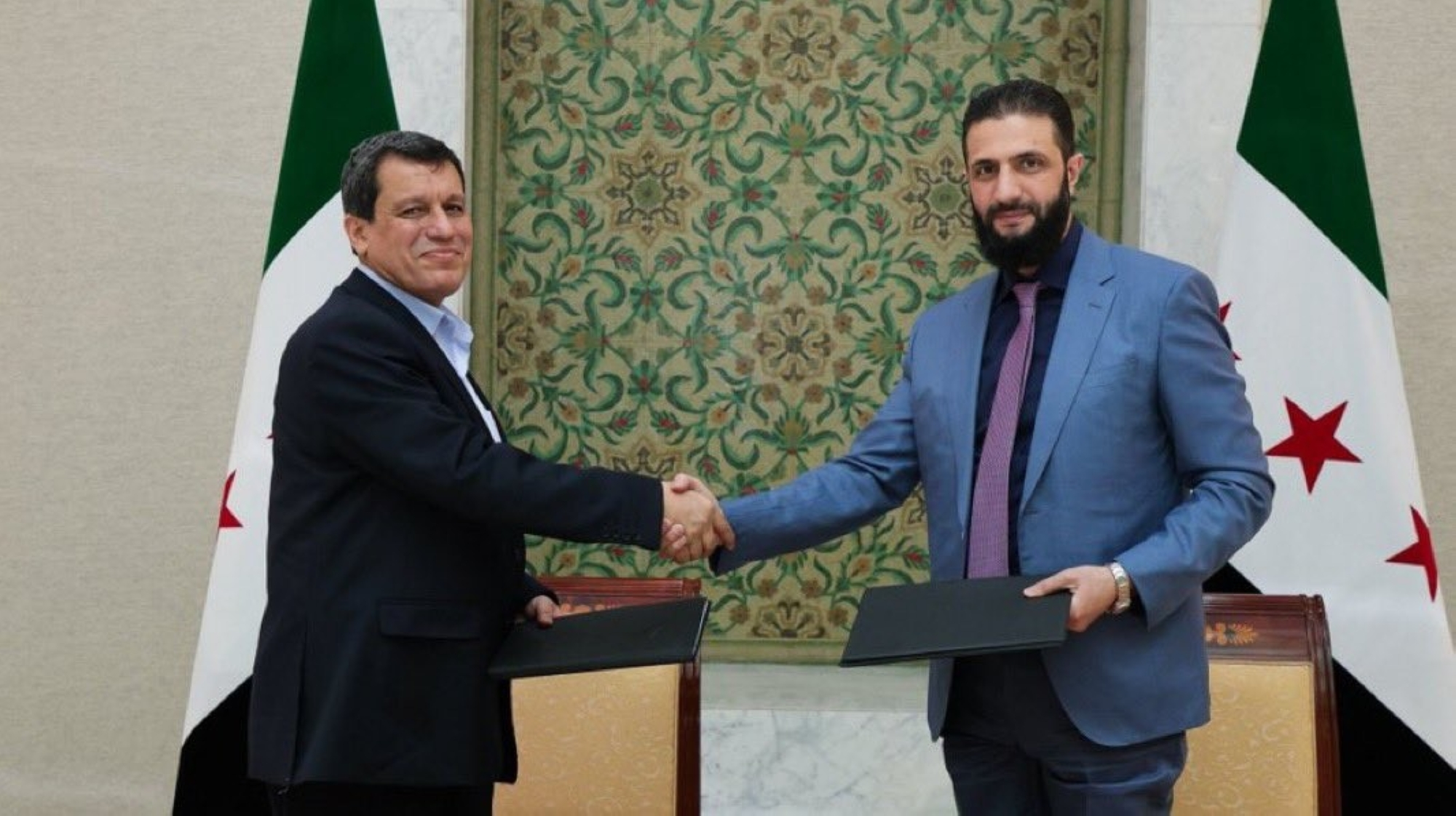
In a historic move that could redraw the political and military map of Syria, the new Syrian government announced a comprehensive agreement with the Syrian Democratic Forces (SDF) aimed at ending the division that has persisted for more than a decade. The agreement stipulates an immediate ceasefire and the commencement of a comprehensive integration process for military and security forces and civilian administrations, paving the way for the unification of Syrian territory under a single central authority.
Background of the conflict and context of the agreement
This agreement follows radical political shifts in Damascus and culminates a long and complex relationship between the central government and the Syrian Democratic Forces (SDF). Since the outbreak of the Syrian crisis in 2011, the SDF, whose backbone is the Kurdish People's Protection Units (YPG), has emerged as a major force in northern and eastern Syria. These forces played a pivotal role in the war against ISIS with the support of the international coalition and established an autonomous administration that governed vast areas. The relationship with Damascus has fluctuated between tension, limited clashes, and tactical coordination against common enemies, but the issue of sovereignty and recognition of the autonomous administration has remained a fundamental point of contention. With the recent changes in power, the door has been opened for serious dialogue to end the division and rebuild the state on new foundations.
Key provisions for unifying the country
According to government sources, the agreement includes detailed and practical provisions. Militarily, forces will withdraw from the front lines, and a new military division will be formed comprising three brigades of SDF fighters, in addition to a brigade specifically for the city of Kobani (Ayn al-Arab), administratively affiliated with Aleppo Governorate. In terms of security, Interior Ministry security forces will enter the cities of Hasakah and Qamishli to enforce the law and enhance stability, paving the way for the integration of local security forces into the official structure. On the civilian level, the institutions of the Autonomous Administration will be integrated into state institutions, with guarantees for the permanent employment of staff and the regularization of their status. The agreement, signed by President Ahmed al-Sharaa on January 18, also guarantees the civil, cultural, and educational rights of the Kurdish component, which Presidential Decree No. (13) affirms is an integral part of the Syrian national identity.
Importance and expected effects
This agreement holds immense strategic importance on all levels. Domestically, it represents a crucial step toward ending the civil war and restoring state authority over all of Syria, including its oil and gas fields and border crossings. This will return vital resources to the public treasury and accelerate the reconstruction process. It also paves the way for the safe return of millions of displaced persons and refugees to their homes. Regionally, the agreement reshapes the balance of power in the region, particularly concerning relations with Turkey, which views the influence of Kurdish forces on its border with concern. Internationally, the agreement resolves the ambiguity surrounding the fate of the areas formerly controlled by the Syrian Democratic Forces (SDF) and presents the international community, including the United States, which supported these forces, with a new reality that necessitates a reassessment of policies toward Syria. This could encourage the lifting of sanctions and support for the path to political stability.
Politics
New Saudi support for the Yemeni Central Bank to enhance economic stability
Through its program for the development and reconstruction of Yemen, Saudi Arabia is providing new support to the Central Bank of Yemen with the aim of achieving financial and monetary stability and improving the living conditions of the Yemeni people.
The Kingdom of Saudi Arabia, through the Saudi Program for the Development and Reconstruction of Yemen, announced a new support package for the Central Bank of Yemen, in a move that confirms the continuation of its efforts aimed at strengthening the foundations of economic and financial stability in the Republic of Yemen, which is suffering from serious challenges.
Historical context and protracted crisis
This support comes amidst the extremely complex economic and humanitarian conditions that Yemen has been experiencing for years. Since the outbreak of the crisis, the Yemeni economy has suffered near-total collapse, with the value of the Yemeni rial plummeting and oil and gas exports, which constituted the main source of government revenue, ceasing, leading to one of the world's worst humanitarian crises. Foreign aid, particularly Saudi support, has been a lifeline for the crippled economy. The Kingdom has previously provided substantial financial deposits to the Central Bank of Yemen in recent years, most notably a multi-billion dollar deposit that temporarily helped to curb the currency's decline and finance imports of essential goods.
Support objectives and expected impact
The new support aims to achieve a range of strategic objectives that extend beyond immediate financial assistance. It focuses on strengthening the institutional capacities of the Central Bank of Yemen and improving governance and transparency in its operations. This support is expected to positively impact the stability of the Yemeni rial's exchange rate, contributing to controlling inflation and alleviating the burden on citizens facing continuously rising prices for food, fuel, and medicine.
Domestically, this support is expected to enable the Yemeni government to meet its obligations, primarily paying public sector salaries regularly, which will boost purchasing power and stimulate the economy. The support also includes empowering the private sector to contribute effectively to sustainable economic growth, creating new job opportunities for young people, and supporting economic and social development initiatives across Yemen's governorates.
Regional and international importance
At the regional and international levels, this support is an integral part of the Kingdom's strategy to support legitimacy in Yemen and contribute to restoring stability to the state and its institutions. A strong and effective central bank is a cornerstone of any future reconstruction efforts and the achievement of sustainable peace. This move also aligns with calls from the international community and humanitarian organizations for urgent economic support for Yemen to prevent the humanitarian catastrophe from worsening. The Saudi Program for the Development and Reconstruction of Yemen affirmed that this support is an extension of the Kingdom's long-standing commitment to supporting Yemen and its people through the implementation of dozens of development projects in vital sectors such as education, health, water, energy, and transportation.
Politics
Saudi Defense Minister in Washington to strengthen strategic partnership
Defense Minister Prince Khalid bin Salman arrived in Washington on an official visit aimed at strengthening the strategic partnership between the two countries and discussing key security issues in the region.

His Royal Highness Prince Khalid bin Salman bin Abdulaziz, Minister of Defense, and his accompanying delegation arrived in Washington, D.C., for an official visit of particular importance given the rapid geopolitical developments in the Middle East and the world. This visit underscores the depth of the strategic relationship that has bound the Kingdom of Saudi Arabia and the United States for decades.
Historical background of a long-standing partnership
This visit represents another link in a long chain of high-level communication and coordination between Riyadh and Washington. The roots of this partnership stretch back more than eight decades, built on fundamental pillars including cooperation in the fields of energy, security, and defense. This relationship has proven its ability to adapt to international changes and has formed a cornerstone in maintaining regional stability and confronting shared threats, from combating terrorism to securing vital waterways for global trade.
The importance of the visit and its expected impact
The visit of His Highness the Minister of Defense comes at a critical time, as the agenda for the talks is expected to focus on a number of pressing issues. Regionally, the discussions are believed to address ways to strengthen joint efforts to achieve stability in the region, including the situation in the Gaza Strip, maritime security in the Red Sea, the Iranian nuclear program, and support for political solutions to the crises in Yemen and Syria. These discussions aim to unify perspectives and coordinate positions to effectively confront these challenges.
Strengthening defense and security cooperation
On the bilateral level, the visit aims to explore ways to strengthen relations between the two friendly countries, particularly in the defense and military fields. This includes reviewing existing cooperation programs, discussing the development of the Kingdom's defense capabilities, and coordinating efforts in combating terrorism and extremism. Military cooperation between the two countries is a cornerstone of the regional security system, encompassing joint exercises and intelligence sharing, which contributes to enhancing the efficiency and readiness of the armed forces in both countries. This visit is not merely a protocol meeting, but a significant strategic milestone for reaffirming mutual commitments and outlining the next phase of cooperation to address global challenges and ensure a secure and stable future for the region and the world.
-

 Local News 5 days ago
Landslide in Riyadh: Details of the incident in Al-Sahafa neighborhood and containment efforts
-
 Local News 6 days ago
The death penalty was carried out against a citizen who stabbed another to death in Tabuk
-

 Culture and Art, 1 week ago
Ramez Galal in Ramadan 2026: Details of the bloody prank show
-
 Local news one week ago
First birth on the Riyadh train: A heartwarming story at Andalus station
-

 Culture and Art 5 days ago
Haifa Wehbe's absence in Riyadh: A photo crisis or a strained relationship with the media?
-
 Local News 5 days ago
Riyadh collapse: Emergency plans to secure water after a main pipeline burst
-

 Culture and Art 5 days ago
City Kitchen series: A drama of conflict and the middle class during Ramadan
-

 Culture and Art 5 days ago
The series "Kasra": Dawood Hussein in a moving social drama this Ramadan