Politics
The Israeli opposition accuses Netanyahu of creating excuses to continue the war
In light of the ongoing demonstrations in Israel condemning Prime Minister Benjamin Netanyahu's obstruction of the prisoner exchange deal and his insistence on

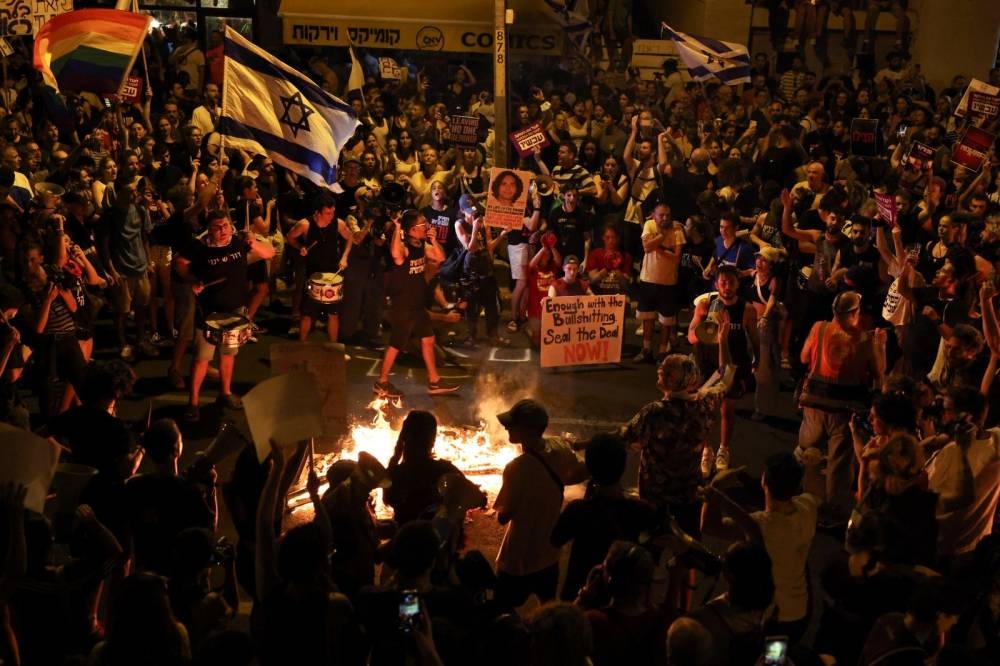
Amid ongoing demonstrations in Israel condemning Prime Minister Benjamin Netanyahu's obstruction of the prisoner exchange deal and his insistence on remaining in the Philadelphi Corridor and the Netzarim Pass, Israeli opposition leader Yair Lapid accused Netanyahu of making excuses to continue the war and of being keen to prevent the collapse of his government.
Lapid said: “Prime Minister Benjamin Netanyahu always has an excuse to continue the war forever by entering Rafah, then Netzarim, and now Philadelphi,” adding: “The only thing that matters to Netanyahu is that his government does not collapse.”.
In statements to Channel 13, the Israeli opposition leader accused Netanyahu of supporting Hamas with money, saying: “No one in the history of the country has strengthened Hamas more than Netanyahu,” stressing that he handed over suitcases full of dollars, with the aim of destabilizing the Palestinian Authority and deepening the rift between them.
This comes as demonstrations continue to pressure Benjamin Netanyahu’s government to accept a ceasefire and prisoner exchange agreement amid a wave of anger following the Israeli army’s announcement that it had recovered the bodies of six prisoners from the Gaza Strip.
Last night, Israeli police clashed with protesters on the Ayalon Highway in Tel Aviv as they tried to disperse the demonstrators. Haifa and Beersheba also witnessed large protests, with participants holding up pictures of the detainees and demanding that Netanyahu cease fire and make a deal to bring them back from detention.
Israeli media reported that police forces arrested 84 protesters, 53 of them at a Tel Aviv demonstration and 24 in Jerusalem.
Hamas announced new instructions to the guards of the detainees regarding how to deal with them if Israeli forces approach the detention sites, holding Israel responsible for the deaths of the six detainees after they deliberately disrupted any prisoner exchange deal for narrow interests, in addition to deliberately killing dozens of them through direct air strikes.
On the other hand, CNN quoted American officials involved in the negotiating team for the Gaza ceasefire and prisoner exchange deal as saying that they believe Israeli Prime Minister Benjamin Netanyahu thwarted their efforts after his press conference yesterday in which he announced his opposition to withdrawing from the Philadelphi Corridor between Egypt and the Palestinian Strip.




Politics
Kuwaiti Defense Ministry: Details of US aircraft crashes and crew survival
The Kuwaiti Ministry of Defense announced the downing of American warplanes and the complete survival of their crews, coinciding with air defenses intercepting hostile targets amid regional tensions and ongoing escalation.

The Kuwaiti Ministry of Defense officially announced the downing of a number of US military aircraft in Kuwaiti airspace, confirming in an urgent statement the survival of all military crews on board, coinciding with the escalation of security events in the Arabian Gulf region and the continuation of Iranian strikes for the third day in a row.
In a statement detailing the incident, the Kuwaiti Army General Staff issued a clarification today (Monday), stating that "this morning, a number of American warplanes crashed, and their crews all survived." The statement emphasized that joint military coordination between the Kuwaiti and American sides contributed to the swift response to the situation, with the relevant authorities immediately commencing search and rescue operations at the crash site.
Evacuation and medical care
The General Staff explained that the aircrews were successfully evacuated and immediately transported to the hospital for necessary medical examinations and to ensure their well-being. Initial medical reports confirm their condition is stable and they are receiving the necessary care. This swift action reflects the readiness of the emergency and rescue teams in handling urgent military incidents.
Background of strategic military cooperation
This incident comes within the context of the close and historic military cooperation between the State of Kuwait and the United States of America. The two countries are bound by decades-long strategic defense and security agreements aimed at enhancing regional security and stability. Kuwait hosts a number of US military bases and units that conduct regular training exercises and air patrols, resulting in a high level of air and operational coordination between the two countries, which explains the rapid response to the rescue operation.
Regional tensions and air defense response
This incident coincides with a highly tense regional situation, with reports indicating that Iran launched a new wave of missile and drone attacks targeting several Gulf capitals and cities, including Doha, Kuwait City, Dubai, Abu Dhabi, and Bahrain. In this regard, military sources reported that Kuwaiti air defense systems proved their effectiveness and intercepted hostile targets in the airspace along the coastline, after sirens sounded warning of the impending threat.
Observers believe that these rapid developments pose significant security challenges to the region, necessitating the highest levels of preparedness to protect airspace and vital facilities, while the relevant authorities continue to closely monitor the situation on the ground to ensure the safety of citizens and residents.
Politics
A joint Gulf-Jordanian-American statement condemns Iran's destabilizing actions
A joint Gulf-Jordanian-American statement strongly condemns the Iranian missile and drone attacks, stressing that they threaten regional stability, violate the sovereignty of states, and endanger civilians.

The United States, the Gulf Cooperation Council (GCC) countries, and the Hashemite Kingdom of Jordan issued a strongly worded joint statement asserting that recent Iranian actions constitute a direct and explicit threat to regional stability in the Middle East. The statement emphasized that Iran's targeting of civilians and infrastructure in countries not involved in hostilities is a reckless act that violates international norms and laws.
The Kingdom of Saudi Arabia, the Kingdom of Bahrain, the State of Qatar, the State of Kuwait, the United Arab Emirates, the Sultanate of Oman, the Hashemite Kingdom of Jordan, and the United States of America strongly condemned Iran’s indiscriminate attacks. The statement noted Tehran’s use of ballistic missiles and drones in attacks targeting sovereign territories across the region, including Bahrain, Iraq (including the Kurdistan Region), Jordan, Kuwait, Oman, Qatar, Saudi Arabia, and the United Arab Emirates.
Context of regional tensions
This statement comes at a time of heightened anticipation and caution in the region due to escalating geopolitical tensions. The issue of Iranian ballistic missiles and drones has long been a central point of discussion in security talks between the Gulf states and their international allies. This diplomatic consensus among the Gulf states, Jordan, and the United States signals a shared understanding of common security threats and sends a clear message about the need to curb activities that could undermine security and peace in this vital global corridor.
Violation of sovereignty and threat to civilians
The joint statement asserted that these unjustified attacks not only violated the sovereignty of states but also endangered the lives of innocent civilians and caused material damage to civilian infrastructure unrelated to any military conflict. The signatories emphasized that such actions constitute a dangerous escalation that threatens to undermine efforts to de-escalate tensions in the region.
The importance of a unified stance
Observers believe that the issuance of this statement in its collective form reflects the depth of the strategic partnership between the United States and its partners in the region, and underscores the mutual commitment to defending shared interests. The statement also highlights the importance of collective action in confronting transnational security challenges, as the security of the Gulf Cooperation Council states and Jordan is considered an integral part of the regional and international security system.
The statement concluded by emphasizing that Iranian actions require a firm international stance to prevent the recurrence of such violations that threaten the safety and sovereignty of states, and place the entire region before open scenarios of instability.
Politics
Trump: I killed Khamenei before he could assassinate me – details of the explosive interview
In statements to ABC News, Donald Trump revealed that Iranian Supreme Leader Ali Khamenei was assassinated in a preemptive strike after two attempts to assassinate the US president, confirming the killing of his potential successors.

In unprecedented statements that sparked widespread controversy in international political circles, US President Donald Trump revealed details of a qualitative military operation, confirming that he rushed to make the decision to assassinate Iranian Supreme Leader Ali Khamenei in a decisive preemptive strike, before Tehran could implement a new plan aimed at physically eliminating him.
In an exclusive interview with ABC News on Sunday evening, Trump revealed details of the covert conflict between Washington and Tehran, stating sharply, "I got to him before he got to me. They tried to kill me twice before, but I was faster and beat him to it in this decisive round." These remarks highlight the unprecedented level of tension between the two sides and indicate a shift in the rules of engagement from proxy wars to direct targeting of the leadership.
The context of the historical tension between Washington and Tehran
This event cannot be separated from the long historical context of the US-Iranian conflict, which spans more than four decades. Since 1979, relations between the two countries have been marked by escalating tensions, including harsh economic sanctions, the US withdrawal from the nuclear agreement, and a series of tit-for-tat attacks in the Gulf and through proxies in the region. Successive US administrations have consistently viewed the Iranian regime as a source of instability in the Middle East, but talk of targeting the Supreme Leader represents a dangerous escalation, as Khamenei is considered the highest religious and political figure in the Iranian regime.
A blow to the leadership structure and a succession crisis
In detailing the operation, the US president pointed out that the recent military action not only targeted the top leadership but also brought about a radical and seismic shift in the entire Iranian leadership structure. Trump added that US intelligence was aware of the names of individuals considered as potential successors to the ruling regime, individuals pre-selected by Tehran to ensure the continuity of power. However, the surprise came when these candidates were also killed in the initial attack.
Trump described the precision of the operation, saying, “The attack was so successful and effective that it eliminated most of the potential successors. None of those we had in mind will be around to take power, because they are all dead.” This statement suggests that Iran has entered a period of leadership and political vacuum, which could open the door to violent internal power struggles in Tehran.
Expected regional and international repercussions
This event is expected to cast a long shadow over the geopolitical landscape of the Middle East and the world. Regionally, the absence of central leadership in Tehran could lead to confusion among pro-Iranian armed groups in countries such as Lebanon, Iraq, and Yemen, potentially altering the balance of power in the region. Internationally, energy markets are likely to experience sharp fluctuations due to fears of retaliatory actions or a full-blown military confrontation, as the international community awaits the next steps and the reshaping of the region's political map by these dramatic developments.
-

 Local news two days ago
Jeddah Airport alerts for travelers due to airspace closure and flight disruptions
-
Local News 4 days ago
Saudi Arabia approves regulations for the continued presence of Gulf vehicles: duration and penalties
-
Local news one week ago
The Ministry of Interior begins procedures for a royal pardon for common law prisoners
-
Local News 6 days ago
The deadline for property registration in Hail and Riyadh is Thursday
-
Sports one week ago
Tickets for the Al-Ahli vs. Al-Hilal King's Cup match postponed: New date
-
Local News 6 days ago
Under the patronage of the Minister of Information, an agreement was signed between the Ministry of Information and Waves Marketing Company
-
Culture and Art 5 days ago
The Devil's Prisons series was halted: The full story of "The Emperor's" being moved to YouTube
-
Local news one week ago
Saleh Al-Maghamsi appointed Imam of the Prophet's Mosque: Details of the Royal Decree