Politics
The Ministry of Health: More than 98,000 health services have been provided to pilgrims since the beginning of the season
The Unified Media Operations Center for Hajj at the Ministry of Information held a media briefing for Hajj 1446-2025 this evening, with the participation of the spokesperson

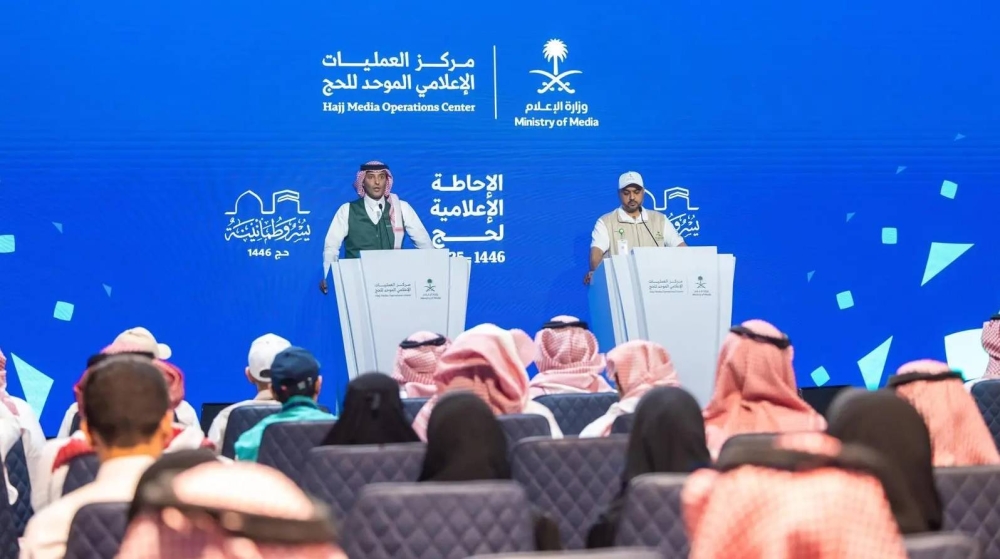
The Unified Media Operations Center for Hajj at the Ministry of Media held this evening the “Media Briefing for Hajj 1446 – 2025”, with the participation of the spokesperson for the Ministry of Health, Engineer Khalid bin Saud Al Tale’, and the spokesperson for the Ministry of Environment, Water and Agriculture, Saleh bin Abdulmohsen bin Dakhil.
The Ministry of Health spokesperson confirmed that, with the implementation of the health plans that were prepared with high accuracy and with complete success and flexibility, on this seventh day of Dhul-Hijjah, the general health condition of the pilgrims is reassuring and stable, under the continued care of the health system for them, in accordance with the directives of the leadership that made serving the pilgrim an honor and a sacred responsibility, in which efforts are combined, and in which the highest meanings of faith and dedication are manifested, so that every pilgrim enjoys comprehensive care, reassuring health, and safe performance of his rituals.
He commended the efforts of the health system in serving and caring for the guests of God, to make this ritual a safe and healthy faith experience, pointing to what the system achieved in this year’s Hajj season in terms of intensive efforts to provide the best health services to the pilgrims of the Sacred House of God from their arrival in the Kingdom until their safe and sound return. The system strengthened “health capability,” which is a legitimate principle and a fundamental pillar in enabling pilgrims to perform their rituals safely, through health requirements that were put in place based on the health risks that were observed during the past years.
He praised the role of medical missions from various countries for their commitment to health requirements and their fruitful cooperation in maintaining the health of pilgrims, noting that the health system has raised its level of preparedness in a proactive and integrated manner, and the bed capacity has reached a 60% increase over last year, with the participation of more than 50,000 medical and technical staff to serve the guests of God and take care of their health and provide them with the best comprehensive medical care.
He said: The health system did not overlook the environmental challenges, and took proactive measures to address the high temperatures in cooperation with the Royal Commission for Makkah and the Holy Sites, which included planting more than 10,000 trees, installing 400 additional water coolers, deploying misting fans, and expanding shaded areas to ensure a safer and more comfortable environment for the pilgrims. He pointed out the launch of comprehensive awareness campaigns in eight languages through field teams, media programs, and medical missions, with the provision of the health awareness kit for the Hajj season of 1446, which enables pilgrims to perform the rituals safely and helps them avoid health risks.
He reported that in a qualitative leap to expand the scope of health services in the holy sites, the system inaugurated a new emergency hospital in Mina with a capacity of 200 beds, in cooperation with Kadana Development and Investment Company, and launched 3 additional field hospitals with a capacity of more than 1,200 beds, in partnership with the Ministries of the National Guard, Defense, and Interior, as well as operating 71 emergency points, 900 ambulances, 11 evacuation aircraft, and more than 7,500 paramedics.
Al-Taleh explained that the system employed innovative technologies and artificial intelligence systems to enhance the health of pilgrims, providing high-quality virtual health services through the virtual health hospital, remote patient sensing and monitoring technologies, and the “ECMO” technology that saves the lives of pilgrims suffering from serious respiratory or heart diseases. This year, the partnership with the private sector was strengthened by operating 3 major hospitals in the holy sites, and launching pioneering initiatives that are the first of their kind globally, using drones to accelerate medical supply in the most crowded areas, reducing the delivery time of medicines from an hour to about 5 minutes only in 6 main medical facilities in Arafat and Mina, with additional support by helicopters to overcome ground congestion and ensure rapid supply.
The health system continued to provide its integrated services to the pilgrims during the Hajj season of 1446, and the total number of health services provided, up to the seventh day of Dhu al-Hijjah, exceeded 98,000 health services. Health statistics since the beginning of the season recorded receiving more than 54,000 patients in health centers, about 26,000 cases in emergency departments, in addition to 1,326 patients in outpatient clinics, and the admission of more than 4,800 cases to hospitals, including 2,156 cases that required care in intensive care. The medical teams performed 16 open-heart surgeries and 148 cardiac catheterizations, and dealt with 62 cases of heat exhaustion efficiently and quickly. The number of pilgrims who were provided with preventive services through the ports of entry exceeded 1.4 million pilgrims.
He pointed out that, with the great challenge of the high temperatures this year, the system is working on recording 62 cases of heat stress, including 15 cases today alone, and is working on monitoring them accurately and intervening immediately to protect and save lives. He stressed the importance of pilgrims adhering to health guidelines, such as drinking fluids regularly, taking breaks, and using umbrellas to protect from the sun, in addition to maintaining food hygiene, avoiding exposed or improperly stored food, and consulting a doctor immediately if they feel any fatigue or health symptoms. He emphasized the importance of pilgrims taking care of their health condition, taking the necessary treatment, and avoiding physical exertion and continuous walking without taking a break.
He affirmed that the health system will be with the pilgrim wherever he is, surrounding him with care and attention, and is fully prepared to provide all health services with the best standards, the latest technologies and practices, and the most skilled specialized medical personnel. The system strives to ensure that the experience of the pilgrims is easy and safe, guaranteeing their health and safety from various health risks, reassuring them - thanks to God Almighty - that no cases of outbreaks or significant epidemics have been recorded, and the general health situation is sound and safe, thanks to God.
Related News
He called for the pilgrims to communicate and to facilitate access to them everywhere and at all times through their smartphones with the “937” call center around the clock, the “Sehhaty” application, and the Seha Virtual Hospital, to provide health care and consultations in multiple languages.
For his part, the spokesperson for the Ministry of Environment, Water and Agriculture, Saleh bin Abdulmohsen bin Dakhil, reviewed the readiness of the environment, water and agriculture sectors, through 12 executive arms, to harness all their capabilities to provide the best services and facilitate the performance of rituals for the guests of God during the Hajj season of 1446, through well-studied and integrated proactive plans that keep pace with the highest quality standards, reflect the directives of the wise leadership - may God support them - and translate the objectives of the Kingdom's Vision 2030, in raising the quality of services provided, noting the partnership of various sectors and the integration of national efforts to provide an exceptional experience for the pilgrims of the Sacred House of God, and the integrated system provides its services to the pilgrims of the Sacred House of God around the clock through approximately 5,000 highly trained staff.
Regarding meeting peak water demand and ensuring reliable water supplies, he indicated that the water system has completed its preparations by producing and transporting 1.2 million cubic meters in Mecca and the Holy Sites, with pumping capacities exceeding one million cubic meters per day, and a treatment plant capacity exceeding 750,000 cubic meters per day, in addition to conducting more than 4,000 laboratory tests daily to ensure the quality and safety of the water, and has prepared about 2,000 trained personnel.
He explained that the National Center for Meteorology has strengthened its system by covering the holy sites with 19 automatic and manned monitoring stations, weather radars, and satellite images, which operate around the clock to cover the atmosphere of the holy sites at a rate of 100%, with the aim of enhancing the accuracy and readiness of response and providing meteorological information and data to all concerned sectors related to Hajj operations, noting that the expected temperatures - God willing - in Makkah and the holy sites starting from tomorrow (Wednesday), until next Sunday, will range between a minimum of 32 degrees Celsius and a maximum of 47 degrees Celsius.
He urged all pilgrims, workers and those present in the holy sites to avoid being in open areas during peak times except when necessary, in order to avoid high temperatures, while emphasizing the importance of following the instructions of the concerned authorities.
Regarding environmental compliance, he noted that the National Center for Environmental Compliance conducts monitoring tours on the roads leading to the Grand Mosque in Mecca, Mina, Arafat, Muzdalifah, and Al-Mu'aisim, in addition to carrying out monitoring visits to slaughterhouses, utilizing 160 personnel and 17 air quality monitoring stations. Through four main channels, the National Center for Plant Pest and Animal Disease Prevention and Control (Wiqa') implements an operational plan to combat insect pests, address animal health risks during the transport of animals within the holy sites, enforce biosecurity and hygiene requirements in livestock markets and slaughterhouses, and conduct veterinary inspections before and after slaughter to ensure the safety of tools and equipment.
He touched on equipping the slaughterhouses of the Holy Capital with a capacity of 177,600 heads of livestock per day, distributed over 26 halls. These development works were completed with an increase of 70% compared to last year. The storage capacity for meat in the slaughterhouse refrigerators increased by more than 18,500 carcasses/hour. The center completed the preparation of 221 trained staff, 64 specialized teams, 14 emergency teams, and 13 teams for monitoring and inspection, in addition to equipping 4 aircraft and 24 veterinary clinics equipped to receive all cases.
He noted that the National Agricultural Services Company has deployed 80 employees around the clock at key entry points, including King Abdullah Port in Rabigh, Prince Mohammed bin Abdulaziz International Airport in Madinah, King Abdulaziz International Airport in Jeddah, Jeddah Islamic Port, and the Al-Khumrah Animal Quarantine, and has cleared more than 1.8 million head of live livestock to ensure the availability of sufficient numbers of healthy and safe animals. The Ministry is working in coordination with relevant authorities to guarantee the availability of the necessary numbers of live animals as part of its operational plan for the 1446 AH Hajj season.
Regarding the importance of the waste sector, he explained that the National Waste Management Center “Mawan” confirmed its readiness with monitoring and inspection teams, which were equipped in the field to follow up on compliance with the waste management system, in addition to conducting a comprehensive assessment of the waste management system for sacrificial animals. He indicated that all these preparations come in addition to the readiness of the Ministry’s branches in the Makkah and Madinah regions to follow up on all the work of the system, and to ensure the provision of the best services to the guests of God, which will be reflected – God willing, and then through the efforts of the participating entities – in providing high-quality services to millions of pilgrims from all over the world, in addition to citizens and residents of the Kingdom, so that they may enjoy a distinctive spiritual experience, and perform the Hajj pilgrimage with ease, comfort and peace of mind. He asked God Almighty to accept from the pilgrims, and to grant them a blessed Hajj, a commendable endeavor and forgiven sins.







Politics
Tehran and Washington: Nuclear talks to include energy and aircraft
An Iranian official revealed details of talks with Washington that included investments in energy and the purchase of aircraft, coinciding with Araqchi's visit to Geneva and the continued military tension in the region.

In a significant development in the complex diplomatic relations between Tehran and Washington, Hamid Ghanbari, Iran's Deputy Foreign Minister for Economic Affairs, revealed a new Iranian strategy aimed at linking a return to the nuclear agreement to tangible economic benefits for the United States. Ghanbari explained that Tehran seeks an agreement that encompasses not only political and nuclear aspects but also includes mutual economic benefits to ensure the agreement's sustainability.
The Iranian official indicated that the current negotiations directly address vital issues, including shared interests in oil and gas fields, as well as joint fields and investments in the mining sector. Perhaps the most significant point in Qanbari's remarks was the explicit mention of including "aircraft purchases" among the negotiating items, a matter of utmost sensitivity and importance for Tehran, whose civilian air fleet has suffered from obsolescence due to long-standing sanctions.
Criticism of the previous agreement and the introduction of economic guarantees
In justifying this new approach, Ghanbari criticized the structure of the 2015 nuclear agreement (the Joint Comprehensive Plan of Action) with world powers, arguing that it "did not guarantee any economic interests for the United States." Tehran believes that the absence of direct US economic interests in the previous agreement facilitated Washington's subsequent withdrawal from it without incurring significant commercial losses. By proposing energy investments and aircraft deals (which could involve major companies like Boeing), Iran is attempting to create a network of interests that would make it difficult for any future US administration to dismantle the agreement again.
Diplomatic moves in Geneva amid military tension
These economic statements coincide with intense diplomatic activity, as the Iranian Foreign Ministry confirmed that Foreign Minister Abbas Araqchi departed Tehran for Geneva. This visit is to participate in a new round of indirect talks with the United States regarding the nuclear issue, as well as to hold important meetings with the Director General of the International Atomic Energy Agency and other international figures, in an effort to break the ongoing deadlock.
Despite the resumption of negotiations this month to resolve the decades-long dispute and avert a military confrontation, the atmosphere is rife with threats of force. US officials have indicated that the United States is not only pursuing diplomacy but has also bolstered its military presence by deploying a second aircraft carrier to the region. This move serves as a clear deterrent, as Washington prepares for the possibility of a large-scale military campaign should diplomatic talks fail to curb Iran's nuclear program, placing the region at a critical crossroads between economic progress and a dangerous military escalation.
Politics
Israel approves land registration in the West Bank: a step towards annexation and Palestinian condemnation
The Israeli government has approved measures to facilitate land registration for settlers in the West Bank. The Palestinian Authority rejects the decision, deeming it a de facto annexation that threatens the future of the two-state solution and the region.

In a remarkable development that deepens the complexities of the political and security landscape in the region, the Israeli Security Cabinet approved a package of new measures aimed at tightening Israeli control over the occupied West Bank and facilitating land purchases and registrations for settlers, a move that has provoked angry reactions from the Palestinian side.
In detailing the decision, Israeli Prime Minister Benjamin Netanyahu confirmed that these moves are in line with his government's security vision, noting that the idea of establishing a Palestinian state represents an existential "security threat" to Israel, especially given the electoral challenges he faces later this year. For his part, Israeli Defense Minister Yisrael Katz defended the decision, considering the transfer of land registration authority in the West Bank a "necessary security measure." The Security Cabinet, in its official statement, justified this step as a direct and appropriate response to what it described as "illegal land registration operations" promoted by the Palestinian Authority in Area C.
On the other hand, the decision was met with categorical rejection from the Palestinian Presidency, which stated that these measures constitute a "de facto annexation" of the occupied Palestinian territories, and an explicit declaration of the start of implementing plans aimed at entrenching the occupation through the expansion of illegal settlements, thus undermining any remaining opportunities to achieve peace based on the two-state solution.
The context of the conflict on land in the West Bank
This Israeli move comes within the context of a long history of conflict over land since the occupation of the West Bank in 1967. The issue of land registration is of paramount strategic importance, as vast areas of the West Bank, specifically Area C as defined by the Oslo Accords, are under full Israeli security and administrative control. Successive Israeli governments have consistently sought to bolster settlement activity in these areas, which constitute approximately 60% of the West Bank and are considered the strategic reserve of a future Palestinian state.
Political and legal repercussions
Observers and political analysts believe that allowing settlers to register their land represents a dangerous shift in the legal status of the West Bank, transferring authority from the military administration to civilian procedures similar to those applied within Israel—a process known as "creeping annexation." This shift not only threatens the territorial contiguity of any future Palestinian state but also presents the international community with new legal challenges regarding violations of international law and UN Security Council resolutions that deem settlements illegal.
This decision is expected to increase tensions on the ground, as Palestinians fear that these concessions will lead to the confiscation of more private and public lands, thus closing the door permanently to the political process and pushing the region towards further escalation and confrontation.
Politics
Russian investigation into oil tanker collision at Ust-Luga port
Russian authorities have launched an investigation into the collision of the oil tanker Tony with a pier at the strategic port of Ust-Luga. Learn more about the incident and the port's importance for energy exports.

Russian authorities have launched a comprehensive and urgent investigation into a maritime incident that occurred in one of the country's most important economic hubs, where an oil tanker collided with a pier in the strategic port of Ust-Luga. This port serves as a vital artery for Moscow's exports of crude oil and refined fuels via the Baltic Sea, making any incident within its boundaries particularly significant.
Details of the accident and material damage
The Northwest Region Transport Prosecutor's Office explained in an official statement that the accident occurred when the oil tanker "Tony" was maneuvering to approach the berth in preparation for loading petroleum products. According to preliminary investigations, the tanker collided with the dock at the port in the Leningrad region, causing significant damage to the dock wall and one of the port cranes.
Despite the structural damage, the statement emphasized a crucial point regarding environmental safety: no oil spill was recorded in the port waters, and no human casualties occurred among the ship's crew or dock workers, thus averting a potential environmental disaster in the sensitive Baltic waters.
Port of Ust-Luga: Strategic and Economic Importance
To understand the extent of the official interest in this incident, one must consider the paramount importance of the port of Ust-Luga. Located on the Gulf of Finland, approximately 110 kilometers west of St. Petersburg, the port has been intensively developed over the past two decades to serve as a Russian alternative to the ports of neighboring Baltic states, thus granting Russia complete sovereignty over its energy exports.
The port of Ust-Luga is one of the largest ports in Russia and the Baltic region in terms of cargo volume, handling massive quantities of crude oil, petroleum products, liquefied natural gas, coal, and fertilizers. Any disruption to its operations could directly impact supply chains and the shipping schedules of Russian energy to global markets.
Impact of the incident and legal proceedings
This incident comes at a time when global attention is focused on oil tanker traffic and port security. The public prosecutor's office is currently examining all circumstances surrounding the incident, including the technical condition of the tanker "Tony," the crew's competence, and the safety procedures in place at the port, to ensure that such incidents, which could threaten vital infrastructure for Russian energy exports, are not repeated.
-

 Local news one week ago
The Spears of Victory 2026 military exercises concluded in Saudi Arabia with international participation
-
Culture and Art 4 days ago
The "Between and Between" exhibition in Jeddah: 5 artists reshape Saudi memory
-
Culture and Art 6 days ago
Shakira's concert in Jeddah: Details of the international star's first concert in Saudi Arabia
-
Culture and Art, 1 week ago
The truth about Nancy Ajram's video and Epstein Island, and her legal response
-
Culture and Art, 1 week ago
Rawan Bin Hussain's first appearance after her imprisonment and deportation from Dubai
-
Local news two days ago
Adopting the National Policy for the Arabic Language: Strengthening Identity and Vision 2030
-
Local News 3 days ago
The Riyadh-Rin-Bisha dual carriageway, spanning 559 km, has been completed
-
Local News 3 days ago
Saudi Arabia's National Arabic Language Policy: 8 Principles to Promote Identity