Politics
The Sudanese army liberates the Presidential Palace in central Khartoum
After fierce fighting, the Sudanese army succeeded in liberating the presidential palace in central Khartoum from the Rapid Support Forces. Army forces were able to..

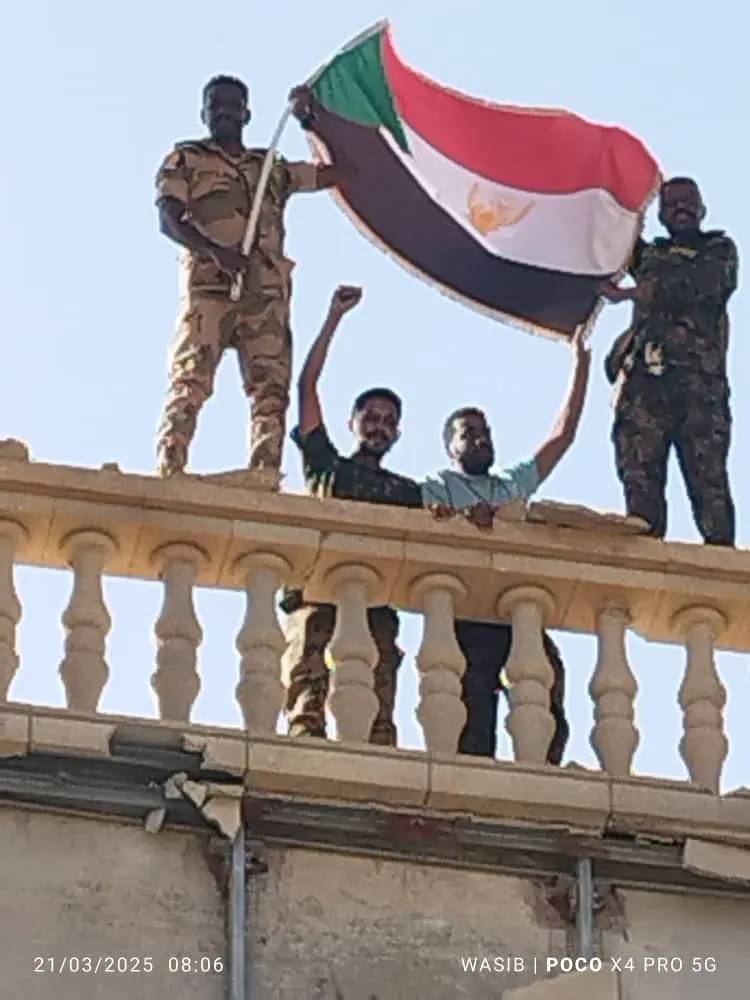
After fierce fighting, the Sudanese army succeeded in liberating the Presidential Palace in central Khartoum from the Rapid Support Forces. Army forces managed to destroy the Rapid Support Forces throughout the palace and enter it for the first time since the outbreak of war on April 15, 2023, today (Friday).
Recent photos show Major General Mohamed Abdel Rahman Al-Bilawi, commander of the Khartoum mobile control unit of the Sudanese army, inside the Presidential Palace, accompanied by army personnel.
The remaining Rapid Support Forces withdrew towards the Arab Market area in central Khartoum, where the army is pursuing the retreating and withdrawing forces from the battle of the palace.
The army explained in a statement that its forces destroyed Rapid Support Forces personnel and equipment at the Presidential Palace and confiscated their weapons, adding that they had seized control of the Presidential Palace and ministry buildings in central Khartoum. It confirmed that its forces were continuing battles on all fronts.
For his part, the commander of operations in Khartoum described the liberation of the Presidential Palace as a "historic moment," adding that they are pursuing the retreating Rapid Support Forces, which he described as "psychologically and morally broken." He said, "We welcome the return of residents to Bahri, East Nile, and Omdurman," noting that Khartoum Airport will resume operations soon. He indicated that they have given the Rapid Support Forces a "limited deadline to surrender," and affirmed the army's control over all sovereign ministries.
Fighting has intensified between the Sudanese army and the Rapid Support Forces recently, after the army regained control of large areas of Khartoum.
The Rapid Support Forces (RSF) denied the army's statements regarding developments in the capital, Khartoum, including at the presidential palace, asserting that fighting continued around the palace and that they remained in control of their positions. The RSF added in a statement that their forces had not been isolated, contrary to the army's claims.
Controlling the Presidential Palace would mean the end of the battle for central Khartoum, given its strategic location and its decisive role in the battle's trajectory. The army would then be able to utilize several bridges connecting the capital's districts, including the Military Hospital and Al-Fatihah bridges linking Khartoum and Omdurman. Furthermore, the army would be able to transport military supplies from Omdurman to the armored corps south of Khartoum. The arrival of these supplies would then allow the army to advance southward and potentially recapture the Yarmouk Defense Industries Complex.
This will lead to a move to take control of the Central Reserve Police Camp and Taiba Camp, as well as an incursion south across the eastern bank of the White Nile to secure control of the Jebel Aulia Dam Bridge, the last of the bridges through which the Rapid Support Forces are moving.
According to field sources, the course of the battles in Khartoum may witness significant changes related to the movement of various forces poised to enter Khartoum via more than one axis in an operation aimed at declaring the country’s capital free of Rapid Support Forces in the coming days.
Related News




Politics
Assassination of Iran's new Defense Minister Majid Ibn Reza in Tehran
Details of the assassination of Iran’s new Defense Minister Majid Ibn Reza in an Israeli airstrike in Tehran, 48 hours after his appointment as successor to Aziz Nasirzadeh, and the escalation of tension in the region.

In a rapidly escalating security and military development reflecting the peak of tensions in the region, informed Iranian sources reported today (Tuesday) the death of Iran's newly appointed Defense Minister, Majid Ibn al-Reza , less than 48 hours after his appointment to this sensitive post. This incident follows the death of his predecessor, Aziz Nasirzadeh, who was also killed in Israeli airstrikes targeting the capital, Tehran, a few days ago, according to media outlets close to the Iranian Revolutionary Guard.
Details of the operation and the Israeli targeting
The Israeli military, in an official statement, claimed responsibility for the operation, confirming that it targeted a senior Iranian commander in Tehran as part of a series of intensive and precise airstrikes. Military spokesman Efi Defrin explained that Israeli forces focused their strikes on the most heavily fortified areas of the Iranian capital, indicating that the operation targeted "the highest echelons" of the Iranian defense establishment.
The Israeli army reiterated its full readiness to continue carrying out qualitative operations against Iranian targets for the coming weeks, stressing that the recent strikes sent strong and direct messages to the Iranian regime regarding Israel’s ability to reach strategic targets deep inside Iranian territory.
Unprecedented security breach
The assassination of two defense ministers within a few days, and in the heart of Tehran, represents a dangerous indication of the extent of the security and intelligence breaches plaguing the Iranian military establishment. Observers believe that reaching figures of such high rank, and within heavily fortified security zones, signifies that the conflict has shifted from a phase of proxy wars and border skirmishes to one of direct confrontation targeting the very core of the military regime.
Regional context and repercussions of the event
These developments come at a time of unprecedented tension in the Middle East, with growing international fears of a slide into a full-blown regional war. Targeting defense ministers is not merely a tactical military operation; it represents a shift in the rules of engagement that have been in place for years. This escalation presents the region with a range of possible scenarios, as Tehran is expected to seek a face-saving response that restores the balance of deterrence severely damaged by these successive strikes.
The future of the conflict and its impact on stability
Strategically, this event raises serious questions about the future of Iran's leadership structure and its ability to protect its senior officials. Furthermore, the Israeli military's continued threats of operations lasting for weeks suggest that the region is heading toward a prolonged period of instability, which could directly impact global energy markets and shipping lanes, necessitating urgent international diplomatic action to contain the situation before it is too late.
Politics
Israeli ground invasion of southern Lebanon and assassination of Hezbollah leaders
Dangerous developments in Lebanon: Israeli forces begin a ground invasion of the south, and violent raids on the southern suburbs of Beirut target Hezbollah leaders amid fears of an all-out war.

In a significant military development that threatens to widen the scope of the conflict in the Middle East, Israeli radio officially announced that Israeli ground forces had begun entering southern Lebanon, coinciding with an unprecedented intensification of airstrikes. This ground operation comes amid escalating tensions between Iran and its allies on one side, and Israel and the United States on the other, placing the entire region on the brink of disaster.
Precise airstrikes and assassinations of leaders in the suburbs
In parallel with the ground offensive, Israeli warplanes launched a concentrated airstrike today (Tuesday) targeting a meeting of senior Hezbollah commanders in Beirut's southern suburbs. Field reports indicate that the strike killed those present, in a blow aimed at crippling the party's leadership capabilities and sowing discord within its ranks amidst escalating fighting.
Hell reaches the southern villages
For the second day in a row, the bombardment of villages and towns in southern Lebanon continued unabated. As part of the escalation that began Sunday night/Monday morning, a fierce wave of airstrikes and artillery shelling targeted several populated towns. According to field reports, the attacks were particularly intense on the Ain al-Samahiyeh area, located between the towns of Zawtar and Nabatieh al-Fawqa, while other missiles struck the town of Siddiqin, causing widespread damage to infrastructure and property.
The context of the conflict and its regional dimensions
This ground invasion cannot be separated from the broader context of the ongoing war, as the fierce Israeli response followed Hezbollah's launch of a barrage of drones and missiles targeting the heart of northern Israel. This tit-for-tat escalation reflects a shift in the rules of engagement, moving the confrontation from cross-border shelling to ground operations and targeted assassinations deep inside Lebanon.
International repercussions and concerns
This ground incursion has sparked widespread international and regional concern that the situation could escalate into a full-blown war, potentially extending beyond Lebanon and Israel. Recent history in this region, particularly the 2006 war, demonstrates that ground operations often complicate the military and political landscape, increasing human and material losses, thus necessitating urgent diplomatic intervention to contain the crisis before it's too late.
Politics
Greece sends military reinforcements to Cyprus after Iranian drone attack
Greece deploys the Kimon frigate and F-16 fighter jets to Cyprus in response to an Iranian drone attack on the British base at Akrotiri. Details of the military escalation in the Eastern Mediterranean.

In a significant development indicating escalating tensions in the Eastern Mediterranean, the Greek Ministry of Defense announced an immediate military deployment, including a naval and air strike force, to the Republic of Cyprus. This decisive action comes in response to an aerial attack carried out by a drone, reportedly of Iranian manufacture, targeting the Royal Air Force base at Akrotiri on the island last night.
In detailing the military deployment, Greek Defense Minister Nikos Dendias affirmed that Athens would not stand idly by in the face of threats to regional security, announcing the dispatch of two advanced warships, spearheaded by the French-built Belharra-class frigate "Kimon." This frigate is distinguished by its advanced technological equipment and modern radar and defense systems designed to counter aerial threats, including anti-drone systems. In parallel with the naval support, orders were issued for four F-16 fighter jets to deploy and reinforce the air defense umbrella of the Republic of Cyprus against any unwarranted violations or external threats.
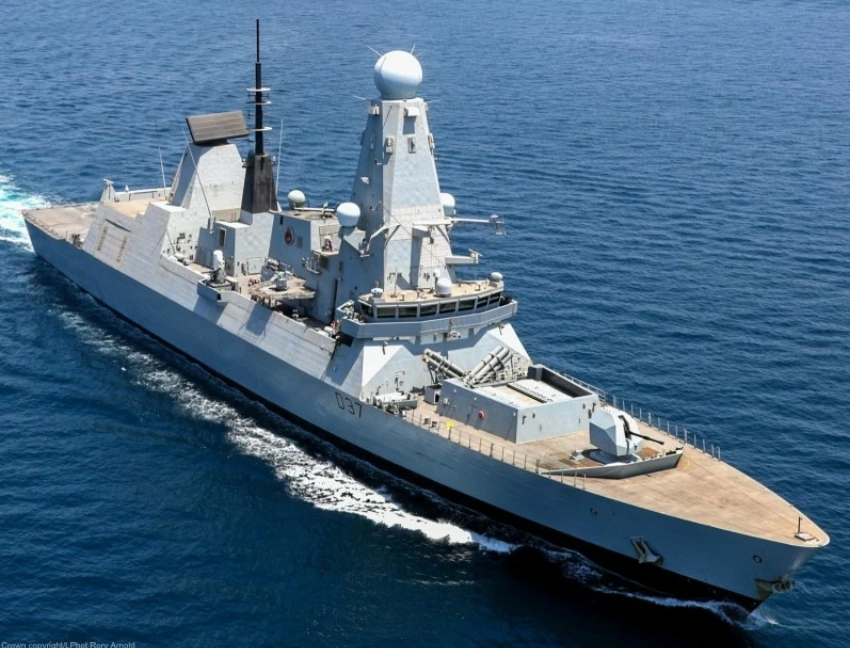
Minister Dendias described this rapid deployment as "an expression of full and absolute solidarity" with Nicosia, stressing in his statements that the attack not only targeted the British base, but also represented "a dangerous escalation" that threatens the security and stability of the entire island and the vital Eastern Mediterranean region.
The strategic importance of the Akrotiri base
To understand the dimensions of this event, it is worth noting that the Akrotiri base is not just an ordinary military facility; it is one of two sovereign British bases in Cyprus (along with Dhekelia) that the United Kingdom retained under the 1960 Treaty of Independence. This base plays a pivotal role as a logistical and operational hub for Western forces in the Middle East, making its targeting by a drone a political and military message that transcends the geographical boundaries of the island, reaching Western influence in the region.
Repercussions of the escalation in the Eastern Mediterranean
This Greek move carries profound geopolitical implications, reaffirming the unspoken doctrine of joint defense between Greece and Cyprus. Amid the turmoil in the Middle East, Cyprus is seen as a forward bulwark for the European Union. Observers believe that the deployment of the Belkara-class frigates, among the most modern vessels in the Greek arsenal, sends a strong deterrent message to any regional actors attempting to exploit the security vacuum or test the patience of European alliances. This escalation could impose new rules of engagement in the region, necessitating increased international attention to ensure that the situation does not spiral into wider confrontations.
-

 Local News 3 days ago
Jeddah Airport alerts for travelers due to airspace closure and flight disruptions
-
Local News 5 days ago
Saudi Arabia approves regulations for the continued presence of Gulf vehicles: duration and penalties
-
Local news one week ago
The Ministry of Interior begins procedures for a royal pardon for common law prisoners
-
Local news one week ago
The deadline for property registration in Hail and Riyadh is Thursday
-
Sports one week ago
Tickets for the Al-Ahli vs. Al-Hilal King's Cup match postponed: New date
-
Local news one week ago
Under the patronage of the Minister of Information, an agreement was signed between the Ministry of Information and Waves Marketing Company
-
Culture and Art 6 days ago
The Devil's Prisons series was halted: The full story of "The Emperor's" being moved to YouTube
-
Local news one week ago
Saleh Al-Maghamsi appointed Imam of the Prophet's Mosque: Details of the Royal Decree