
Politics
Municipality: 5 km/h speed limit for bicycles and scooters in parks and pedestrian areas
The requirements for renting bicycles and scooters stipulate a maximum speed for scooters of 25 km/h in designated bicycle lanes

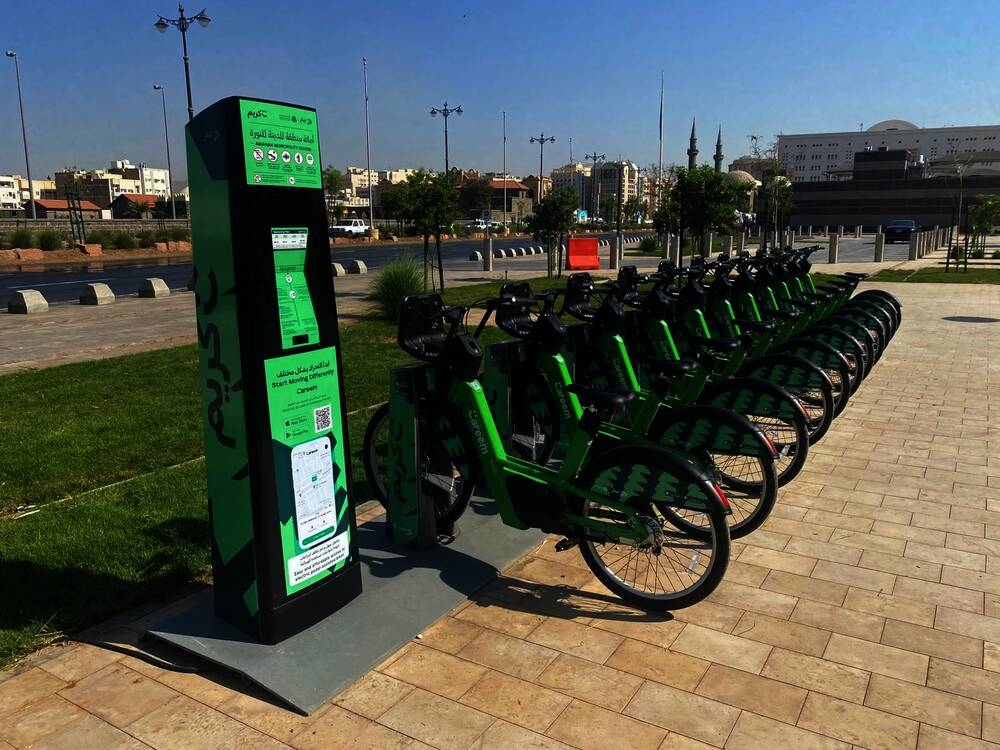
The requirements for renting bicycles and scooters set the maximum speed for the scooter at 25 km/h in lanes designated for bicycles, and set the maximum speed for the scooter at 5 km/h in parks, pedestrian areas and recreational facilities, as part of a project proposed by the Ministry of Municipalities and Housing to solicit opinions on it.
These requirements aim to achieve the goals of developing and improving the business environment in a way that fulfills the general aspirations and goals of the individual and society together, and to help those wishing to invest in this field, and to raise the standard of compliance to address the manifestations of visual distortion.
The licensing requirements included that the procedures for issuing, canceling, renewing, amending and suspending the license be in accordance with the Municipal Licensing Procedures System and its executive regulations, obtaining Civil Defense approval for shops and kiosks before issuing the license, submitting a valid commercial registration containing the activity to be licensed, attaching an investment contract for the investor practicing the activity of renting bicycles and scooters “points of sale”, and the approval of the supervising authority for the commercial activity to be licensed, if any. According to the requirements, additional activities approved by the Ministry are permitted, provided that the total area of the added activities does not exceed 50% of the total area stated in the license, and that the minimum area of the main activity is maintained, and that the area of the additional activity is not less than 6m2, with the exception of self-service machines. The external staircase of the building must be made of safe, slip-resistant, and durable materials, such as granite, treated marble, rough paint with epoxy, ceramic, porcelain, and similar materials. A ramp for people with disabilities must be provided within the boundaries of the shop or facility, with the exception of shops located in buildings that provide requirements for people with disabilities. The ramp must be free of defects, not affect the external sidewalk, and not cause any visual distortion.
Regarding the technical requirements for bicycles and scooters, the technical requirements contained in the technical regulation for individual electric means of transport (scooters) and the relevant standard specifications issued by the Saudi Standards, Metrology and Quality Organization must be adhered to.
The requirements included: The maximum speed of the scooter must be set at 25 km/h in lanes designated for bicycles, and the maximum speed of the scooter must be set at 5 km/h in parks, pedestrian areas and recreational facilities. Scooters must also be separated and classified according to their specifications for use, whether on lanes designated for bicycles or in parks, pedestrian areas and recreational facilities.
Sterilizing protective helmets
The requirements specify the operating requirements for bicycles and scooters. It is prohibited for shops and kiosks to sell bicycles and scooters. Protective helmets must be sterilized after each use, or a hair clip must be provided for bicycles and scooters in recreational facilities. Repairing, maintaining, and cleaning bicycles and scooters is permitted in the shop, provided that the repair area inside the shop does not exceed 20% of the shop's area. It is prohibited to repair any bicycle not belonging to the shop.
She stressed the need for daily maintenance of scooters, with a dedicated log for tracking, and prohibited contact with or access to another adjacent outlet unless explicitly stated in the license of either. She emphasized the obligation to provide all technical requirements for bicycles and scooters, and to obtain a permit to occupy a sidewalk in recreational facilities if the investor wishes to display bicycles or scooters inside the facilities for pickup and drop-off, provided that the number of bicycles or scooters does not exceed 10 per (kiosk/collection point). She also stressed the need to ensure the suitability and safety of bicycles and scooters, and the operator bears responsibility for any damages that may be caused to the safety of individuals and public and private property. She also stressed the obligation to provide protective helmets for bicycles and scooters in recreational facilities, and the investor must adhere to specifying locations and speeds, and not display scooters outside licensed locations or rent them out in locations other than those specified and agreed upon.
Designate a charging area
The requirements included allocating an area for charging bicycles and electric scooters in a safe manner in the rental areas, and a specific area (that does not obstruct the movement of pedestrians, cars or facilities) must be allocated for parking unused bicycles and scooters.
It is prohibited to ride bicycles and scooters outside of designated paths or areas. It is also prohibited to ride bicycles and scooters in any way that poses a danger or annoyance to others. It is obligatory to maintain a sufficient safety distance and to use bicycles and scooters individually, as it is strictly forbidden to carry another passenger or anything that leads to imbalance.
Among the prohibitions included in the requirements is the use or leaving of bicycles and scooters in a way that constitutes an obstruction or disruption to the movement of pedestrians or vehicles. A protective helmet with a reflector and appropriate clothing and shoes must be worn while riding bicycles and scooters in designated squares and paths. The use of mobile phones or two-way headphones is strictly prohibited while riding bicycles and scooters, or using them on public roads and streets not designated for this purpose. In addition, eating and drinking while riding scooters is prohibited, as is carrying heavy objects while riding a scooter, such as transporting goods. Also, bicycles and scooters must not be tied to traffic lights and poles.








Politics
Saudi Arabia welcomes the ceasefire agreement between the Syrian government and the SDF
The Kingdom of Saudi Arabia welcomes the comprehensive ceasefire agreement in Syria between the government and the SDF, and hopes that it will contribute to achieving peace and stability and strengthening national unity.
The Saudi Ministry of Foreign Affairs announced that the Kingdom of Saudi Arabia welcomes the statement issued regarding the ceasefire agreement between the Syrian government and the Syrian Democratic Forces (SDF). This welcome comes in light of the agreement's pivotal role as a step that could contribute to turning a page in the complex conflict that the country has been witnessing for years.
In an official statement, the Ministry expressed the Kingdom's hope that this comprehensive agreement, which includes integrating self-governing institutions into Syrian state institutions, will contribute to Syria's progress toward achieving lasting peace, security, and stability. The statement affirmed that this step aligns with the aspirations of the brotherly Syrian people to build a secure and prosperous future and strengthen their national unity and territorial integrity.
Background of the conflict and the importance of the agreement
This agreement comes in the context of a devastating civil war that began in 2011 and has led to deep geographical and political divisions. The Syrian Democratic Forces (SDF), whose backbone is the Kurdish People’s Protection Units (YPG), have emerged as a major force in northern and eastern Syria, particularly after their pivotal role in the war against the ISIS terrorist group, with support from the US-led international coalition. Over the past years, the SDF has administered large areas through the “Autonomous Administration of North and East Syria,” creating a complex political and military reality that is relatively independent of the authority of the central government in Damascus.
Potential impacts at the local and regional levels
The agreement holds significant strategic importance. Domestically, integrating the self-governing institutions into the state structure could lead to the reassertion of Syrian sovereignty over all its territory, unify governance, and redirect resources toward reconstruction and development rather than conflict. It also paves the way for a comprehensive political settlement that guarantees the rights of all components of the Syrian people. Regionally, stability in northeastern Syria reduces the likelihood of foreign intervention and alleviates the concerns of neighboring countries, particularly Turkey, which views the influence of Kurdish forces along its borders with apprehension.
International support and diplomatic efforts
In closing, the Kingdom reiterated its full support for all efforts undertaken by the Syrian government to preserve its sovereignty, unity, and territorial integrity. The Kingdom also commended the responsiveness of both the Syrian government and the Syrian Democratic Forces to the diplomatic efforts it exerted, alongside the efforts led by the United States, which were instrumental in establishing a ceasefire and reaching this historic agreement. This development reflects a shift in regional and international dynamics and underscores the importance of dialogue and a political settlement as the only way to achieve a sustainable end to the Syrian crisis.
Politics
A comprehensive agreement between the Syrian government and the SDF to unify the country
The new Syrian government and the Syrian Democratic Forces (SDF) have reached a historic agreement to cease fire and integrate forces and institutions, with the aim of ending the division and unifying Syrian territory.
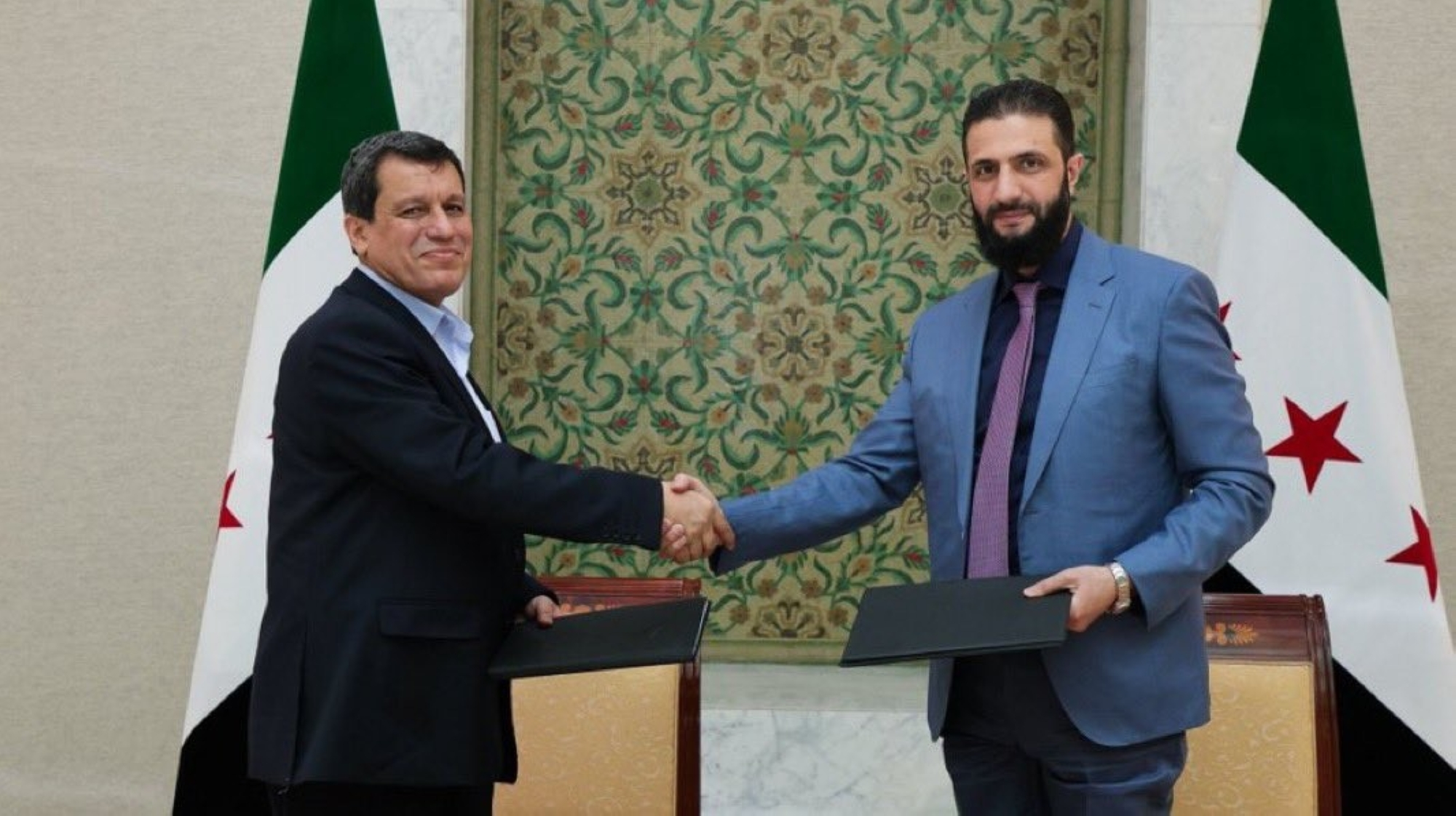
In a historic move that could redraw the political and military map of Syria, the new Syrian government announced a comprehensive agreement with the Syrian Democratic Forces (SDF) aimed at ending the division that has persisted for more than a decade. The agreement stipulates an immediate ceasefire and the commencement of a comprehensive integration process for military and security forces and civilian administrations, paving the way for the unification of Syrian territory under a single central authority.
Background of the conflict and context of the agreement
This agreement follows radical political shifts in Damascus and culminates a long and complex relationship between the central government and the Syrian Democratic Forces (SDF). Since the outbreak of the Syrian crisis in 2011, the SDF, whose backbone is the Kurdish People's Protection Units (YPG), has emerged as a major force in northern and eastern Syria. These forces played a pivotal role in the war against ISIS with the support of the international coalition and established an autonomous administration that governed vast areas. The relationship with Damascus has fluctuated between tension, limited clashes, and tactical coordination against common enemies, but the issue of sovereignty and recognition of the autonomous administration has remained a fundamental point of contention. With the recent changes in power, the door has been opened for serious dialogue to end the division and rebuild the state on new foundations.
Key provisions for unifying the country
According to government sources, the agreement includes detailed and practical provisions. Militarily, forces will withdraw from the front lines, and a new military division will be formed comprising three brigades of SDF fighters, in addition to a brigade specifically for the city of Kobani (Ayn al-Arab), administratively affiliated with Aleppo Governorate. In terms of security, Interior Ministry security forces will enter the cities of Hasakah and Qamishli to enforce the law and enhance stability, paving the way for the integration of local security forces into the official structure. On the civilian level, the institutions of the Autonomous Administration will be integrated into state institutions, with guarantees for the permanent employment of staff and the regularization of their status. The agreement, signed by President Ahmed al-Sharaa on January 18, also guarantees the civil, cultural, and educational rights of the Kurdish component, which Presidential Decree No. (13) affirms is an integral part of the Syrian national identity.
Importance and expected effects
This agreement holds immense strategic importance on all levels. Domestically, it represents a crucial step toward ending the civil war and restoring state authority over all of Syria, including its oil and gas fields and border crossings. This will return vital resources to the public treasury and accelerate the reconstruction process. It also paves the way for the safe return of millions of displaced persons and refugees to their homes. Regionally, the agreement reshapes the balance of power in the region, particularly concerning relations with Turkey, which views the influence of Kurdish forces on its border with concern. Internationally, the agreement resolves the ambiguity surrounding the fate of the areas formerly controlled by the Syrian Democratic Forces (SDF) and presents the international community, including the United States, which supported these forces, with a new reality that necessitates a reassessment of policies toward Syria. This could encourage the lifting of sanctions and support for the path to political stability.
Politics
New Saudi support for the Yemeni Central Bank to enhance economic stability
Through its program for the development and reconstruction of Yemen, Saudi Arabia is providing new support to the Central Bank of Yemen with the aim of achieving financial and monetary stability and improving the living conditions of the Yemeni people.
The Kingdom of Saudi Arabia, through the Saudi Program for the Development and Reconstruction of Yemen, announced a new support package for the Central Bank of Yemen, in a move that confirms the continuation of its efforts aimed at strengthening the foundations of economic and financial stability in the Republic of Yemen, which is suffering from serious challenges.
Historical context and protracted crisis
This support comes amidst the extremely complex economic and humanitarian conditions that Yemen has been experiencing for years. Since the outbreak of the crisis, the Yemeni economy has suffered near-total collapse, with the value of the Yemeni rial plummeting and oil and gas exports, which constituted the main source of government revenue, ceasing, leading to one of the world's worst humanitarian crises. Foreign aid, particularly Saudi support, has been a lifeline for the crippled economy. The Kingdom has previously provided substantial financial deposits to the Central Bank of Yemen in recent years, most notably a multi-billion dollar deposit that temporarily helped to curb the currency's decline and finance imports of essential goods.
Support objectives and expected impact
The new support aims to achieve a range of strategic objectives that extend beyond immediate financial assistance. It focuses on strengthening the institutional capacities of the Central Bank of Yemen and improving governance and transparency in its operations. This support is expected to positively impact the stability of the Yemeni rial's exchange rate, contributing to controlling inflation and alleviating the burden on citizens facing continuously rising prices for food, fuel, and medicine.
Domestically, this support is expected to enable the Yemeni government to meet its obligations, primarily paying public sector salaries regularly, which will boost purchasing power and stimulate the economy. The support also includes empowering the private sector to contribute effectively to sustainable economic growth, creating new job opportunities for young people, and supporting economic and social development initiatives across Yemen's governorates.
Regional and international importance
At the regional and international levels, this support is an integral part of the Kingdom's strategy to support legitimacy in Yemen and contribute to restoring stability to the state and its institutions. A strong and effective central bank is a cornerstone of any future reconstruction efforts and the achievement of sustainable peace. This move also aligns with calls from the international community and humanitarian organizations for urgent economic support for Yemen to prevent the humanitarian catastrophe from worsening. The Saudi Program for the Development and Reconstruction of Yemen affirmed that this support is an extension of the Kingdom's long-standing commitment to supporting Yemen and its people through the implementation of dozens of development projects in vital sectors such as education, health, water, energy, and transportation.
-

 Local News 5 days ago
Landslide in Riyadh: Details of the incident in Al-Sahafa neighborhood and containment efforts
-
 Local News 6 days ago
The death penalty was carried out against a citizen who stabbed another to death in Tabuk
-

 Culture and Art, 1 week ago
Ramez Galal in Ramadan 2026: Details of the bloody prank show
-
 Local news one week ago
First birth on the Riyadh train: A heartwarming story at Andalus station
-

 Culture and Art 5 days ago
Haifa Wehbe's absence in Riyadh: A photo crisis or a strained relationship with the media?
-
 Local News 5 days ago
Riyadh collapse: Emergency plans to secure water after a main pipeline burst
-

 Culture and Art 5 days ago
City Kitchen series: A drama of conflict and the middle class during Ramadan
-

 Culture and Art 5 days ago
The series "Kasra": Dawood Hussein in a moving social drama this Ramadan