Politics
The Yemeni Women's Coalition accuses the Houthis of committing 7,885 crimes
The National Coalition of Independent Women accused the Houthi group on Sunday of committing 7,885 human rights violations in Yemen

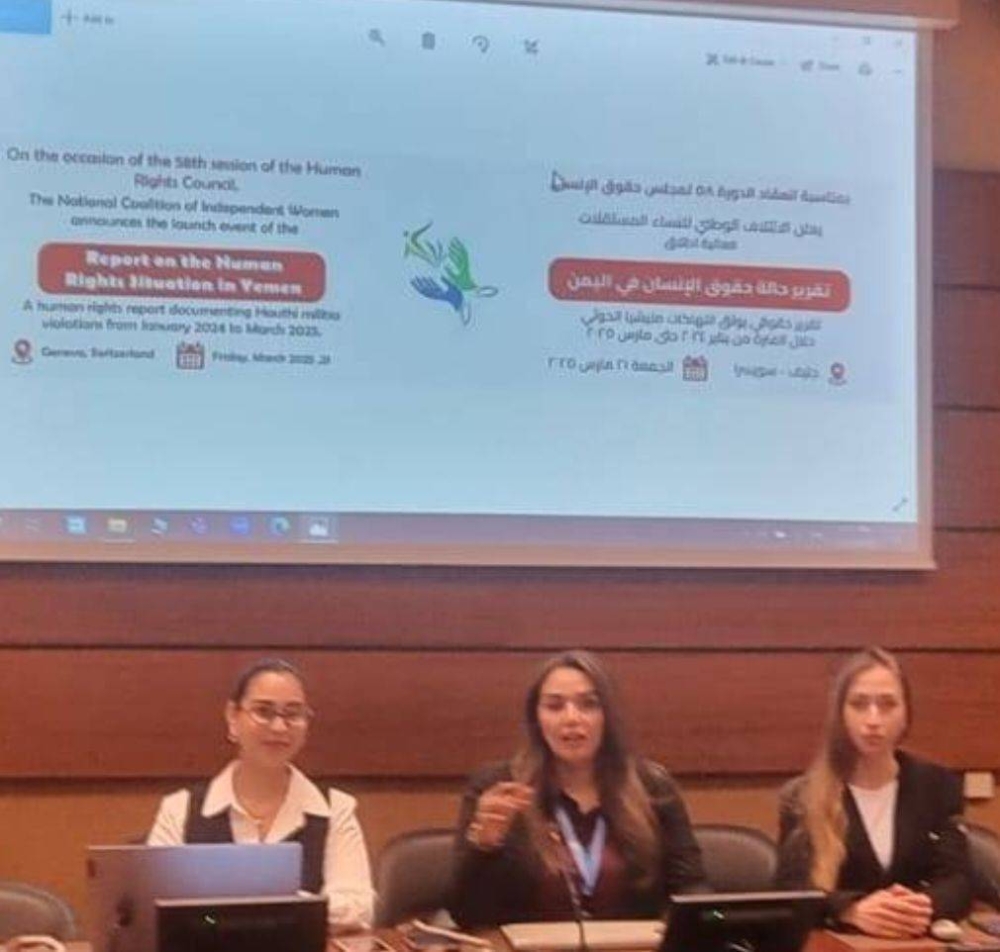
The National Coalition of Independent Women accused the Houthi group on Sunday of committing 7,885 human rights violations in Yemen between January 2024 and March 2025, asserting that the violations included the killing of civilians, kidnappings, and other human rights abuses.
In the report entitled “The State of Human Rights in Yemen,” the head of the coalition, Dr. Wissam Basendwah, reviewed on the sidelines of the fifty-eighth session of the Human Rights Council in Geneva, Switzerland, a series of systematic violations committed by the Houthi group, especially the six grave violations addressed by international law.
Basendwah said: “The report documented the killing of 301 civilians, including 69 children and 38 women. Hodeidah topped the list with 58 crimes. It also recorded the injury of 585 civilians, including 138 children and 42 women, as a result of indiscriminate shelling and hostilities. Taiz topped the list with 137 crimes, 64 killed, and 109 injured as a result of Houthi planting of mines.”.
She noted that the Houthi group arrested and abducted 646 people, confirming that the coalition received testimonies about the use of brutal torture methods, with Sana'a topping the list with 174 crimes. She indicated that the Houthis abducted 80 humanitarian workers, including 6 women. The coalition also documented 45 illegal trials during which death sentences were issued against opponents, including women, among them the prominent human rights activist Fatima Saleh Al-Arwali.
Basendwah pointed out that the Houthis continued to bomb the homes of opponents, as the coalition documented the bombing of 32 homes, with Al-Bayda topping the list. 111 crimes of attack on public property and 450 cases of attack on private property were documented, with Ibb topping the list with 174 cases. Regarding violations in the health and education sector, 41 attacks on hospitals and health centers were documented, and 37 incidents of attack on the education sector. As for displacement and forced migration, the forced displacement of more than 20,000 families was recorded.
Regarding Houthi violations against women and children, Basendwah explained that the “Coalition” documented the killing of 38 women, the injury of 42, and the abduction of 32. It also documented the killing of 69 children, the injury of 138, and the recruitment of 4,421 children. The capital Sana’a topped the list with 659 cases. It also documented cases of harassment of children, their deprivation of health care and education, and the abduction of 16 children.
Related News




Politics
Aoun: Banning Hezbollah's military activities is a final decision for Lebanon's sovereignty
Lebanese President Joseph Aoun affirms that the ban on Hezbollah's military activities is an irreversible decision. The Cabinet, with the support of the five-member committee, has restricted the decision regarding war and peace to the state.

In a remarkable development that is reshaping the political and security landscape in Lebanon, Lebanese President Joseph Aoun stressed that banning Hezbollah’s military and security activities is a “sovereign and final decision that cannot be reversed,” affirming the state’s determination to extend its full authority over all Lebanese territory.
This firm stance came in response to the outcomes of yesterday's (Monday's) cabinet meeting, which concluded with a historic decision affirming the Lebanese state's sole right to decide on matters of war and peace, and prohibiting all military and security activities outside the framework of the law and official institutions. Aoun clarified that the cabinet entrusted the Lebanese army and security forces with the task of implementing this crucial decision in all regions without exception.
Context of the decision and its field repercussions
For his part, Lebanese Prime Minister Nawaf Salam announced that Lebanon would begin enforcing a strict ban on Hezbollah's military activities. This swift government action follows a serious security deterioration, marked by the party's large-scale missile and drone attack on Israel, an operation Hezbollah described as "revenge" for the assassination of Iranian Supreme Leader Ali Khamenei. This escalation has placed Lebanon before critical international and regional challenges, prompting the government to take preemptive steps to spare the country the devastating consequences of a full-scale war.
The importance of arms control and the decision of peace and war
This decision is of exceptional importance in the Lebanese context, where the issue of Hezbollah's weapons and the decision of war and peace have been subjects of intense political contention for decades. Observers note that consolidating these decisions in the hands of the state is the cornerstone of restoring national sovereignty and building a state based on institutions. The state's move to impose its security control reflects an official desire to abide by international resolutions and to insulate Lebanon from regional power struggles that have burdened its economy and security for many years.
International support and the five-member committee
On the diplomatic front, this Lebanese approach was met with immediate welcome and support. The Egyptian ambassador to Lebanon, Alaa Moussa, affirmed the full support of the "Quintet Committee" for the Lebanese state's steps. This committee comprises the ambassadors of influential countries (the United States, France, Saudi Arabia, Qatar, and Egypt) that play a pivotal role in helping Lebanon overcome its political and economic crises. This international support indicates that the international community is conditioning any future aid or economic recovery programs on the restoration of state sovereignty, thus placing the recent Lebanese decision in the realm of paramount national necessity to save the country.
Politics
Khamenei's successor: The Assembly of Experts is taking action, and Washington prefers a friendly regime
Uncertainty surrounds Khamenei's successor after his assassination. The Assembly of Experts emphasizes the need for a swift selection, while Washington prefers a friendly regime without pursuing regime change. An analysis of the Iranian landscape.

The political landscape in Tehran remains shrouded in uncertainty and cautious anticipation following the announcement of the assassination of Iranian Supreme Leader Ali Khamenei in a series of airstrikes targeting his compound in the capital—an event marking a pivotal turning point in the history of the Islamic Republic. All eyes are now on the Assembly of Experts, the constitutional body tasked with selecting the country's supreme leader, amidst international and regional speculation about who will fill this significant leadership vacuum.
Council of Experts: The decision will not be long in coming
In the first official reaction to the succession process, Ali Moallemi, a member of the Assembly of Experts, stated that the selection of a successor to the Supreme Leader "will not take long." In press statements carried by the ISNA news agency, Moallemi emphasized that the Assembly is aware of the sensitivity of the current situation, noting that "members of the Assembly have sworn a constitutional and legal oath that personal desires or narrow factional and partisan affiliations will not interfere in the selection of the new Supreme Leader." This indicates the religious establishment's desire to demonstrate internal cohesion and quickly contain the situation.
Selection mechanism and historical background
To understand the context of this event, it's important to note that the Assembly of Experts consists of 88 jurists elected by direct vote. Their primary task, according to the Iranian constitution, is to appoint the Supreme Leader, oversee his work, and dismiss him if necessary. In this context, Iranian memory recalls the experience of 1989, following the death of the Islamic Republic's founder, Ruhollah Khomeini. The Assembly convened in an emergency session and selected Ali Khamenei as his successor in a swift transition that averted chaos. Today, the Assembly faces a similar challenge, but within a more complex geopolitical landscape.
The American position: Seeking a friendly regime
Internationally, American statements reflected a delicate balance between strategic interests and political realism. US Vice President Jay D. Vance explained that the US administration was closely monitoring the situation, noting that Washington "prefers a friendly regime" in Tehran. These statements suggest that the United States, despite deep disagreements, may not necessarily seek "regime change" in the radical sense that could lead to regional chaos, but rather aspires to the rise of a new leadership that might be more pragmatic or less confrontational with Western interests.
Potential regional and international repercussions
This event carries implications that extend far beyond Iran's borders. The Supreme Leader has the final say on foreign and military policy, including managing the nuclear program and supporting regional allies. Therefore, the identity of the next Supreme Leader will determine the shape of future relations with neighboring countries and major powers. Observers fear that any prolonged period of political vacuum could lead to internal power struggles that could negatively impact regional stability and global energy markets, which explains the Assembly of Experts' haste in reassuring both domestic and international audiences.
Politics
Saudi Arabia condemns the Iranian attack on the US embassy and vows to retaliate
The Kingdom strongly condemns the Iranian attack on the US Embassy in Riyadh, and affirms its right to respond and protect its territory, warning against a dangerous escalation that violates the Vienna Convention on Diplomatic Relations.

The Kingdom of Saudi Arabia today (Tuesday) expressed its strongest condemnation of the Iranian attack targeting the US Embassy in Riyadh. The Kingdom considers this hostile act a blatant violation of its sovereignty and a direct threat to security and stability in the region, affirming its categorical rejection of such criminal acts, which contravene all international values and principles.
Violation of international conventions and diplomatic immunity
The Kingdom affirmed in its statement that the repetition of this cowardly and unjustified attack blatantly violates all international norms and laws, most notably the 1949 Geneva Conventions and the 1961 Vienna Conventions on Diplomatic Relations. It is worth noting that the Vienna Convention explicitly stipulates the inviolability of diplomatic premises and obligates host states and all parties to protect diplomatic missions and their personnel, granting them full immunity even in cases of armed conflict. This makes this attack a grave violation of international law that warrants accountability.
A dangerous escalation despite de-escalation initiatives
The Kingdom stressed that this blatant Iranian behavior is occurring at a sensitive time, despite the Iranian authorities' full awareness of Saudi Arabia's balanced stance. The Kingdom has previously affirmed that it will not allow its airspace or territory to be used as a platform to target Iran. Analysts indicate that Tehran's attack, despite Saudi assurances, reflects a desire to push the region toward further escalation and chaos, and undermines any efforts aimed at strengthening regional security.
The right of reply and the protection of national sovereignty
In closing, the Kingdom reiterated its firm and legitimate right to take all necessary measures to protect its national security, territorial integrity, and the lives of its citizens and residents, as well as its vital interests. Riyadh clarified that all options remain on the table, including a military response to this aggression, noting that leniency towards such transgressions could embolden the aggressor to further recklessness, which the Kingdom will not permit under any circumstances.
-

 Local News 3 days ago
Jeddah Airport alerts for travelers due to airspace closure and flight disruptions
-
Local News 5 days ago
Saudi Arabia approves regulations for the continued presence of Gulf vehicles: duration and penalties
-
Local news one week ago
The Ministry of Interior begins procedures for a royal pardon for common law prisoners
-
Local news one week ago
The deadline for property registration in Hail and Riyadh is Thursday
-
Sports one week ago
Tickets for the Al-Ahli vs. Al-Hilal King's Cup match postponed: New date
-
Local news one week ago
Under the patronage of the Minister of Information, an agreement was signed between the Ministry of Information and Waves Marketing Company
-
Culture and Art 6 days ago
The Devil's Prisons series was halted: The full story of "The Emperor's" being moved to YouTube
-
Local news one week ago
Saleh Al-Maghamsi appointed Imam of the Prophet's Mosque: Details of the Royal Decree