Politics
Statistics: Non-oil exports rise by 18.1%
Non-oil exports recorded an increase of 18.1% compared to December 2023, and the value of re-exported goods also increased

Non-oil exports recorded an increase of 18.1% compared to December 2023, and the value of re-exported goods increased by 23.4% in the same period. Merchandise exports decreased in December 2024 by 2.8%, while imports increased by 27.1% compared to December 2023.
The results of the International Trade Statistics Bulletin for December 2024, issued today by the General Authority for Statistics, showed that “chemical industry products” are among the most important non-petroleum export goods, as they constituted 25.9% of total non-petroleum exports.
On the other hand, the results of the International Trade Bulletin for the fourth quarter of 2024 reported an increase in non-oil exports (including re-exports) by 17.3% compared to the fourth quarter of 2023, while national non-oil exports (excluding re-exports) increased by 8.2%, while the value of re-exported goods increased to 47.3% in the same period. Merchandise exports in the fourth quarter of 2024 decreased by 6.1% compared to the fourth quarter of 2023, as a result of a decrease in oil exports by 13.3%. The percentage of oil exports in total exports also decreased from 76.4% in the fourth quarter of 2023 to 70.5% in the fourth quarter of 2024.
Related News
Regarding imports, they increased by 15.5% in the fourth quarter of 2024, and when looking at the merchandise trade balance, the surplus decreased by 52.4% compared to the fourth quarter of 2023.
It is worth noting that international trade statistics are based on administrative records from the Zakat, Tax and Customs Authority (non-petroleum) and the Ministry of Energy (petroleum), and the Kingdom’s merchandise exports and imports are classified according to the Harmonised Commodity Description and Coding System 2022.




Politics
US Defense Secretary: Iran is exposed and will not possess nuclear weapons
In his first press conference, US Defense Secretary Pete Hegseth confirmed that Iran is now militarily exposed, stressing the need to destroy its missile and naval capabilities and prevent it from acquiring nuclear weapons.
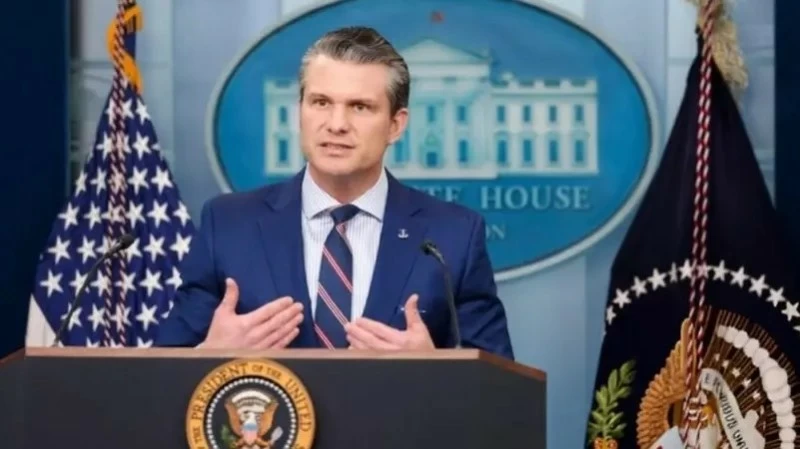
In a significant development in the Middle East's military and political landscape, US Defense Secretary Pete Hegseth asserted that Iran is now completely exposed to American military capabilities, emphasizing firmly that Iran cannot possess a nuclear weapon under any circumstances. This came during his first press conference since the start of military operations, where he outlined the new US strategy toward Tehran.
America imposes rules of engagement
On Monday, Hegseth announced a decisive stance regarding the war's objectives, explaining that "the war with Iran was not initially aimed at direct regime change, but the facts on the ground indicate that the regime has already changed as a result of military pressure." The Secretary added that the missile arsenal Tehran had been brandishing for years "no longer poses a threat," emphasizing in a clear message to the international community and the American public that "the United States will set the terms of the war and its conclusion with Iran," reflecting considerable confidence in the US forces' position on the ground.
Objectives of the military mission
In detailing the nature of the operations, the Secretary of Defense stated that "the American mission in Iran is specific and precise, and consists of destroying its missile capabilities, completely neutralizing its naval forces, and ensuring its permanent denial of nuclear weapons." This statement indicates a strategic shift in dealing with the Iranian issue, as Washington has moved from a decades-long policy of containment and economic sanctions to a phase of direct military action to eliminate the sources of regional threats.
Not a repeat of the Iraq scenario
In an effort to reassure American and international public opinion, and to prevent unsettling historical comparisons, Higseth commented bluntly: “This is not Iraq, and this is not an endless war.” This statement carries profound implications, suggesting that the Pentagon has learned the lessons of the 2003 US invasion of Iraq. The current strategy relies on targeted, precise strikes and air and naval superiority, rather than a protracted ground incursion that would deplete forces and occupy cities.
Strategic context and regional dimensions
These statements come at a time of major geopolitical shifts in the Middle East. Iran’s missile arsenal and nuclear program have long been a major concern for the Gulf states and Israel, as well as Western powers. The Secretary of Defense’s assertion of “exposing Iran” militarily means destroying its air defense and radar systems, thus opening Iranian airspace to American aircraft. This development not only alters the balance of power locally but also sends reassuring messages to regional allies that the American security umbrella remains effective and capable of neutralizing existential threats.
In conclusion, it appears that through these operations, Washington seeks to reshape the security arrangements in the region and ensure that no new nuclear power emerges that could threaten global stability, while being very careful not to get drawn into the quagmire of long wars of attrition.
Politics
Oman: One person killed in attack on oil tanker off Muscat
Details of the attack on the oil tanker MKD VYOM off the coast of Oman, which resulted in the death of an Indian sailor. Learn about the background of the incident and its impact on maritime security in the region.
In a serious escalation threatening maritime security in the region, the official Oman News Agency reported that an oil tanker flying the flag of the Marshall Islands was attacked while sailing in the Gulf of Oman. The incident occurred 52 nautical miles off the coast of Muscat Governorate, highlighting once again the rising tensions in vital waterways in the Middle East.
The agency explained in its detailed statement that the attack was carried out by an unmanned boat, which collided with the tanker "MKD VYOM." This direct targeting resulted in a massive fire and explosion in the ship's main engine room, causing the death of one crew member, an Indian national. The tanker is a large vessel, with a capacity of 59,463 metric tons of oil, which would have led to an environmental disaster had the situation not been brought under control.
In a swift response to the crisis, Omani authorities confirmed that, in direct coordination with the Maritime Security Centre, a successful evacuation of the tanker's 21-member crew was carried out. The crew members included 12 Indian nationals, 4 Bangladeshi nationals, and 1 Ukrainian national, in addition to other nationalities. A vessel from the Royal Navy of Oman fleet has begun monitoring the damaged tanker to secure the area and prevent any oil spill.
Strategic importance and regional risks
This incident is of paramount importance due to its sensitive geographical location; the Sea of Oman is the gateway to the strategic Strait of Hormuz, through which approximately one-fifth of the world's oil production passes daily. Any security threat in this region not only affects the littoral states but also extends its impact to global energy markets, potentially leading to higher oil prices and increased shipping insurance costs.
Context of maritime tensions
This attack is part of a series of security incidents in the Gulf and the Arabian Sea in recent years, often linked to shadow wars and geopolitical tensions in the region. The use of unmanned boats in maritime attacks indicates a qualitative shift in the threats facing commercial vessels, necessitating enhanced international and regional cooperation to protect international shipping lanes and ensure the uninterrupted flow of global energy supplies.
Politics
Lebanon bans Hezbollah activities: Government decision to restrict weapons
In a historic first, the Lebanese cabinet decided to ban Hezbollah’s military activities and confine the decision to wage war to the state, following an emergency session chaired by Nawaf Salam.

In a radical shift in the Lebanese political and security landscape, the Lebanese Cabinet, headed by Prime Minister Nawaf Salam, took an unprecedented step today (Monday), which was the issuance of an official decision to ban the activities of “Hezbollah”, against the backdrop of the recent security tensions and the missile launch operation that the country witnessed on Sunday night.
This pivotal decision redefines the concept of Lebanese sovereignty, as the government deemed the recent military actions a blatant and flagrant violation of the principle of "the exclusive right to decide on war and peace," a right that must be solely vested in the Lebanese state and its constitutional institutions. This announcement, following a marathon session and lengthy deliberations within the Cabinet, puts an end to years of constructive ambiguity surrounding Hezbollah's weapons and its regional role.
Return to the Constitution and the Taif Agreement
This decision formally enshrines the government's position of prohibiting any military or security activity outside the framework of legitimate institutions (the Lebanese Army and security forces), and establishes, for the first time, a clear executive framework for holding the party accountable and compelling it to abide by Lebanese law. This approach is based on the core of the "National Reconciliation Document" (Taif Agreement), which ended the Lebanese Civil War and explicitly stipulated the dissolution of all Lebanese and non-Lebanese militias and the surrender of their weapons to the state—a clause that has remained a subject of intense political contention for decades.
Explosive security context and international pressure
This firm stance was expressed by Prime Minister Nawaf Salam following an emergency cabinet meeting held this morning at the Presidential Palace in Baabda, amidst a tense atmosphere coinciding with intensified Israeli airstrikes. Salam stated, "In accordance with the Constitution and the National Accord Document, the state will not compromise on protecting its national security.".
Strategically, this decision reflects an official Lebanese attempt to spare the country the devastating consequences of a full-scale war, especially given the ongoing international pressure to implement UN Security Council Resolution 1701, which calls for the area south of the Litani River to be free of any weapons or armed personnel other than government forces and UNIFIL. Observers suggest that the government's move may be the last lifeline for breaking Lebanon's Arab and international isolation by demonstrating the state's ability to extend its authority over all its territory.
Local and regional repercussions of the decision
Domestically, this decision presents political forces with a historic challenge, as it ends the "army, people, and resistance" equation that was included in previous ministerial statements, replacing it with the equation of "state, sovereignty, and law." Regionally, this decision could reshuffle the cards in the region, as it removes official Lebanese cover for any military operations launched from Lebanese territory without government approval, thus holding the perpetrators fully accountable before the international community.
-

 Local News 4 days ago
Saudi Arabia approves regulations for the continued presence of Gulf vehicles: duration and penalties
-
Local news two days ago
Jeddah Airport alerts for travelers due to airspace closure and flight disruptions
-
Local news one week ago
The Ministry of Interior begins procedures for a royal pardon for common law prisoners
-
Local News 6 days ago
The deadline for property registration in Hail and Riyadh is Thursday
-
Sports one week ago
Tickets for the Al-Ahli vs. Al-Hilal King's Cup match postponed: New date
-
Local News 7 days ago
Under the patronage of the Minister of Information, an agreement was signed between the Ministry of Information and Waves Marketing Company
-
Local news one week ago
Saleh Al-Maghamsi appointed Imam of the Prophet's Mosque: Details of the Royal Decree
-
Culture and Art 5 days ago
The Devil's Prisons series was halted: The full story of "The Emperor's" being moved to YouTube