Politics
Prince Mohammed bin Salman receives the Speaker of the Arab Parliament in Jeddah
Crown Prince and Prime Minister Mohammed bin Salman bin Abdulaziz Al Saud received the Speaker of the Arab Parliament in Jeddah today

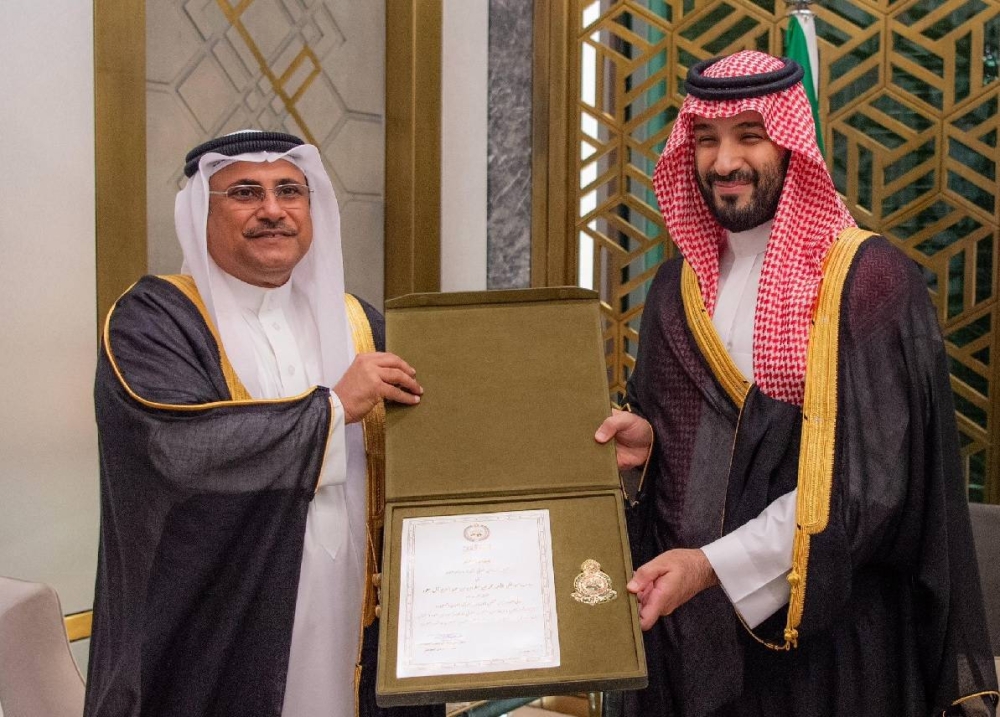
Crown Prince and Prime Minister Prince Mohammed bin Salman bin Abdulaziz Al Saud received in Jeddah today the Speaker of the Arab Parliament, Adel bin Abdulrahman Al-Asoumi.
The Speaker of the Arab Parliament presented the Commander's Medal to the Crown Prince in appreciation and recognition from the Arab people for his pioneering stances in defending Arab causes and promoting joint Arab action.
The reception was attended by the Vice President of the Shura Council, Dr. Meshaal bin Fahm Al-Salami.




Politics
Lebanon is moving towards extending the term of its parliament by two years due to the war
Reports indicate a political consensus in Lebanon to extend the term of the House of Representatives for two years due to the security situation and the ongoing Israeli war, amidst escalating field operations and psychological warfare.
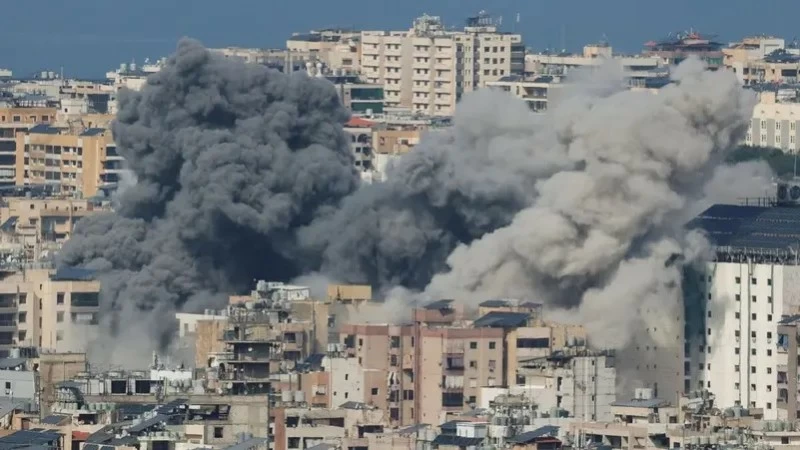
Given the dire security situation in Lebanon, and with the ongoing Israeli aggression and the expansion of airstrikes and drone attacks, extending the term of the current parliament has become the most likely and realistic scenario. Political sources indicate that a number of MPs began last night drafting an expedited bill to extend the current parliament's term for an additional two years, in order to avoid a legislative vacuum given the impossibility of holding elections.
This proposal is expected to be included on the agenda of a legislative session that Speaker of Parliament Nabih Berri intends to convene no later than the end of this week or the beginning of next week. Information in this context indicates that Speaker Berri, who had been adamant about adhering to constitutional deadlines, received information suggesting the difficulty of holding the elections. Prime Minister Nawaf Salam, in agreement with President Joseph Aoun, informed him that the current field and logistical conditions render holding the elections impossible, prompting most parliamentary blocs to express their initial agreement to the extension option as an inevitable necessity.
Unprecedented escalation on the ground and psychological warfare
On the ground, the Israeli war on Lebanon entered its third consecutive day with even greater intensity. Operations were no longer limited to airstrikes and assassinations; the Israeli side introduced a new element to its psychological warfare: "false calls." Telecommunications networks recorded more than 800 suspicious calls within a few hours, targeting citizens in various Lebanese regions, including a building housing MP Imad Hout, the Palace of Justice in Baabda, and even customs and security personnel at the Masnaa border crossing, urging them to evacuate immediately. This created a state of panic and fear among civilians.
In the context of direct targeting, airstrikes hit a residential area in Aramoun, east of Beirut, targeting a member of the Islamic Group. This coincided with a mysterious assassination at the Comfort Hotel in the Hazmieh-Baabda area, where the identity of the targeted individual remains unknown. The Israeli Air Force also intensified its airstrikes to an unprecedented degree across the entire area south of the Litani River, transforming it into a military operations zone. This led to a large-scale displacement of residents from border towns towards safer areas in the north.
Historical background and constitutional reality
This situation is reminiscent of past scenarios in Lebanon, where Parliament resorted to extending its own term on several occasions (most notably between 2013 and 2017) under the pretext of compelling security circumstances. Legislators base this approach on the principle of "force majeure," which they argue prevents the proper practice of democracy, especially given the presence of hundreds of thousands of displaced people who have fled their villages. This, they contend, renders the electoral process illegitimate and unconstitutional if it is held without the participation of large areas of the South and the Bekaa Valley.
In a significant development reflecting the sensitivity of the current situation, the Lebanese army has carried out tactical redeployments, withdrawing from some advanced border positions to its main rear bases. This measure comes in compliance with the political leadership's decision to avoid engaging in a direct and unequal confrontation, and amid intelligence reports of Israeli intentions to conduct limited ground incursions, following warnings issued to more than 120 southern towns. This places the country at a dangerous political and military crossroads that could alter the face of the region.
Politics
Lebanon is moving towards postponing parliamentary elections and extending the parliament's term by two years
Parliamentary blocs in Lebanon agree to extend the parliament's term and postpone elections for two years due to the ongoing Israeli war, security threats, and displacement campaigns.

Given the dire security situation in Lebanon, postponing parliamentary elections and extending the term of the current parliament has become the most likely and realistic scenario. Political sources close to the legislative process indicate that several MPs began drafting a bill last night to extend the parliament's term for two full years, in order to avoid a legislative vacuum given the impossibility of holding elections.
Nabih Berri may convene at the end of this week or, at the latest, the beginning of next week, for its approval. Despite the Speaker's previous adherence to constitutional deadlines, dramatic developments have created a new reality, particularly after consultations with Prime Minister Nawaf Salam —according to the source—and in agreement with Army Commander General Joseph Aoun. These consultations concluded that holding the elections is now "not possible" logistically and from a security standpoint.
Political context and historical background
This move toward extending the parliamentary term is not unprecedented in modern Lebanese politics. Lebanon has witnessed similar scenarios during previous periods of instability, with Parliament resorting to extending its mandate several times (as happened between 2013 and 2017) to avoid institutional vacuum. The current consensus among most parliamentary blocs on the "two-year extension" option reflects a tacit acknowledgment that the current crisis transcends a mere border tension; it is a state of open warfare with potentially protracted repercussions, thus necessitating the suspension of constitutional processes until the situation on the ground becomes clearer.
Field escalation and psychological warfare
On the ground, Israel continued its war on Lebanon for the third consecutive day at an escalating pace, employing new strategies that went beyond conventional bombing. The element of "psychological warfare" in an unprecedented manner, with more than 80,000 false phone calls detected within a few hours, aimed at spreading panic and terror among residents in various Lebanese regions and urging them to evacuate. These threats did not spare official institutions, targeting customs and security personnel at the Masnaa border crossing, the Palace of Justice in Baabda, and even the residence of MP Imad Hout.
In the context of direct military operations, the Israeli army expanded its targets to include densely populated residential areas, as happened in the Aramoun east of Beirut, where a member of the Islamic Group was targeted, in addition to a mysterious assassination inside the Comfort Hotel in the Hazmieh-Baabda area. Simultaneously, the Israeli Air Force launched a series of intense and violent raids on all the villages south of the Litani River, leading to a massive exodus and the complete depopulation of border towns.
Repercussions of the military situation
Faced with this bloody scene and indications of a potential ground incursion, the Lebanese army carried out tactical redeployments, withdrawing from some forward positions to its main bases, in compliance with the political authority's decision to avoid engaging in a direct and unequal confrontation at present. This withdrawal, coinciding with Israeli warnings targeting more than 120 towns, presents Lebanon with enormous humanitarian and political challenges, making talk of holding elections on schedule a pipe dream and pushing the country into a new phase of political uncertainty under the shadow of war.
Politics
US travel advisory for Egypt: Washington maintains classification at level 2
Washington maintains Egypt at Level 2 in its travel advisories and excludes it from its Middle East departure warnings. Learn more about the decision and its impact on Egyptian tourism.

In a remarkable diplomatic success reflecting the stability of the internal situation despite the turmoil in the regional environment, the Egyptian Ministry of Foreign Affairs managed to maintain Egypt's classification as a relatively safe region in the US travel advisories, thus overcoming the wave of urgent warnings that affected many Middle Eastern countries.
The U.S. State Department issued an official update to its travel advisory on Tuesday, maintaining Egypt at Level 2 , which advises "expedite travel with increased caution"—the same level applied to many stable European countries. This decision comes at a time of unprecedented military escalation in the region, including an exchange of attacks between Israel and Iran and tensions on multiple fronts, prompting Washington to urge its citizens to immediately leave more than 14 countries in the region.
Implications of timing and regional context
This decision is of particular strategic importance given its timing, as the Middle East is experiencing heightened tensions. Western countries typically resort to issuing travel warnings for the entire region as a precautionary measure in such circumstances. However, Cairo's success in exempting itself from these warnings reflects international confidence in the resilience of the Egyptian home front and the ability of its security apparatus to protect the country and its visitors, while simultaneously insulating Egypt from border tensions.
Intensive diplomatic efforts
This classification did not come about by chance, but was the result of intensive diplomatic efforts led by the Egyptian Ministry of Foreign Affairs in coordination with the Egyptian Expatriates Affairs sector. These efforts included high-level contacts with Western decision-making capitals, specifically the United States, Canada, and Ireland, to clarify the reality of the stable security situation in tourist destinations and major cities, far from border tension hotspots.
The US Embassy in Cairo confirmed in a routine security alert that travel advisories have not changed, with the Level 4 (Do Not Travel) warning limited to specific and isolated geographic areas, namely North and Central Sinai and some western border areas, while all major tourist cities such as Cairo, Alexandria, Luxor, Aswan, Hurghada and Sharm El Sheikh remain within the safe and open area for international tourism.
Economic and tourism impact
This announcement serves as an international "certificate of confidence" upon which the Egyptian tourism sector heavily relies, especially with the start of the winter tourist season. Egypt's continued status at Level 2 sends reassuring messages to international tour operators and global insurance companies, protecting tourist flows from cancellations that often accompany geopolitical tensions. This position also reinforces Egypt's pivotal role as a secure logistical hub for evacuations and humanitarian aid when needed, while Egyptian airports and airspace continue to operate efficiently and without interruption.
-

 Local News 6 days ago
Saudi Arabia approves regulations for the continued presence of Gulf vehicles: duration and penalties
-
Local news one week ago
The Ministry of Interior begins procedures for a royal pardon for common law prisoners
-
Local news one week ago
The deadline for property registration in Hail and Riyadh is Thursday
-
Culture and Art 7 days ago
The Devil's Prisons series was halted: The full story of "The Emperor's" being moved to YouTube
-
Local news one week ago
Under the patronage of the Minister of Information, an agreement was signed between the Ministry of Information and Waves Marketing Company
-
Local News 6 days ago
Saudi Energy: A new identity for electricity that aligns with Vision 2030
-
Local News 6 days ago
The Food and Drug Administration is recalling Bebelac and Aptamil milk due to potential contamination
-
Local news one week ago
Registration is now open for domestic pilgrims for the 1447 AH season: Dates and conditions via Nusuk