Local News
Protecting the rights of Saudi designers: A comprehensive guide to intellectual property
Discover how to protect your rights as a Saudi fashion designer with the new Intellectual Property Guide, a step towards empowering local creativity.


Launch of the guide to protecting designers' rights in the Saudi fashion industry
In a move reflecting the Kingdom of Saudi Arabia’s commitment to fostering a creative work environment and empowering local talent, the Saudi Fashion Commission, in collaboration with the Saudi Authority for Intellectual Property, announced on July 1, 2025, the launch of a guide to protecting designers’ rights in the fashion industry. This announcement comes as part of ongoing efforts to support innovation and protect intellectual property in the fashion sector.
Guidelines
This guide aims to be a practical resource for designers to utilize available intellectual property protection laws by registering their designs and benefiting from the associated legal protections. It also seeks to foster a culture of creativity and encourage designers to develop new ideas without fear of imitation or plagiarism.
Main areas of the guide
The guide covers four key areas related to the fashion industry:
- Patents: These are dedicated to covering technical and technological innovations in the development of fabrics and clothing.
- Industrial models: They deal with the aesthetic, design, and decorative dimensions of the piece.
- Copyright: Includes drawings, artistic and creative models associated with the design.
- Branding: This refers to the names, logos, and symbols that distinguish the product in the market.
Availability and legal support
The guide is available on the official website of the Fashion Authority, where designers and brand owners can access and utilize it. The Saudi Authority for Intellectual Property also receives reports of rights infringement, whether under the Copyright Law or the Trademark Law, from rights holders or their representatives through its official website.
Enhancing the Kingdom's position as a supportive environment for creativity
Through this initiative, the Authority reaffirms its commitment to supporting innovation in the fashion industry and empowering designers across the entire product value chain. This strengthens the Kingdom's position as an environment that adheres to global standards in protecting creativity and industrial innovation. This step not only supports local talent but also underscores Saudi Arabia's commitment to providing a business environment that respects and upholds intellectual property rights in accordance with the highest international standards.
Related News


Local News
19 requirements to reduce dust from projects in Riyadh and fines for violators
Learn about the new regulations to reduce dust from construction projects in Riyadh. Fines of up to 50,000 riyals will be imposed to ensure environmental compliance and improve air quality in line with Vision 2030.

In a move aimed at promoting environmental sustainability and improving the quality of life in the capital, the National Center for Environmental Compliance, in strategic partnership with the Royal Commission for Riyadh City, has adopted a new set of environmental controls that includes 19 strict requirements to control and manage dust and dirt resulting from the increasing construction work in Riyadh.
Details of requirements and financial penalties
The center's official spokesperson, Saad Al-Mutrafi, explained that these new requirements will be mandatory for all construction projects with an area of 2,000 square meters or more. This step aims to ensure the reduction of volatile emissions that negatively impact air quality and public health. Al-Mutrafi emphasized that any laxity in applying these standards will subject violating facilities to financial penalties, with fines reaching 50,000 riyals for each violation. He stressed that compliance with these procedures is crucial to avoid financial losses and contribute to the national environmental effort.
Implementation mechanisms and technologies used
The adopted procedures include a range of practical and technical solutions, most notably:
- Use dust inhibitors and adhere to daily spraying of work sites to prevent dust from flying around.
- Organizing the movement of trucks and heavy equipment and covering them tightly during transport.
- Installing advanced devices to measure air quality within project sites.
- Linking these devices to the unified dust monitoring platform ensures transparency and continuous monitoring.
- Requiring establishments to submit detailed periodic reports on their environmental performance and their compliance with standards.
The context of urban growth and Vision 2030
These decisions come at a time when the capital, Riyadh, is witnessing an unprecedented urban renaissance and rapid growth in major development projects, such as the Qiddiya project, the Diriyah Gate, and massive housing and infrastructure projects, within the objectives of the Kingdom's Vision 2030. This intense construction activity requires a careful balance between urban development and environmental preservation, which is what the Royal Commission for Riyadh City and the National Center for Environmental Compliance are striving for through these regulations.
Environmental and health importance
The importance of these requirements extends beyond mere regulation to encompass crucial health and environmental dimensions. Reducing particulate matter directly contributes to lowering respiratory illnesses and allergies among city residents, and supports the "Green Riyadh" and "Green Saudi Arabia" initiatives, which aim to improve air quality and reduce temperatures. Al-Mutrafi noted that the center's air quality monitoring stations have been redistributed to align with the geographical distribution of major projects, emphasizing the continued, precise, real-time monitoring in accordance with the Kingdom's executive regulations for air quality.
Local News
The intersection of the Fourth Ring Road with Al-Sail Road in Mecca will be operational ahead of schedule
The Royal Commission for Mecca announces the opening of the Fourth Ring Road intersection with Al-Sail Road ahead of schedule. This vital project facilitates access to the Grand Mosque and the holy sites and enhances traffic flow.
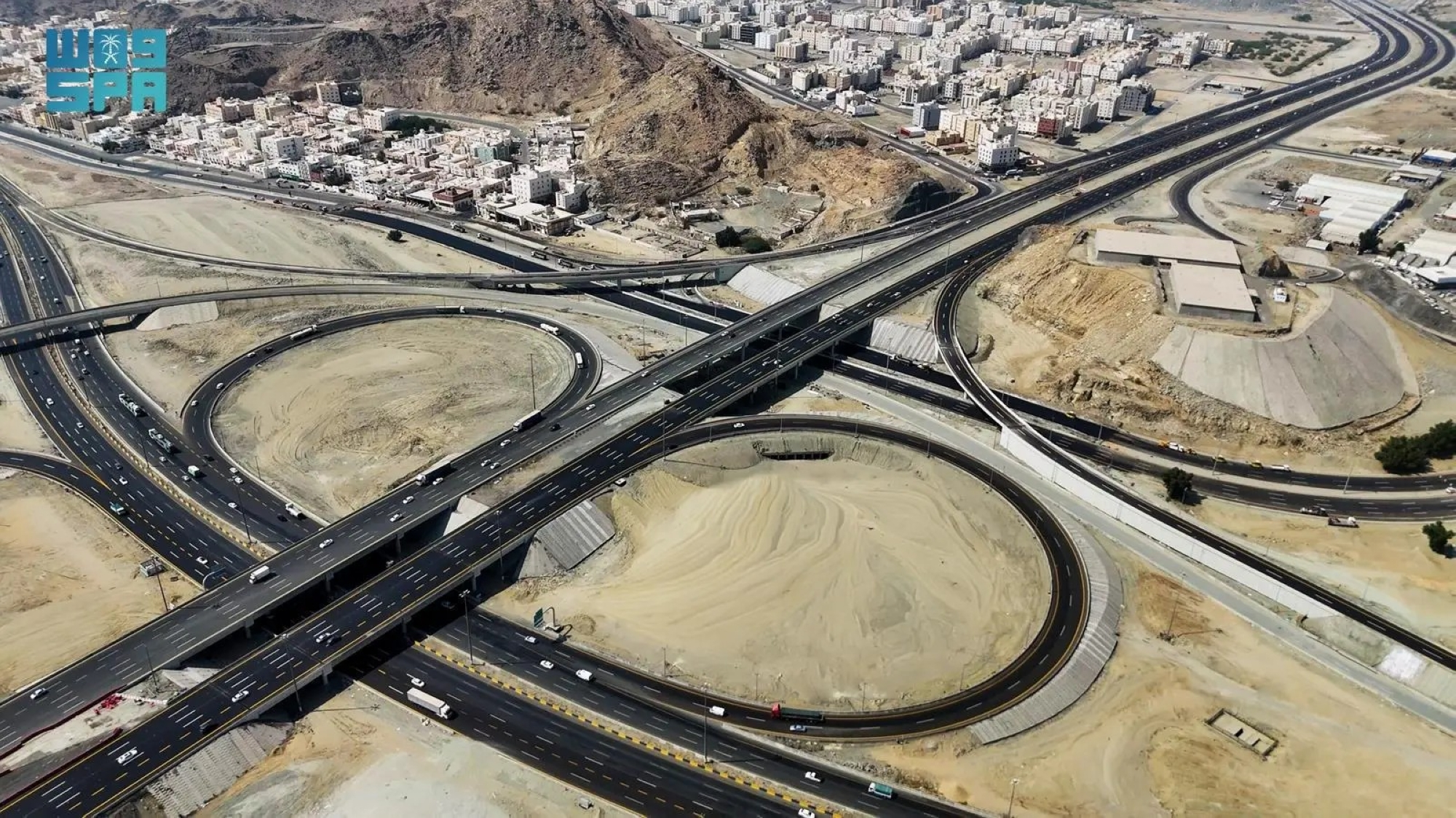
In a move reflecting the accelerating pace of development in the Holy City, the Royal Commission for Makkah and the Holy Sites announced a new qualitative achievement represented by the completion of the operation of the elements of the Fourth Ring Road intersection project with King Faisal Road (known as Al-Sail Road), ahead of the planned time date, which enhances the efficiency of the road network and supports the readiness of traffic to serve residents and visitors.
Project details and new routes
The official announcement included the activation and opening of direct lanes for vehicles coming from the Fourth Ring Road towards King Faisal Road in both directions (towards the Grand Mosque and towards Al-Sail). This step aims to improve connectivity between the main axes of the Holy City and increase the operational efficiency of one of the most vital intersections in Mecca, thus ensuring the smooth and easy flow of traffic.
The strategic importance of the Fourth Ring Road
The Fourth Ring Road project occupies a pivotal position in Makkah's transportation system, serving as a strategic link connecting various districts of Makkah with the holy sites (Mina, Arafat, and Muzdalifah). This ring road contributes to alleviating traffic congestion in the central area by diverting through traffic away from the city center, thus facilitating the movement of pilgrims during peak seasons.
The project's impact on traffic flow and Hajj and Umrah
The Al-Sail Road intersection is of particular importance as it is located at the eastern gateway to Mecca, receiving those arriving from Taif and the eastern and central regions, in addition to pilgrims arriving by land. This operation is expected to contribute to:
- Reduce travel time: by eliminating traffic congestion at previous intersection points.
- Improving safety: by separating traffic flow and reducing points of conflict between vehicles.
- Facilitating access to the holy sites: Supporting smooth access to the central area and the holy sites, which is vital, especially during the Hajj and Umrah seasons.
Integration with the Kingdom's Vision 2030
The early commissioning of this project reflects the efficiency of its planning and execution, as well as the integrated efforts of the relevant authorities. It is part of a package of infrastructure development projects underway in the Kingdom. These efforts directly contribute to achieving the goals of Vision 2030, specifically the Guests of God Service Program, which aims to facilitate the hosting of more Umrah and Hajj pilgrims and improve the quality of life for the residents of Makkah and visitors to the Holy Mosque by providing a world-class road network that ensures comfort and safety for all.
Local News
Banking service fee reductions to begin tomorrow: Details of the new SAMA guide
Starting tomorrow, the Saudi Central Bank’s decision to reduce banking service fees and prohibit exceeding the maximum fee limit will be implemented, in order to promote financial inclusion and protect customer rights in the Kingdom.
Starting tomorrow (Friday), 3/9/1447 AH (February 20, 2026), the Saudi Central Bank (SAMA) will implement its decision regarding the "Financial Institutions Services Fee Guide," which imposes a strict prohibition on financial institutions exceeding the maximum fees for basic transactions and services offered to individual customers. This decision represents a pivotal step in regulating the relationship between banks and their customers, as the new guide will replace the previously applied "banking fees," reflecting the Central Bank's commitment to its supervisory and regulatory role in ensuring fair financial transactions.
In the context of enhancing transparency and protecting consumers, the Central Bank emphasized that the new guide primarily aims to promote financial inclusion in the Kingdom, enabling all segments of society to benefit from banking services at fair and reasonable fees. The guide also focuses on supporting digital transformation by encouraging customers to use electronic channels, a trend that aligns with the rapid technological advancements in the financial sector. This contributes to increased operational efficiency, reduced reliance on cash, and ultimately, enhanced confidence in the financial system as a whole.
The guide includes significant changes that benefit customers, such as reducing the maximum fees for a wide range of services. Among the most notable changes are reduced administrative fees associated with financing products, fees for reissuing Mada cards, and lower costs for international purchases and cash withdrawals. The reductions also extend to fees for money transfers from bank accounts or e-wallets, as well as fees for using Mada cards at point-of-sale terminals within the GCC network, thus facilitating financial transactions for citizens and residents while traveling within the GCC countries.
From a regulatory and procedural standpoint, the Central Bank mandated that financial institutions fully disclose all fees before providing services and implement clear mechanisms to ensure customers understand the associated costs. The bank also stipulated that customers must obtain prior, documented consent through official channels for any fees or charges, and must be notified immediately via text message upon deduction. These measures aim to close loopholes that could lead to unexpected charges, thereby enhancing overall customer satisfaction with the banking sector.
To protect small balances, the bank issued a strong and important warning that banks are absolutely prohibited from imposing any fees when a bank account or e-wallet balance falls below a certain threshold, or when the balance is low. It also prohibited charging customers any additional costs related to third parties after receiving the product or service, emphasizing that the fees specified in the guide do not include value-added tax (VAT), which is applied separately according to the applicable tax system.
-

 Culture and Art, 1 week ago
The "Between and Between" exhibition in Jeddah: 5 artists reshape Saudi memory
-
Local News 6 days ago
Saudi Arabia's National Arabic Language Policy: 8 Principles to Promote Identity
-
Culture and Art, 1 week ago
Shakira's concert in Jeddah: Details of the international star's first concert in Saudi Arabia
-
Local News 5 days ago
Adopting the National Policy for the Arabic Language: Strengthening Identity and Vision 2030
-
Local News 6 days ago
The Riyadh-Rin-Bisha dual carriageway, spanning 559 km, has been completed
-
Culture and Art, 1 week ago
Ramez Level the Monster: Details of Ramez Galal's program in Ramadan 2026
-
Local news two days ago
Human Resources sets the date for the 2026 Founding Day holiday for both sectors
-
Local news one week ago
Launch of the new Dammam project with investments of 98 billion riyals