Local News
Producing 2.75 million liters of milk daily to enhance food security during Ramadan
The Saudi Ministry of Environment announces the production of 2.75 million liters of milk daily to meet Ramadan needs as part of the "Our Land's Goodness" campaign, which enhances food security and supports the national economy.


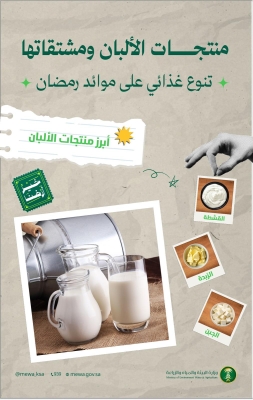
The Saudi Ministry of Environment, Water and Agriculture announced the readiness of the national dairy sector to meet increased demand during the holy month of Ramadan, confirming that daily production exceeds 2.75 million liters. This announcement underscores the strength of the Kingdom's food supply chains and its ability to achieve self-sufficiency in strategic commodities.
Enhancing food security in line with Vision 2030
This figure is not merely a passing statistic, but rather a reflection of the Kingdom's long-term strategic efforts within the framework of Vision 2030. The Ministry has worked to transform the agricultural and livestock sector into a highly efficient and sustainable industry. This massive production reinforces the concept of "food security," a matter of paramount importance to the leadership, especially during peak consumption seasons such as Ramadan. This ensures price stability and the availability of high-quality products for citizens and residents without complete reliance on imports.
"Our Land's Bounty" campaign and support for local products
As part of its ongoing awareness campaign under the slogan "The Bounty of Our Land," the Ministry explained that locally produced dairy products are characterized by a wide variety, including fresh milk, yogurt, cream, cheeses, and butter. This campaign aims to raise consumer awareness of the importance of choosing locally produced goods, not only for their high quality and reliable sources, but also for their pivotal role in supporting the local economy. Every purchase of locally produced goods directly benefits farmers and livestock breeders, thus stimulating continued production and sustainable agricultural development.
Nutritional and economic value
The ministry highlighted the health benefits of consuming dairy products during Ramadan, given their rich content of proteins, vitamins, and fluids essential for replenishing the body during Iftar and Suhoor. Economically, this abundant production contributes to reducing the Kingdom's import bill and strengthens the position of national companies, which are now competing globally in terms of quality and food safety standards, making reliance on local produce a strategic and national imperative.




Local News
The Ministry of Interior confirms the stability of the security situation in the Kingdom
The Ministry of Interior confirmed that the security situation in the Kingdom is reassuring and life is proceeding normally, warning against rumors and stressing the readiness of the security sectors to serve everyone.

The Saudi Ministry of Interior confirmed in an official statement that the security situation is stable in all regions of the Kingdom of Saudi Arabia, stressing that the daily lives of citizens and residents are proceeding in their normal and usual manner, thanks to God and then thanks to the security efforts exerted. This confirmation comes in light of monitoring the regional events and developments that the region has witnessed recently.
The Ministry noted that all security sectors are operating around the clock at the highest levels of readiness, within a comprehensive and interconnected security and service system. This system aims to enhance national security, protect its resources, and ensure the safety of all who live within its borders—citizens, residents, and visitors—based on well-defined strategic plans and advanced technologies that guarantee sustained stability.
Regional context and the importance of security stability
These assurances are of paramount importance given the geopolitical position of the Kingdom of Saudi Arabia and its pivotal influence in the Middle East. Despite the tensions that the region may experience from time to time, the Kingdom has successfully maintained its status as an oasis of security and stability, thanks to its wise policies and constant security vigilance. This stability is a fundamental pillar not only for internal security but also for the continued progress of the country's economic and social development.
The implications of security for development and Vision 2030
Maintaining security is closely linked to the goals of the Kingdom's Vision 2030, as a safe environment is a prerequisite for attracting foreign investment, revitalizing the tourism sector, and welcoming millions of pilgrims and Umrah performers annually. The Ministry of Interior's message affirms to the world that the Kingdom places the safety of all people – citizens and visitors alike – at the forefront of its priorities, thus reinforcing international confidence in Saudi Arabia's safe and stable environment.
Beware of rumors and unknown sources
In closing, the Ministry of Interior issued an important warning to the public, urging them to exercise caution and avoid being swayed by malicious rumors or sharing videos and information from unknown sources, which may aim to incite unwarranted panic. The Ministry stressed the importance of obtaining information and news only from official and accredited sources to ensure access to accurate and reliable facts, emphasizing that public awareness is the first line of defense against misleading campaigns.
Local News
National Water Company implements projects in Al-Jawf worth 55 million riyals
Learn about the details of the new national water projects in Al-Jawf, costing 55 million riyals, to serve 23,000 beneficiaries in Sakaka, Al-Qurayyat and Suwayr, within the framework of the Kingdom’s Vision 2030.

The National Water Company announced the completion of two vital water projects in the Al-Jawf region, a move that enhances the efficiency of the water infrastructure in Saudi Arabia. The total cost of these two projects exceeded 55 million Saudi riyals, and they aim to serve more than 23,000 new beneficiaries, reflecting the company's ongoing commitment to developing services and improving operational efficiency across the Kingdom.
Details of new water projects in Sakaka and Al Qurayyat
The company explained in its official statement that the projects' geographical scope encompassed several vital locations, including the implementation of advanced water networks in the western Qara and southern Al-Laqait neighborhoods of Sakaka city, as well as in the Suwayr governorate and the Adhfa center. Development efforts also extended to the Prince Abdul-Ilah neighborhood in the Qurayyat governorate. The technical work involved laying over 190 kilometers of main and secondary water lines and networks, ensuring the delivery of desalinated and sustainable water to the homes of citizens and residents.
In addition to the underground networks, the projects included the construction of an elevated water tank with an operational capacity of 100 cubic meters to ensure the stability of the pumping, as well as the construction of a new pumping station with a production capacity exceeding 19,000 cubic meters per day, which represents a qualitative leap in the water distribution system in the region.
Supporting the goals of the Kingdom's Vision 2030 and quality of life
These projects are an integral part of the National Water Company's strategy to align with the goals of Saudi Vision 2030, specifically the Quality of Life Program. Through these substantial investments, the Kingdom aims to ensure water security and provide reliable and sustainable water services to all residents. Developing water infrastructure in northern regions like Al-Jawf is a strategic step to support the urban expansion and population growth the region is experiencing, thus contributing to enhanced economic and social development.
The importance of projects for the Al-Jawf region
These projects are of particular importance given the geographical and agricultural nature of the Al-Jawf region. The availability of modern water networks will contribute to reducing water waste and increasing operational efficiency, as well as gradually eliminating the use of water tankers, thus reducing traffic congestion and environmental pollution. These steps underscore the wise leadership's commitment to providing a decent standard of living for citizens in all governorates and districts.
In closing, the National Water Company called on all customers in the neighborhoods and governorates benefiting from these projects to take the initiative to request the service through the official approved digital channels, whether through the company’s application on smartphones or through the electronic branch, in order to immediately benefit from the improved water services.
Local News
Ruling on taking period-delaying pills for Ramadan fasting: The opinions of Al-Mani' and Al-Shathri
Learn about the ruling on taking menstrual cycle-delaying pills to fast the entire month of Ramadan. Details of Sheikh Abdullah Al-Manea's fatwa and Sheikh Saad Al-Shathri's opinion on what is preferable and the Sharia and health guidelines.


As the holy month of Ramadan approaches each year, the jurisprudential and medical question that concerns a wide segment of Muslim women is renewed regarding the ruling on using medical drugs to delay or stop the menstrual cycle, out of their desire to fast the entire holy month without interruption, and to take advantage of its nights in prayer and worship.
Sheikh Abdullah Al-Manea's opinion: Permissibility is conditional upon the absence of harm
In this context, Sheikh Abdullah Al-Manea, a member of the Council of Senior Scholars, settled the ongoing debate by confirming that the Council had issued an official fatwa permitting women to use birth control pills or medications to stop menstruation for the purpose of fasting during Ramadan. Sheikh Al-Manea stipulated that this permission is contingent upon a crucial condition: that taking these pills does not cause any health harm to the woman.
Al-Manea explained the issue in detail, stating that the determining factor in Islamic law is the cessation of menstrual bleeding. If a woman takes medication and does not bleed, she is considered ritually pure, and her fasting, prayers, and other acts of worship are valid. The fact that her purity is due to medication does not affect the validity of her worship. He added, however, that if menstruation occurs despite taking the medication, she is not permitted to fast or pray and must make up the missed days after Ramadan.
Sheikh Saad Al-Shathri's opinion: Permissibility, but abstention is preferable
For his part, Sheikh Saad Al-Shathri, a member of the Council of Senior Scholars, agreed with the view that taking medication to stop menstruation is permissible and that there is no religious objection to it. However, he offered a deeper perspective, indicating that "avoiding such pills is preferable." Al-Shathri explained that the woman is rewarded in both cases.
Al-Shathri explained that a woman during her menstrual and postpartum periods receives the full reward for her good deeds, and even has her rewards multiplied, because her abstention from prayer and fasting during that time is in obedience to God's command. Therefore, she is considered to be in a state of worship even though she is not fasting. He considered that taking advantage of the religious dispensation and conforming to the physiological nature with which God created women may be a better option than medication that could cause hormonal imbalances.
The legal and medical context of the issue
This issue falls under what is known as "fiqh al-nawazil" or new issues that combine religious rulings with medical advice. Historically, jurists viewed menstruation as a natural occurrence that prevented fasting and prayer. However, with the development of medicine and the emergence of hormone-regulating drugs, the need arose to adapt the religious ruling based on the jurisprudential principle "the default ruling for things is permissibility unless there is evidence of prohibition." Since the goal is to be able to perform acts of worship, most contemporary scholars have leaned towards permissibility.
The importance of medical consultation before Ramadan
Despite its permissibility according to Islamic law, doctors and specialists emphasize that women should not make this decision unilaterally. Hormonal use can lead to side effects that vary from woman to woman, such as nausea, headaches, or menstrual irregularities in the following months. Therefore, the condition set by Sheikh Al-Manea, namely "no harm," implicitly requires consulting a specialist well before Ramadan to ensure the type and dosage are suitable for the woman's health condition, thus guaranteeing a safe and acceptable fast.
-

 Local News 4 days ago
Saudi Arabia approves regulations for the continued presence of Gulf vehicles: duration and penalties
-
Local news two days ago
Jeddah Airport alerts for travelers due to airspace closure and flight disruptions
-
Local news one week ago
The Ministry of Interior begins procedures for a royal pardon for common law prisoners
-
Local News 6 days ago
The deadline for property registration in Hail and Riyadh is Thursday
-
Sports one week ago
Tickets for the Al-Ahli vs. Al-Hilal King's Cup match postponed: New date
-
Local News 7 days ago
Under the patronage of the Minister of Information, an agreement was signed between the Ministry of Information and Waves Marketing Company
-
Culture and Art 5 days ago
The Devil's Prisons series was halted: The full story of "The Emperor's" being moved to YouTube
-
Local news one week ago
Saleh Al-Maghamsi appointed Imam of the Prophet's Mosque: Details of the Royal Decree