Local News
Local millet: A healthy and strategic choice for Ramadan tables
The Ministry of Environment emphasizes the importance of locally grown millet as a strategic choice for Ramadan meals. Learn about its nutritional benefits and its role in enhancing food security and Saudi Arabia's cultural heritage.


The Saudi Ministry of Environment, Water and Agriculture has affirmed that locally grown millet is a vital strategic choice for Ramadan meals, emphasizing its status as one of the Kingdom's most prominent agricultural crops. This affirmation stems from millet's high nutritional value and exceptional quality, as well as its integral role in the Kingdom's culinary and cultural heritage, particularly in the southern regions.
Millet has recently gained increasing importance as a healthy and ideal alternative to other grains. It is completely gluten-free, making it an excellent choice for people with wheat allergies or digestive disorders, which aligns with the nature of fasting and the need for easily digestible, high-energy foods. Millet also contains high levels of fiber, protein, and essential minerals such as iron and magnesium, helping to maintain stable blood sugar levels—a crucial health benefit during the holy month of Ramadan.
From an agricultural and geographical perspective, millet cultivation is a cornerstone of the Kingdom's agricultural sector, concentrated in the Jazan, Asir, Al-Baha, and Makkah regions. This crop is distinguished by its exceptional ability to withstand harsh climatic conditions and drought, in addition to its low water requirements compared to other crops, making it a sustainable crop that aligns with the region's environmental and water challenges.
In line with the Kingdom’s Vision 2030, supporting millet cultivation plays a pivotal role in enhancing national food security. The Ministry, through its Sustainable Rural Development (REEF) programs, is working to support small-scale farmers in increasing their production of local grains, with the aim of achieving self-sufficiency and reducing reliance on imports. Returning to local crops like millet is not merely a nostalgia initiative, but a strategic and economic step that supports the local economy and preserves biodiversity.
In conclusion, millet remains strongly present in the popular Saudi memory, as it is used in the preparation of many traditional Ramadan dishes such as porridge, bread, and soup, adding a special flavor that blends health benefits and the fragrance of history to the Iftar and Suhoor table.




Local News
Integrity Commission suspends 78 employees and investigates 349 in corruption and bribery cases
The Oversight and Anti-Corruption Authority (Nazaha) announces the results of its campaign for February 2026, investigating 349 defendants and suspending 78 in bribery and abuse of power cases involving 5 ministries.

The Saudi Oversight and Anti-Corruption Authority (Nazaha) announced the results of its intensive oversight tours during February 2026, revealing new figures that reflect the Kingdom's continued firm approach to combating financial and administrative corruption. In a statement issued today (Sunday), the Authority explained that it had initiated a large number of criminal and administrative cases, affirming its commitment to further strengthening the principles of transparency and integrity across all government sectors.
In its announcement, the National Anti-Corruption Commission (Nazaha) revealed that its specialized teams conducted 3,164 field inspections during the past month. These inspections and thorough investigations resulted in the opening of investigation files against 349 employees of various job ranks. These investigations concluded with the detention of 78 defendants (some of whom were later released on bail) in accordance with the Code of Criminal Procedure, pending their referral to the judiciary to adjudicate the charges against them.
The ministries involved and the charges against them
The commission's statistical report indicated that the accused and detained individuals belong to several key sovereign and service ministries, including the Ministry of Interior, the Ministry of Defense, the Ministry of Municipalities and Housing, the Ministry of Health, and the Ministry of Human Resources and Social Development. The most prominent charges against the detainees centered on bribery and abuse of official influence for personal gain, crimes considered among the most significant threats to administrative and financial efficiency in the public sector.
National context for promoting transparency
These stringent measures are an extension of Saudi Arabia's approach to combating corruption, a cornerstone of its Vision 2030. The Saudi leadership aims to eradicate corruption at its roots, recognizing it as a major obstacle to development, by implementing the principle of "Where did you get this?" and showing zero tolerance for anyone found to be involved in corruption, regardless of their position. Recent years have witnessed a qualitative shift in oversight and accountability mechanisms, contributing to the Kingdom's improved ranking in international transparency indices.
The economic and social impact of combating corruption
The importance of these campaigns extends beyond mere punishment, encompassing significant economic and social impacts. Economically, combating corruption contributes to creating an attractive and secure investment environment, ensuring fair competition for both local and foreign investors, free from illicit practices. Socially, these efforts bolster public trust in government institutions, reinforce the principles of justice and the rule of law, and ensure that state financial resources are directed towards development projects that directly benefit citizens, rather than being squandered through corruption.
“Nazaha” renews its ongoing call to citizens and residents to cooperate with it through official channels to report any suspicious practices that may involve financial or administrative corruption, stressing that protecting public funds is a shared responsibility that falls on everyone.
Local News
Inauguration of the economic city in Abyan: the largest investment project in Yemen
The Minister of Public Works laid the foundation stone for the economic city in Abyan, in the Al-Alam area. The project, spanning 96 million square meters and including a waterway, aims to boost investment and infrastructure.
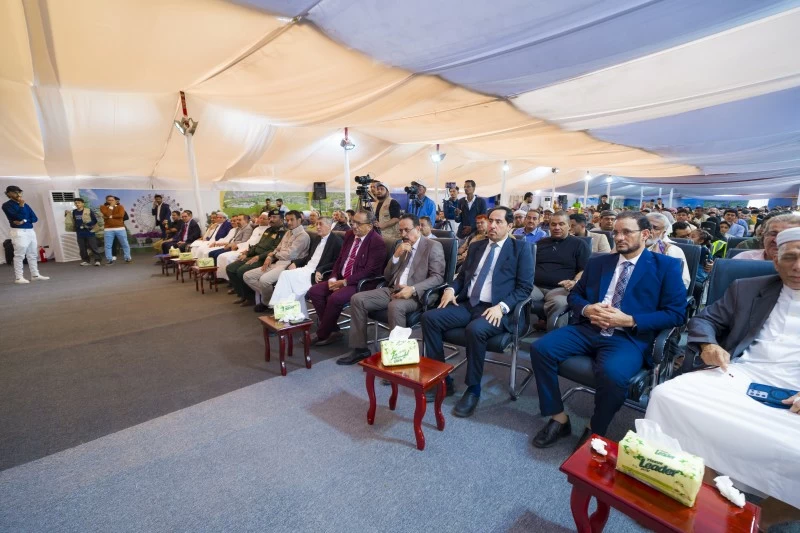
In a strategic move aimed at accelerating development and reconstruction in the liberated governorates, the Minister of Public Works and Highways, Engineer Hussein Al-Aqrab, laid the foundation stone today, Saturday, for the "New Economic City" project in the coastal area of Al-Alam in Abyan Governorate. This project is one of the largest investment and development projects the region has witnessed, spanning a vast area of approximately 96 million square meters.
Details of the giant investment project
The project boasts a strategic location in the Al-Alam district, considered the eastern gateway to the interim capital, Aden, and a vital link to Abyan Governorate. According to the announced plans, the project goes beyond traditional urban planning, encompassing the construction of a massive canal exceeding 26 kilometers in length. This canal aims to enhance the city's aesthetic appeal and tourism potential, while also boosting the investment climate and attracting local and foreign capital, reflecting an ambitious vision to transform the region into a vibrant economic hub.
High-level official attendance
The inauguration ceremony was attended by prominent state and local government officials, including Minister of Youth and Sports Naif al-Bakri and Secretary-General of the Abyan Governorate Local Authority Mahdi al-Hamdi. A large number of undersecretaries, security and military leaders, and prominent social figures from the governorates of Aden, Abyan, and Lahj were also present, along with a select group of businesspeople and investors who see this project as a promising opportunity to revitalize the real estate and commercial market in Yemen.
The strategic and economic importance of the project
The establishment of the economic city comes at a crucial time, as the Yemeni government seeks to create genuine investment opportunities that transcend current challenges. The Al-Alam area derives its significance from being a pristine coastal region possessing immense, yet untapped, tourism and commercial potential. This project is expected to generate thousands of job opportunities for young people, revitalize the contracting and construction sector, and alleviate population and urban pressure on Aden by creating new, well-planned urban centers designed according to the latest engineering standards.
Supporting infrastructure and regional integration
Officials confirmed during the inauguration that this project is not merely a residential development, but rather the nucleus of a fully integrated city that will bolster the national economy. The new economic city is expected to serve as a hub for commercial activity among the southern governorates, thus strengthening economic integration between Abyan, Aden, and Lahj. This initiative is part of a series of government efforts aimed at normalizing conditions and improving services and infrastructure that have suffered in recent years, sending reassuring messages to investors about the future of the investment climate in the region.
Local News
King Salman directs that stranded Gulf nationals be hosted in the Kingdom's airports
Based on the Crown Prince’s proposal, the Custodian of the Two Holy Mosques directed that the stranded Gulf nationals be hosted in the Kingdom’s airports and provided with full care, as a confirmation of the depth of the fraternal ties.

In a generous humanitarian gesture that embodies the deep and strong fraternal ties that unite the Gulf Cooperation Council (GCC) countries, the Custodian of the Two Holy Mosques, King Salman bin Abdulaziz Al Saud - may God protect him - issued a royal directive approving the hosting of all stranded Gulf nationals at the Kingdom’s airports.
This generous directive came in response to what was presented by His Royal Highness Prince Mohammed bin Salman bin Abdulaziz, Crown Prince and Prime Minister, as the royal order included an emphasis on preparing all the necessary procedures to host and honor the Gulf citizens, and providing all means that ensure their comfort and reassurance among their families and brothers in their second country, the Kingdom of Saudi Arabia, until the appropriate conditions are prepared that allow them to return to their countries safe, honored and respected.
An embodiment of the concept of a unified Gulf
This decision reflects the Kingdom of Saudi Arabia's unwavering policy towards its brothers in the Gulf Cooperation Council (GCC), a policy based on the principle of "one body" and a shared destiny. The Kingdom, under its wise leadership, has always been a steadfast protector and a welcoming home for the people of the Gulf in all circumstances and crises. This hosting is not merely a matter of protocol, but a tangible embodiment of the values of brotherhood and neighborliness enshrined in the GCC charters and reinforced by the deep-rooted historical and social ties between the peoples of the region.
Immediate response and crisis management
The Custodian of the Two Holy Mosques also directed all relevant government, security, and service agencies to take the necessary measures to implement this directive immediately and to dedicate all available resources to serving those stranded. This swift action reflects the efficiency of the Kingdom's crisis management system and its ability to deal with unforeseen circumstances with remarkable flexibility, placing human life, safety, and dignity above all else.
The depth of Saudi-Gulf relations
Historically, the Kingdom of Saudi Arabia has never hesitated to provide support and assistance to its brothers, whether on the political, economic, or social levels. Caring for Gulf citizens and treating them as Saudi citizens in such circumstances is an extension of a long legacy of honorable stances taken by the Kings of Saudi Arabia. The sense of security felt by Gulf citizens while under the Kingdom's hospitality underscores the success of the Gulf Cooperation Council in consolidating the concept of Gulf citizenship, where Gulf citizens do not feel like strangers in Saudi Arabia, but rather among their own family and kin.
May God protect the Custodian of the Two Holy Mosques and His Crown Prince, and may He perpetuate the blessings of security, safety, stability and prosperity upon the Kingdom and the Gulf States.
-

 Local News 3 days ago
Saudi Arabia approves regulations for the continued presence of Gulf vehicles: duration and penalties
-
Local News 6 days ago
The Ministry of Interior begins procedures for a royal pardon for common law prisoners
-
Local news one week ago
19 requirements to reduce dust from projects in Riyadh and fines for violators
-
Local news one day ago
Jeddah Airport alerts for travelers due to airspace closure and flight disruptions
-
Politics, one week ago
Trump plans to create a $2 billion alternative to the World Health Organization
-
Culture and Art, 1 week ago
Amr Diab appears with his four sons and a highly anticipated concert in Türkiye
-
 Local news one week ago
Three billion riyals deposited as Ramadan aid for social security beneficiaries
-
Local News 5 days ago
The deadline for property registration in Hail and Riyadh is Thursday