Local News
Discovery of a historical document detailing King Abdulaziz's communication with the state
Discover a historical document that reveals King Abdulaziz’s vision for building the Saudi state, highlighting his efforts to achieve economic prosperity and social stability.

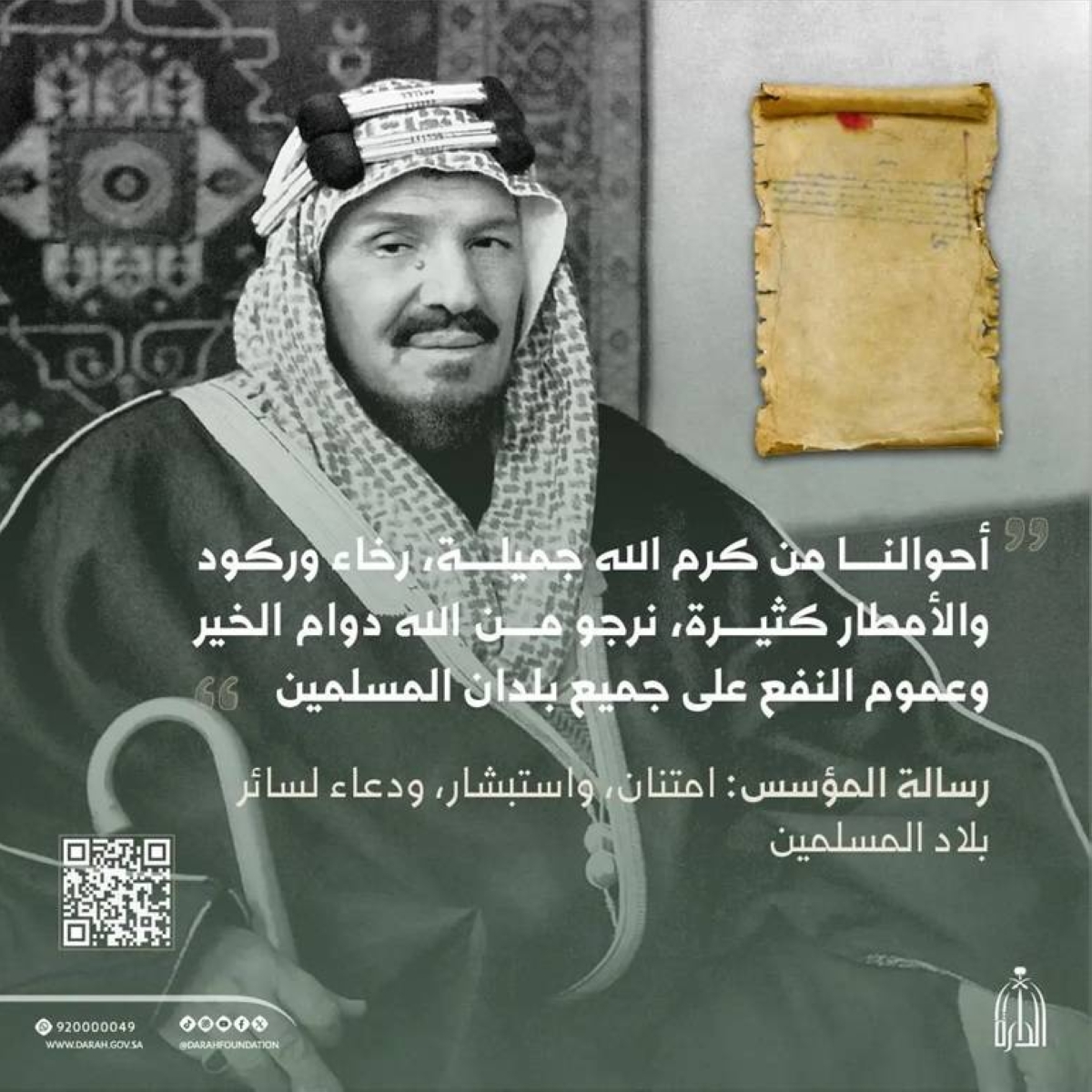
A historical document highlighting King Abdulaziz's vision for building the state
The King Abdulaziz Foundation highlighted a historical document dated 25 Shawwal 1344 AH, containing a telegram from King Abdulaziz bin Abdulrahman Al Saud (may God have mercy on him), demonstrating his profound concern for the economic prosperity and social stability of the Kingdom of Saudi Arabia during its founding period. This document is not merely a passing message, but rather a testament to the wise leadership style adopted by the founding king during that critical period in the country's history.
historical and political circumstances
During that period, Saudi Arabia was undergoing radical transformations following its unification under King Abdulaziz. The focus was on achieving internal stability and strengthening the infrastructure of the fledgling state. This phase was marked by economic and social challenges facing the Kingdom, but King Abdulaziz's insightful vision helped overcome many obstacles.
The content and importance of the telegram
The telegram sent to Abdul Wahab Abu Malha—a prominent statesman at the time—was not merely a personal message, but carried strategic implications reflecting King Abdulaziz's vision for building a cohesive and prosperous society. In it, he praised the country's economic stability and abundant rainfall, praying that its blessings would extend to all Muslim lands. This supplication reflects his keenness to strengthen relations with other Islamic nations and underscores the importance of communication and mutual prayers.
The telegram also included assurances regarding his personal well-being and his pleasure at receiving Abu Malha's letter and inquiry about his health, along with well wishes and instructions to convey greetings to the children and the regards of the King's brothers and sons. This reflects the depth of the social relations and human bonds that he—may God have mercy on him—was keen to cultivate with the statesmen and citizens of his country.
The document's implications for understanding good leadership
This document is a significant example of the leadership's communication style during the reign of King Abdulaziz and his concern for internal affairs and the general conditions of society. It also sheds light on the overall atmosphere in the Kingdom, including its prosperity, stability, and security. Highlighting such documents helps in understanding how a strong and stable state was built upon solid foundations of cooperation and communication between the leadership and the people.
Lessons learned and the current Saudi position
Examining such historical documents highlights how wise leadership can establish a strong and stable state by focusing on internal development and strengthening social and political bonds. Today, the Kingdom of Saudi Arabia continues to follow in the footsteps of its founder by adopting policies that support stability and sustainable development both domestically and regionally.
The Kingdom of Saudi Arabia continues to play a pivotal role regionally and internationally thanks to its strategic vision, which is based on a well-established leadership legacy since the era of the founder, thus enhancing its position as an active and balanced diplomatic power.




Local News
The governor of Al-Ardiyat offers condolences to the Al-Shamrani family: A story of loyalty and social cohesion
Touching details about the passing of a father in Al-Ardiyat Governorate and the stance of Governor Ali bin Yousef Al-Sharif, which embodies the unity of the official and the citizen, and the values of good upbringing in Saudi society.

On the morning of Wednesday, February 4, 2026 (1447 AH), two weeks before the start of the holy month of Ramadan, the Al-Ardiyat Governorate in the Makkah Region awoke to the news of the death of a prominent figure in his family and community—a father who left an indelible mark on his children and society. This event was not merely a passing loss, but rather a moment to reflect on the values of good upbringing and the exemplary father figure who contributed to building an educated and aware generation, despite his own illiteracy.
Authentic values: The founding generation of close-knit families
The deceased was a living example of a generation of fathers who built their families on the foundations of true Islam and authentic Arab values. For decades, he was committed to raising his children by setting a good example before preaching. He never missed the opening takbir (Allahu Akbar) at the mosque, except on one rare occasion that remains etched in his son's memory: when he said "Amen" alone on the way to the mosque, ashamed of missing the first rak'ah (unit of prayer). These meticulous details reflect the depth of his religious conviction and his keenness to eat only what is lawful. He spent on his children's education from primary school through university and married them off with the fruits of his honest labor, without ever allowing them to consume a single grain of what is forbidden.
Social cohesion and the role of the official in incidents
In a related context, the values of social cohesion that characterize Saudi society were evident during the days of mourning, as large crowds gathered to pray for the deceased and offer condolences to his family. This was not limited to ordinary citizens; the responsible role of the administrative leadership in the province was also apparent. The Governor of Al-Ardiyat, Mr. Ali bin Yousef Al-Sharif, made a point of offering his condolences despite being abroad on a trip at the time of the death.
To underscore the deep bond between officials and citizens in the Kingdom of Saudi Arabia, the governor did not limit himself to the phone call he made immediately upon hearing the news. He promptly visited the family home upon his return from his trip. This visit, characterized by humility and respect, reflected the open policy adopted by the leadership and officials in sharing the joys and sorrows of citizens, thus alleviating the burden of grief and strengthening national unity.
An enduring legacy and welcoming Ramadan with supplication
The passing of such men leaves a great void, but they bequeath values that endure. The deceased was a paragon of honesty, kinship, and meticulous and trustworthy generosity towards those in need. As the blessed month of Ramadan approaches, the family welcomes it with a profound sense of loss, yet with acceptance of God's will and decree. They pledge to keep their father's memory alive in their prayers and charitable acts, and they deeply appreciate the support of the community and officials, which has eased the pain of their loss.
Local News
The Shura Council calls on universities to embrace digital transformation and empower women by 2024
The Shura Council directs Saudi universities to promote digital transformation, empower women, and invest in innovation and endowments to achieve financial sustainability in accordance with Vision 2030.

In a move reflecting the Kingdom of Saudi Arabia’s interest in raising the efficiency of the university education sector to align with the goals of Vision 2030, the Shura Council held its regular session today (Monday) under the chairmanship of His Excellency the Speaker of the Council, Sheikh Dr. Abdullah bin Mohammed bin Ibrahim Al Sheikh, where it issued a package of important decisions and recommendations directed to a number of Saudi universities, which focused in their entirety on empowerment, digital transformation, and financial sustainability.
Development context and strategic direction
These recommendations come at a time when the Kingdom's education sector is undergoing radical transformations aimed at bridging the gap between educational outcomes and the evolving needs of the labor market. The Human Capital Development Program is a cornerstone of the vision upon which these directives are based, as the Council, through its decisions, seeks to encourage universities to adopt more efficient operational models based on self-financing, innovation, and comprehensive digitalization, rather than relying entirely on traditional government support.
Women's empowerment and institutional excellence
During the session, the council directed Princess Nourah bint Abdulrahman University to adopt an institutional identity that directly focuses on empowering women in areas of national development priority. This recommendation is particularly important given the significant strides Saudi women have recently made in the labor market. The council also urged the university to increase its recruitment of international students and develop student exchange programs, which will enhance cultural diversity and improve the university's global ranking and academic reputation.
In a related context, the council called on Al-Baha University to address shortcomings in institutional performance and raise the quality of educational and research outputs, stressing the importance of highlighting the university’s identity in a manner that is appropriate to the comparative advantages of the Al-Baha region, and developing the digital transformation system and partnerships with the private sector to ensure sustainability.
Innovation and the knowledge economy
The Council's recommendations to King Faisal University focused on the economic aspect of knowledge, calling for maximizing the benefits of innovative products and patents and transforming them into sustainable investment models. It also urged the university to leverage its digital infrastructure to develop a smart student guidance system. This step is essential for transforming universities from purely academic institutions into productive research centers that contribute to the national economy.
Preserving heritage and digital transformation
The session also addressed the issue of heritage, with the council urging the Islamic University of Madinah to digitize its library's paper holdings. This initiative aims to preserve and make Islamic and scientific heritage globally accessible, while respecting intellectual property rights. The council also called upon Jeddah University to complete its digital transformation and establish a unified database.
Localization of talent and financial sustainability
Regarding human resources, the council urged Hafr Al-Batin University to attract qualified national academic staff and provide scholarship opportunities for outstanding students to address staffing shortages and enhance the scientific research environment. Discussions also touched upon the importance of diversifying income sources through endowments and self-investments to ensure the financial and operational sustainability of universities, a point emphasized by council members in their comments on the reports from Majmaah University and Jeddah University.
The session concluded with the approval of two memoranda of understanding; the first between the Supreme Commission for Industrial Security and Naif Arab University for Security Sciences, and the second between the Ministry of Transport and Logistics and the Tunisian Ministry of Communication Technologies, which strengthens international and local cooperation in the security and logistics fields.
Local News
The Shura Council calls on universities to embrace digital transformation and empower women
The Shura Council issues recommendations to Saudi universities focusing on digital transformation, women's empowerment, financial sustainability, and heritage preservation, in line with the Kingdom's Vision 2030.

In a move aimed at raising the efficiency of the higher education sector and aligning its outputs with the objectives of the Kingdom’s Vision 2030, the Shura Council held its regular session today (Monday) under the chairmanship of His Excellency Sheikh Dr. Abdullah bin Mohammed bin Ibrahim Al Sheikh, where it issued a package of important decisions and recommendations directed to a number of Saudi universities, which focused in their entirety on digital transformation, women’s empowerment, and enhancing innovation and financial sustainability.
The context of university development and Vision 2030
These recommendations come within the context of the comprehensive development movement underway in the Kingdom's education sector, which is based on the new university system aimed at granting academic institutions controlled autonomy that enables them to build their own resources. The Shura Council's call for universities to focus on "digital transformation" and "investment" is an integral part of the national transformation strategy to build a sustainable knowledge-based economy and reduce total dependence on direct government support by diversifying income sources through endowments and university-based companies.
Women's empowerment and corporate identity
During the session, the council directed Princess Nourah bint Abdulrahman University to adopt a clear institutional identity that focuses primarily on empowering women in areas of national development priority. The council also emphasized the importance of increasing the number of international students and activating student exchange programs, which will enhance cultural diversity and raise the university's global ranking and academic reputation.
Addressing shortcomings and enhancing quality
Regarding Al-Baha University, the council called for expediting the addressing of shortcomings in institutional performance, emphasizing the need to improve the quality of educational and research outputs. The recommendations stressed the importance of the university reflecting the region's identity and comparative advantages, along with the necessity of developing its digital infrastructure and building strategic partnerships with the private sector to ensure financial sustainability.
Innovation and the knowledge economy
In order to strengthen the knowledge economy, the Council urged King Faisal University to maximize the utilization of its innovative products, including patents and business incubators, and transform them into profitable investment models. The Council also called on the university to leverage its digital infrastructure to develop a smart student advising system, with a focus on data governance and privacy protection.
Heritage preservation and digital transformation
Among the prominent recommendations, which carry a global cultural and Islamic dimension, is the Council's request that the Islamic University of Madinah digitize its library's paper holdings. This step aims not only for preservation but also to make the scientific and Islamic heritage available to researchers worldwide, thus reinforcing the Kingdom's leading role in serving Islam and the Arabic language, while respecting intellectual property rights.
Additional recommendations and memoranda of understanding
The session also included demands for Jeddah University to complete the digital transformation system and establish an investment system for endowments, calls for Hafr Al-Batin University to attract national talent, and observations on the performance of Majmaah University to enhance the governance of initiatives.
The session concluded with the approval of two memoranda of understanding; the first between the High Commission for Industrial Security and Naif Arab University for Security Sciences, and the second between the Ministry of Transport and Logistics and its Tunisian counterpart for cooperation in the postal sector.
-

 Culture and Art 5 days ago
The "Between and Between" exhibition in Jeddah: 5 artists reshape Saudi memory
-
Culture and Art 6 days ago
Shakira's concert in Jeddah: Details of the international star's first concert in Saudi Arabia
-
Local News 3 days ago
Saudi Arabia's National Arabic Language Policy: 8 Principles to Promote Identity
-
Local news two days ago
Adopting the National Policy for the Arabic Language: Strengthening Identity and Vision 2030
-
Culture and Art, 1 week ago
The truth about Nancy Ajram's video and Epstein Island, and her legal response
-
Culture and Art, 1 week ago
Rawan Bin Hussain's first appearance after her imprisonment and deportation from Dubai
-
Local News 3 days ago
The Riyadh-Rin-Bisha dual carriageway, spanning 559 km, has been completed
-
Culture and Art, 1 week ago
Abla Kamel returns in Ramadan 2026 with a surprise alongside Menna Shalaby and Yasmine Abdel Aziz