Local News
Warning against the digital identity theft of young people at a seminar held at the Ibn Idris Center
A seminar in Tanomah explores the digital identity challenges of youth in an era of rapid transformations, with the participation of a select group of academics and writers.

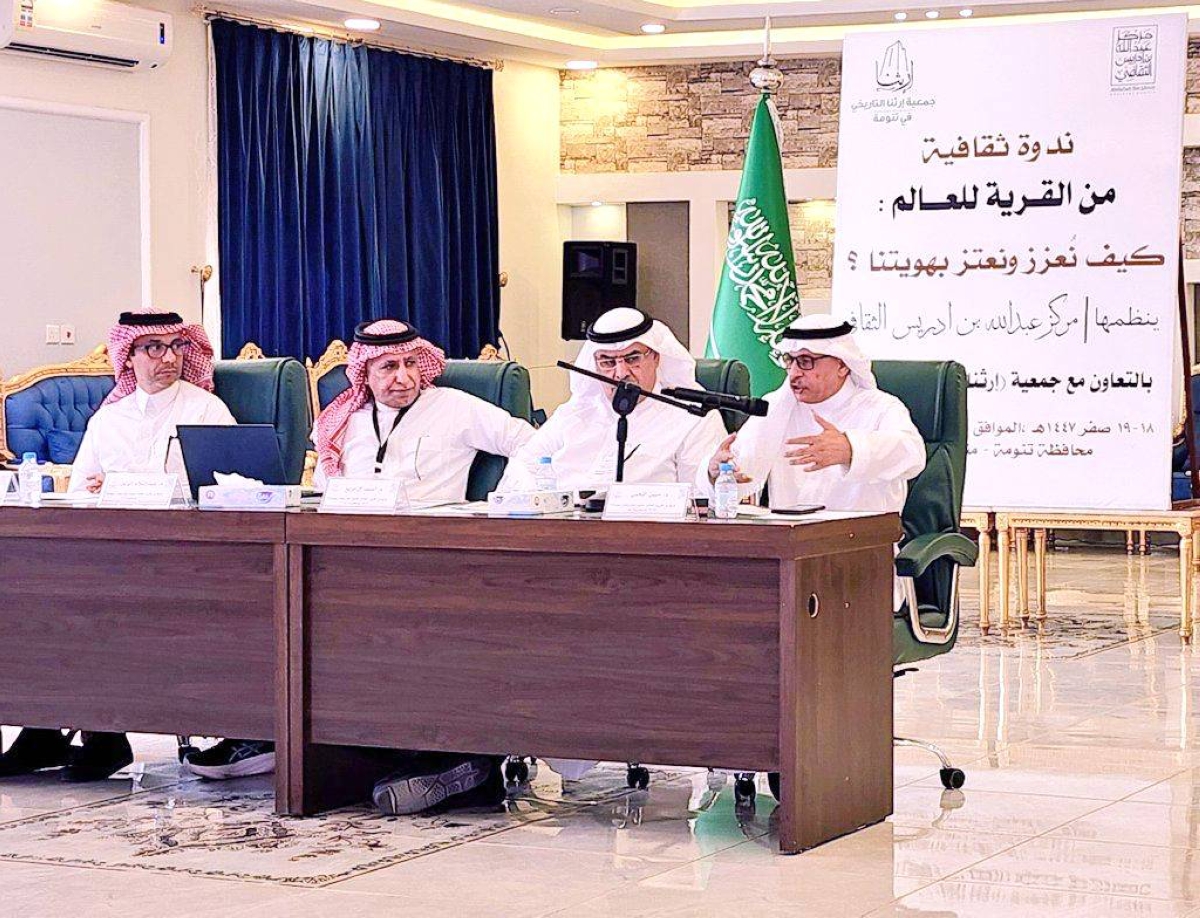
“Strengthening Identity from the Village to the World” Symposium in Tanouma
A symposium titled “Strengthening Identity from the Village to the World” recently concluded in Tanomah Governorate. Organized by the Abdullah bin Idris Cultural Center in collaboration with the Our Heritage Association, the two-day event featured a group of academics and writers who discussed topics related to identity amidst the rapid transformations the world is witnessing.
Modern challenges to identity
The symposium participants focused on the challenges facing diverse identities due to globalization and rapid change. Experts expressed concern about the impact of these transformations on the digital identities of young people, as they could lead to the erosion, erasure, or dissolution of these identities.
Islamic history and identity
Dr. Ismail Al-Bashri, former president of Al-Jouf University, discussed the history of human identity and how Islam has addressed it since the Constitution of Medina. He emphasized that Islam recognizes all identities without conflict or erasure, making it a comprehensive document of human rights.
Virtual identity and the impact of technology
Dr. Khalid Al-Radiean from King Saud University discussed the impact of social media and digital technology on concepts and identities. He pointed to the emergence of what is called virtual identity, where individuals get to know each other online and form groups with shared characteristics similar to elements of traditional identity. However, these virtual identities are fluid and can be easily abandoned if they become burdensome.
The search for identity in Arab societies
Dr. Musfir Al-Qahtani from the University of Petroleum explained that the question of identity has been one of the most important issues in Arab societies over the past decades. Following the end of military colonialism, Arab societies continue to search for their identity, whether it be multifaceted religious, diverse ethnic, or national. However, these identities are often contradictory and cannot be easily integrated, either at the individual or societal level.
The impact of technology and digitalization on daily life and the future
Technology and digitalization play a significant role in shaping our identities today. For example, social media platforms like Facebook and Twitter allow individuals to connect and exchange ideas with people from all over the world. This creates new opportunities for interaction but also presents new challenges regarding the preservation of privacy and personal identity.
Real-world examples : The impact of technology is clearly visible when we look at how young people use the internet to learn new skills or start small online businesses. This type of activity fosters a sense of independence and self-actualization, but it also requires an awareness of how to maintain a strong cultural identity amidst diverse global influences.
Summary
The symposium highlighted the importance of strengthening cultural and local identity in an era of globalization and rapid technological advancement. We must all reflect deeply on how to preserve our identity while embracing and utilizing modern technology to improve our daily lives and future.


Local News
Hajj vaccinations 1447: Health Ministry mandates meningococcal vaccination for domestic pilgrims
The Ministry of Health announces the requirements for Hajj 1447 AH for domestic pilgrims. Meningococcal vaccination is mandatory, and influenza and COVID-19 vaccines are recommended. Book your appointment now through the Sehhaty app.

The Saudi Ministry of Health announced a set of preventive health measures and requirements for those wishing to perform the Hajj pilgrimage from within the Kingdom for the 1447 AH season, as part of its ongoing efforts to ensure a safe and healthy environment for the pilgrims, and to enable them to perform the rituals in an atmosphere of peace and security.
Details of mandatory and recommended vaccines
In its announcement, the Ministry emphasized the importance of completing necessary immunizations, specifying the meningococcal (meningococcal) vaccine as a mandatory requirement for all those wishing to perform Hajj, as well as for healthcare professionals participating in the pilgrimage season. The Ministry clarified that this requirement applies to individuals who have not received the vaccine within the past five years, noting that immunization status can be easily verified through the "Sehhaty" app.
In addition to the mandatory vaccination, the ministry emphasized the importance of receiving the seasonal flu vaccine , stipulating that it must have been administered no earlier than September 1st of last year to ensure its effectiveness during the season. The ministry also strongly recommended receiving COVID-19 vaccine , provided that the dose was administered no earlier than January 1st, 2025.
The importance of immunization in mass gathering medicine
These stringent measures stem from Saudi Arabia's extensive experience in mass gathering medicine, given that the Hajj season is one of the world's largest annual human gatherings. These vaccinations are of paramount importance in bolstering community immunity within the holy sites, as proactive immunization helps prevent the spread of infectious diseases and epidemics that can be transmitted through droplets or contact in crowded areas.
The Ministry of Health is working according to a proactive preventive strategy aimed at reducing the rates of respiratory and infectious diseases, which positively impacts the ability of pilgrims to complete their rituals without health obstacles, and reduces the pressure on field health facilities during the season.
Digital transformation and streamlining procedures
To facilitate matters for citizens and residents, the Ministry called on those intending to perform Hajj and healthcare professionals to book vaccination appointments through the "Sehhaty" digital application and proceed to the "Adult Vaccination Clinic." This procedure is part of the digital transformation of the Saudi healthcare sector, which aims to automate health services and facilitate access to them, ensuring the accuracy of health data and the speed of procedures, in line with the Kingdom's Vision 2030 goals of enhancing public health and quality of life.
Local News
The Saudi Council of Engineers has identified 55 violators in Jazan
The Saudi Council of Engineers has apprehended 55 unlicensed engineering practitioners in Jazan and referred them to the Public Prosecution, as part of a campaign to regulate the sector and ensure the quality and safety of projects.


As part of its ongoing efforts to regulate the engineering labor market and ensure the quality of construction outputs, the Saudi Council of Engineers announced the results of an intensive inspection tour it conducted in the Jazan region, which resulted in the detection of serious violations in one of the establishments operating in the contracting sector.
Details of the seizure and legal procedures
An inspection revealed that a contracting company working on a major project in the region was employing 55 individuals performing engineering and technical work without obtaining the necessary professional accreditation from the relevant authority. This constitutes a clear violation of the Engineering Professions Practice Law and its implementing regulations in the Kingdom of Saudi Arabia.
The authority confirmed that it has taken immediate legal action, referring the violating establishment and individuals to the Public Prosecution, according to its jurisdiction, to complete the investigations and apply deterrent legal penalties, stressing that its monitoring tours are ongoing and will include all regions of the Kingdom without exception to ensure full compliance.
The #ApprovedOrNot campaign and advance warnings
These measures were not implemented suddenly, but were preceded by intensive awareness and warning campaigns by the Authority. The Authority explained that it had sent awareness text messages to the phone numbers of unaccredited practitioners registered on the "Absher" platform, as part of the national campaign #AccreditedOrNot. These messages aimed to urge practitioners to quickly rectify their status and complete the requirements for professional accreditation before punitive measures were applied.
The importance of professional accreditation and its impact on the sector
The Saudi Council of Engineers' emphasis on professional accreditation stems from its pivotal role in protecting society and the national economy. Professional accreditation is not merely an administrative procedure; it is a safeguard that ensures those overseeing engineering projects possess genuine and documented academic qualifications and practical experience.
The importance of this procedure is highlighted in the following points:
- Ensuring public safety: Reducing engineering errors that may result from non-professionals, which may lead to construction disasters that threaten lives and property.
- Improving project quality: The presence of certified engineers contributes to raising the efficiency of implementation and ensuring that projects comply with the Saudi building code and international standards.
- Combating fake certificates: The accreditation system works to verify certificates and expose forgers and intruders into the profession, thus enhancing the integrity of the sector.
The context of urban development and Vision 2030
These regulatory campaigns coincide with the comprehensive urban development the Kingdom is witnessing under Vision 2030, where mega-projects are being implemented that demand the highest levels of efficiency and professionalism. Therefore, purging the market of unauthorized and unlicensed entities is a fundamental pillar for the success and sustainability of these projects, thus enhancing the Kingdom's position as an attractive investment environment that adheres to the highest standards of quality and occupational safety.
Local News
The development of Abu Bakr Al-Siddiq Mosque in Najran is part of the Prince Mohammed bin Salman project
Learn about the details of the development of Abu Bakr Al-Siddiq Mosque in Najran as part of Prince Mohammed bin Salman’s project to develop historical mosques, and the efforts to preserve the authentic architecture and increase the capacity.

The Kingdom of Saudi Arabia continues its tireless efforts to preserve Islamic and architectural heritage. The Prince Mohammed bin Salman Project for the Development of Historical Mosques is a cornerstone in maintaining the Kingdom's architectural identity. In the latest achievement of this pioneering national project, the development and restoration of the historic Abu Bakr Al-Siddiq Mosque in the Najran region has been completed, restoring it as a vibrant religious and cultural landmark, in line with the objectives of the Kingdom's Vision 2030, which places great importance on heritage sites.
Historical importance and strategic location in Najran
The Abu Bakr Al-Siddiq Mosque occupies a prominent place in the heart of Thar Governorate in the Najran region of southern Saudi Arabia. It is the oldest mosque in the area and one of its most prominent heritage landmarks, located in the old town west of the governorate. Its paramount importance lies in being the only mosque in the surrounding area where Friday prayers are held, making it a focal point for the residents of the village and neighboring villages, and a vital center that brings together the people of the region.
Historically, this mosque was not just a place for performing religious rites, but played a pivotal social role; it served as a “mini-parliament” and a cultural school where meetings were held to discuss daily life matters, resolve disputes, and reconcile differences, reflecting the deep social cohesion that has characterized local communities in Najran over the decades.
Development details: Combining authenticity with modernity
The mosque underwent a comprehensive and meticulous renovation as part of the Prince Mohammed bin Salman project, focusing on enhancing its functionality while strictly preserving its authentic architectural character. Originally built in the local Najran architectural style, the mosque covers an area of approximately 130 square meters. Its construction is distinguished by the use of concrete blocks, while its roof consists of wooden beams topped with wooden panels and a concrete layer, vividly embodying the simplicity of traditional architecture.
The recent renovation work included the following:
- Increasing capacity: The mosque's capacity has increased from 57 worshippers to about 118 worshippers.
- Functional additions: Development of the prayer house, the mosque courtyard, and the retreat, in addition to the creation of a special prayer room for women.
- Service facilities: Equipped with modern toilets and ablution areas designated for men and women.
National context: Prince Mohammed bin Salman's project to develop historical mosques
The development of the Abu Bakr Al-Siddiq Mosque comes within the broader context of Prince Mohammed bin Salman's project, which covers all 13 regions of the Kingdom. This strategic project aims to rehabilitate and restore 130 historical mosques in several phases, ensuring the preservation of these historical landmarks for future generations. The project is based on four strategic objectives:
- Rehabilitating historical mosques for worship and prayer.
- Restoring the architectural authenticity of mosques in accordance with their local environments.
- Highlighting the cultural dimension of the Kingdom of Saudi Arabia.
- Enhancing the religious and cultural status of historical mosques.
The project is keen to rely on Saudi companies specializing in heritage buildings, and to involve Saudi engineers to ensure the preservation of the authentic architectural identity, while applying standards that ensure the sustainability of buildings and the integration of modern technologies without compromising the historical character.
-

 Culture and Art, 1 week ago
The ban on the Hamdiya series in Iraq: Reasons and official response
-
Local News 5 days ago
The Ministry of Interior begins procedures for a royal pardon for common law prisoners
-
Culture and Art, 1 week ago
The series "Taht El Ard" (Underground) has been postponed and will not air during Ramadan 2026
-
Culture and Art, 1 week ago
Ramez Level the Monster promo: Prank details and list of victims this Ramadan
-
Reports one week ago
King Salman Relief Center's Ramadan aid includes 9 countries
-
Local news one day ago
Saudi Arabia approves regulations for the continued presence of Gulf vehicles: duration and penalties
-
Local news one week ago
Completion of the first phase of transferring terminals at King Khalid International Airport
-
Local news one week ago
19 requirements to reduce dust from projects in Riyadh and fines for violators