Local News
Development of the Trench Site and the Seven Mosques in Medina: Project Details
Learn about the details of the project to develop the site of the Battle of the Trench and the Seven Mosques in Medina, its historical importance and efforts to improve the visitor experience within the Kingdom’s Vision 2030.

Medina is witnessing rapid development aimed at preserving its historical and Islamic sites. Recent field reports, including those by Okaz newspaper, have noted the accelerated pace of work on the Al-Khandaq area development project and the Seven Mosques project. This project is part of a comprehensive plan to improve the urban landscape and enrich the experience of visitors and pilgrims, in a manner befitting the sanctity of the place and its profound historical significance.
Details of the development work on site
Current work at the Al-Khandaq site focuses on rehabilitating the area surrounding the Seven Mosques. Improvements include developing the courtyards, paving pedestrian walkways to facilitate movement, and installing modern lighting systems to enhance the site's beauty at night. The project also aims to address visual pollution and provide necessary services for visitors, while preserving the distinctive Islamic architectural identity of Madinah. Machinery is operating regularly to ensure the project's completion according to schedule, reflecting the commitment of the relevant authorities to developing the infrastructure of archaeological sites.
The Trench: An Immortal Memory of Islamic History
This site derives its paramount importance from being the scene of the Battle of the Trench (or the Battle of the Confederates), which took place in Shawwal of the fifth year of the Hijra. This battle is considered a pivotal turning point in Islamic history, as Arab tribes allied against the Muslims in Medina. Visitors to this place recall the genius of the noble companion Salman al-Farsi (may God be pleased with him), who suggested digging the trench to protect the city, a military strategy unheard of among the Arabs at that time. The site includes what is known today as the "Seven Mosques," which are prayer areas associated with the positions of the Companions and the Prophet Muhammad (peace and blessings be upon him) during the battle. Among the most prominent are the Mosque of the Conquest, the Mosque of Salman al-Farsi, the Mosque of Abu Bakr al-Siddiq, the Mosque of Umar ibn al-Khattab, and the Mosque of Ali ibn Abi Talib.
Strategic importance and alignment with Vision 2030
The development of the Al-Khandaq site is not limited to urban planning alone; it is central to the goals of Saudi Vision 2030, specifically the "Guests of God" program. The Kingdom aims to host 30 million Umrah pilgrims and visitors annually by 2030, and to achieve this, efforts are underway to "humanize cities" and develop historical sites into integrated tourist and cultural destinations. This project contributes to enhancing religious and cultural tourism, offering visitors from around the world the opportunity to experience Islamic history in a safe and modern environment, thus solidifying Madinah's position as a global Islamic and cultural destination.


Local News
Saudi Airlines extends flight cancellations to 8 destinations until March 4
Saudi Arabian Airlines has announced the extension of its flight cancellations to eight destinations, including Dubai and Moscow, until March 4, 2026. Learn more about the details and the company's guidelines for travelers.


Saudi Arabian Airlines, the Kingdom's national carrier, announced today, Sunday, March 2, 2026, its decision to extend the suspension and cancellation of its flights to and from eight major regional and international destinations. This decision comes in response to the ongoing situation, which necessitates taking the utmost precautions to ensure the safety of its operations.
Details of the destinations covered by the decision
The extension includes flights to and from Amman, Kuwait, Abu Dhabi, Dubai, Doha, Bahrain, Moscow, and Peshawar. The airline clarified that this suspension will continue until 23:59 GMT on Tuesday, March 4, requiring passengers to reschedule their travel plans accordingly.
Safety priority and operational standards
This measure comes as part of Saudia's strict adherence to international aviation safety standards. Suspending flights in such circumstances is a routine precautionary step taken by major international airlines whenever there are any indications that could affect flight operations or passenger safety. The company consistently emphasizes that the safety of its guests and crew is its top priority and cannot be compromised under any circumstances.
Mechanisms for communicating with travelers
As part of its commitment to providing the best possible service to its customers, Saudia confirmed that it is immediately and directly contacting guests affected by this cancellation through the contact methods registered in their bookings (SMS and email). This step aims to keep them informed of updates as they become available and to minimize the impact of the flight schedule changes. The airline also reiterated its call for all passengers to check the status of their flights via the official website or mobile app before heading to the airports to avoid any inconvenience.
The strategic importance of the affected destinations
The destinations included in the decision are of paramount importance, representing vital capitals and cities in the Gulf Cooperation Council (GCC) countries (Kuwait, Abu Dhabi, Dubai, Doha, and Bahrain), in addition to the Jordanian capital, Amman. These destinations are key hubs for fraternal and commercial travel within the region. The routes to Moscow and Peshawar are also significant, serving a wide range of travelers for both business and family visits. The company anticipates operating at full capacity to accommodate the backlog of demand as soon as the situation stabilizes and flights resume. Any further updates will be announced through the company's official channels.
Local News
The Ministry of Interior confirms the stability of the security situation in the Kingdom
The Ministry of Interior confirmed that the security situation in the Kingdom is reassuring and life is proceeding normally, warning against rumors and stressing the readiness of the security sectors to serve everyone.

The Saudi Ministry of Interior confirmed in an official statement that the security situation is stable in all regions of the Kingdom of Saudi Arabia, stressing that the daily lives of citizens and residents are proceeding in their normal and usual manner, thanks to God and then thanks to the security efforts exerted. This confirmation comes in light of monitoring the regional events and developments that the region has witnessed recently.
The Ministry noted that all security sectors are operating around the clock at the highest levels of readiness, within a comprehensive and interconnected security and service system. This system aims to enhance national security, protect its resources, and ensure the safety of all who live within its borders—citizens, residents, and visitors—based on well-defined strategic plans and advanced technologies that guarantee sustained stability.
Regional context and the importance of security stability
These assurances are of paramount importance given the geopolitical position of the Kingdom of Saudi Arabia and its pivotal influence in the Middle East. Despite the tensions that the region may experience from time to time, the Kingdom has successfully maintained its status as an oasis of security and stability, thanks to its wise policies and constant security vigilance. This stability is a fundamental pillar not only for internal security but also for the continued progress of the country's economic and social development.
The implications of security for development and Vision 2030
Maintaining security is closely linked to the goals of the Kingdom's Vision 2030, as a safe environment is a prerequisite for attracting foreign investment, revitalizing the tourism sector, and welcoming millions of pilgrims and Umrah performers annually. The Ministry of Interior's message affirms to the world that the Kingdom places the safety of all people – citizens and visitors alike – at the forefront of its priorities, thus reinforcing international confidence in Saudi Arabia's safe and stable environment.
Beware of rumors and unknown sources
In closing, the Ministry of Interior issued an important warning to the public, urging them to exercise caution and avoid being swayed by malicious rumors or sharing videos and information from unknown sources, which may aim to incite unwarranted panic. The Ministry stressed the importance of obtaining information and news only from official and accredited sources to ensure access to accurate and reliable facts, emphasizing that public awareness is the first line of defense against misleading campaigns.
Local News
Producing 2.75 million liters of milk daily to enhance food security during Ramadan
The Saudi Ministry of Environment announces the production of 2.75 million liters of milk daily to meet Ramadan needs as part of the "Our Land's Goodness" campaign, which enhances food security and supports the national economy.

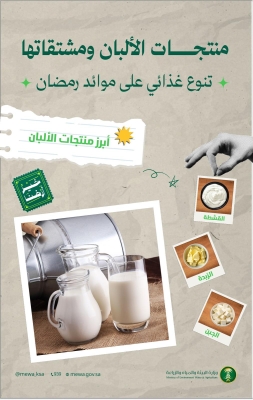
The Saudi Ministry of Environment, Water and Agriculture announced the readiness of the national dairy sector to meet increased demand during the holy month of Ramadan, confirming that daily production exceeds 2.75 million liters. This announcement underscores the strength of the Kingdom's food supply chains and its ability to achieve self-sufficiency in strategic commodities.
Enhancing food security in line with Vision 2030
This figure is not merely a passing statistic, but rather a reflection of the Kingdom's long-term strategic efforts within the framework of Vision 2030. The Ministry has worked to transform the agricultural and livestock sector into a highly efficient and sustainable industry. This massive production reinforces the concept of "food security," a matter of paramount importance to the leadership, especially during peak consumption seasons such as Ramadan. This ensures price stability and the availability of high-quality products for citizens and residents without complete reliance on imports.
"Our Land's Bounty" campaign and support for local products
As part of its ongoing awareness campaign under the slogan "The Bounty of Our Land," the Ministry explained that locally produced dairy products are characterized by a wide variety, including fresh milk, yogurt, cream, cheeses, and butter. This campaign aims to raise consumer awareness of the importance of choosing locally produced goods, not only for their high quality and reliable sources, but also for their pivotal role in supporting the local economy. Every purchase of locally produced goods directly benefits farmers and livestock breeders, thus stimulating continued production and sustainable agricultural development.
Nutritional and economic value
The ministry highlighted the health benefits of consuming dairy products during Ramadan, given their rich content of proteins, vitamins, and fluids essential for replenishing the body during Iftar and Suhoor. Economically, this abundant production contributes to reducing the Kingdom's import bill and strengthens the position of national companies, which are now competing globally in terms of quality and food safety standards, making reliance on local produce a strategic and national imperative.
-

 Local News 4 days ago
Saudi Arabia approves regulations for the continued presence of Gulf vehicles: duration and penalties
-
Local news two days ago
Jeddah Airport alerts for travelers due to airspace closure and flight disruptions
-
Local news one week ago
The Ministry of Interior begins procedures for a royal pardon for common law prisoners
-
Local News 6 days ago
The deadline for property registration in Hail and Riyadh is Thursday
-
Sports one week ago
Tickets for the Al-Ahli vs. Al-Hilal King's Cup match postponed: New date
-
Local News 7 days ago
Under the patronage of the Minister of Information, an agreement was signed between the Ministry of Information and Waves Marketing Company
-
Culture and Art 5 days ago
The Devil's Prisons series was halted: The full story of "The Emperor's" being moved to YouTube
-
Local news one week ago
Saleh Al-Maghamsi appointed Imam of the Prophet's Mosque: Details of the Royal Decree