
Local News
The transport of sensitive explosive materials in separate containers is prohibited
New amendments to the explosives system in Saudi Arabia to enhance security include the inclusion of PETN. Learn about the details and its impact on civil safety.


New amendments to the explosives system in Saudi Arabia
The Saudi Minister of Interior, Prince Abdulaziz bin Saud bin Nayef, issued a decision amending and adding articles to the executive regulations of the Explosives and Fireworks Law. This decision comes as part of ongoing efforts to enhance safety and security in the use of explosives for civilian purposes.
Inclusion of PETN material
The new amendment includes the chemical compound PETN among the types of explosives permitted for use in civil rock cutting. PETN is known for its high effectiveness and is widely used in numerous industrial applications worldwide.
Strict storage and transportation procedures
According to the amendment published in the Umm Al-Qura Gazette, the new instructions emphasize the necessity of storing PETN in a warehouse separate from other explosives. The instructions also prohibit the transport of this material with other highly sensitive explosives, such as detonators and fuses, unless they are separated according to the approved technical specifications for explosive ordnance transport vehicles.
Historical and political context
These amendments are part of Saudi Arabia's strategy to enhance security and public safety, particularly regarding the civilian use of hazardous materials. Historically, Saudi Arabia has prioritized establishing strict regulations to ensure the safe and responsible use of explosives and fireworks, thereby protecting lives and property.
Different points of view
Some experts believe that the inclusion of PETN reflects a trend toward updating regulations to keep pace with global technological advancements. Others, however, emphasize the importance of focusing on training and awareness to ensure the safe use of these materials.
The positive Saudi stance:
These amendments reflect Saudi Arabia's commitment to achieving a strategic balance between industrial development and ensuring public safety. The decision demonstrates Saudi Arabia's ability to adopt flexible policies that align with international standards without compromising national security.
Future challenges
As industrial and technological development continues, the Kingdom will face new challenges related to the management and use of hazardous materials. Therefore, efforts are expected to continue to strengthen legal and regulatory frameworks to ensure the safety of society and the environment.
in conclusion
The decision to amend the executive regulations of the Explosives Law represents a significant step towards enhancing safety and security in the use of explosive materials in the Kingdom of Saudi Arabia. This decision stands out as part of a comprehensive strategy aimed at achieving sustainable development while maintaining the highest levels of safety and public security.


Local News
Integrity Commission investigates major corruption cases in Saudi Arabia | Local News
The Oversight and Anti-Corruption Authority “Nazaha” announces the arrest of those involved in corruption, bribery and abuse of power cases worth millions of riyals, as part of the Kingdom’s efforts to promote transparency.
In a move reaffirming Saudi Arabia’s commitment to eradicating corruption and promoting transparency and integrity, the Oversight and Anti-Corruption Authority (Nazaha) announced that it has initiated several major criminal cases recently. These efforts are part of the comprehensive reforms underway in the Kingdom under Vision 2030, which prioritizes combating corruption to ensure an attractive investment environment, protect public funds, and achieve sustainable development. These periodic announcements from Nazaha are part of its transparency policy, keeping the public informed about its ongoing efforts to prosecute those who violate the law.
The official spokesperson for the Oversight and Anti-Corruption Authority stated that the Authority has initiated a number of criminal cases during the past period, and the necessary legal procedures are being completed against the perpetrators. The most prominent cases were as follows:
The first case: In cooperation with the Public Investment Fund, a resident working as a project manager in one of the Fund’s commercial entities was arrested for receiving (2,175,000) riyals from two citizens “who were arrested” who own a commercial entity and a resident working as an executive manager of another commercial entity “who was arrested” in exchange for awarding a project to renovate one of the company’s sites to one of the commercial entities, in addition to enabling the two commercial entities to obtain subcontract work in one of the projects.
The second case: An employee working in health affairs in one of the regions was arrested at the moment he received an amount of (500,000) riyals, in exchange for facilitating the qualification and awarding procedures for two projects in health affairs in the same region to one of the commercial entities with a total amount of (384,295,150) riyals. Through investigations it was proven that the total amount agreed upon was (10,000,000) riyals, of which he had previously received an amount of (4,500,000) riyals from the executive director of the commercial entity “who was arrested.” The first one handed over the amount to the director of engineering affairs, the assistant general manager of engineering affairs, and the head of the bids examination committee in the same health affairs “who were arrested.”
The third case: Three employees working in the Civil Status Department in one of the regions were arrested for receiving (850,000) riyals in installments from a citizen who was arrested in exchange for registering births and issuing national identity cards in an irregular manner.
The fourth case: In cooperation with the Ministry of Interior, a retired non-commissioned officer was arrested for embezzling (2,160,000) riyals from the funds seized in criminal cases during his time working at a police station in one of the governorates.
Fifth case: An employee working in the secretariat of one of the governorates was arrested at the moment he received the sum of (300,000) riyals out of an agreed sum of (800,000) riyals, in exchange for facilitating and completing the procedures for issuing licenses, organizational sketches and raw land in the same governorate.
Case Six: In cooperation with the Ministry of Interior, a non-commissioned officer working in the Civil Defense in one of the governorates was arrested for requesting sums of money from commercial entities in exchange for not issuing violations for their non-compliance with safety regulations.
Case Seven: In cooperation with the Ministry of Interior, a soldier working at a police station in one of the regions and two citizens were arrested for conspiring to steal (1,400,000) riyals from a resident.
Case Eight: An employee working in the secretariat of one of the regions was arrested for receiving an amount of (20,000) riyals from a citizen who was arrested in exchange for facilitating the procedures for awarding a project to construct and develop a building for one of the municipalities, as he was a member of the bids examination committee.
Case Nine: An employee working at the Ministry of Environment, Water and Agriculture and a resident were arrested for receiving sums of money from citizens in exchange for opening files and updating the eligibility for agricultural support for livestock by creating fake numbers for non-existent livestock.
Case Ten: An employee working at the municipality of one of the regions was arrested for receiving sums of money in exchange for issuing building permits and building completion certificates in an irregular manner, in cooperation with a resident who was arrested and who works for a contracting company.
Eleventh case: An employee working for the development authority of one of the regions was suspended for employing his wife in one of the companies contracted with his employer and for her receiving monthly salaries without her presence.
These issues are of paramount importance due to their direct impact on the trust of citizens and investors in state institutions. Prosecuting those involved in corruption cases, regardless of their positions, sends a powerful message that no one is above the law, thus strengthening the rule of law and reinforcing the principle of justice. Economically, these measures contribute to improving the business climate and attracting foreign investment, as transparency and the fight against corruption are among the most important criteria by which investors evaluate a country's environment.
The official spokesperson for the Authority confirmed that it continues to monitor and apprehend anyone who misappropriates public funds or exploits their position to achieve their personal interests or to harm the public interest, and will hold them accountable even after their relationship with the position ends, since financial and administrative corruption crimes do not lapse with time, and that the Authority is proceeding with the application of what the system stipulates against violators without leniency.
Local News
The General Entertainment Authority employs 68 graduates within the Happiness Makers program
The General Entertainment Authority celebrated the graduation of 68 young men and women from its training program that ends with employment, to supply the entertainment sector in Qiddiya and Jeddah with national talents in line with Vision 2030.
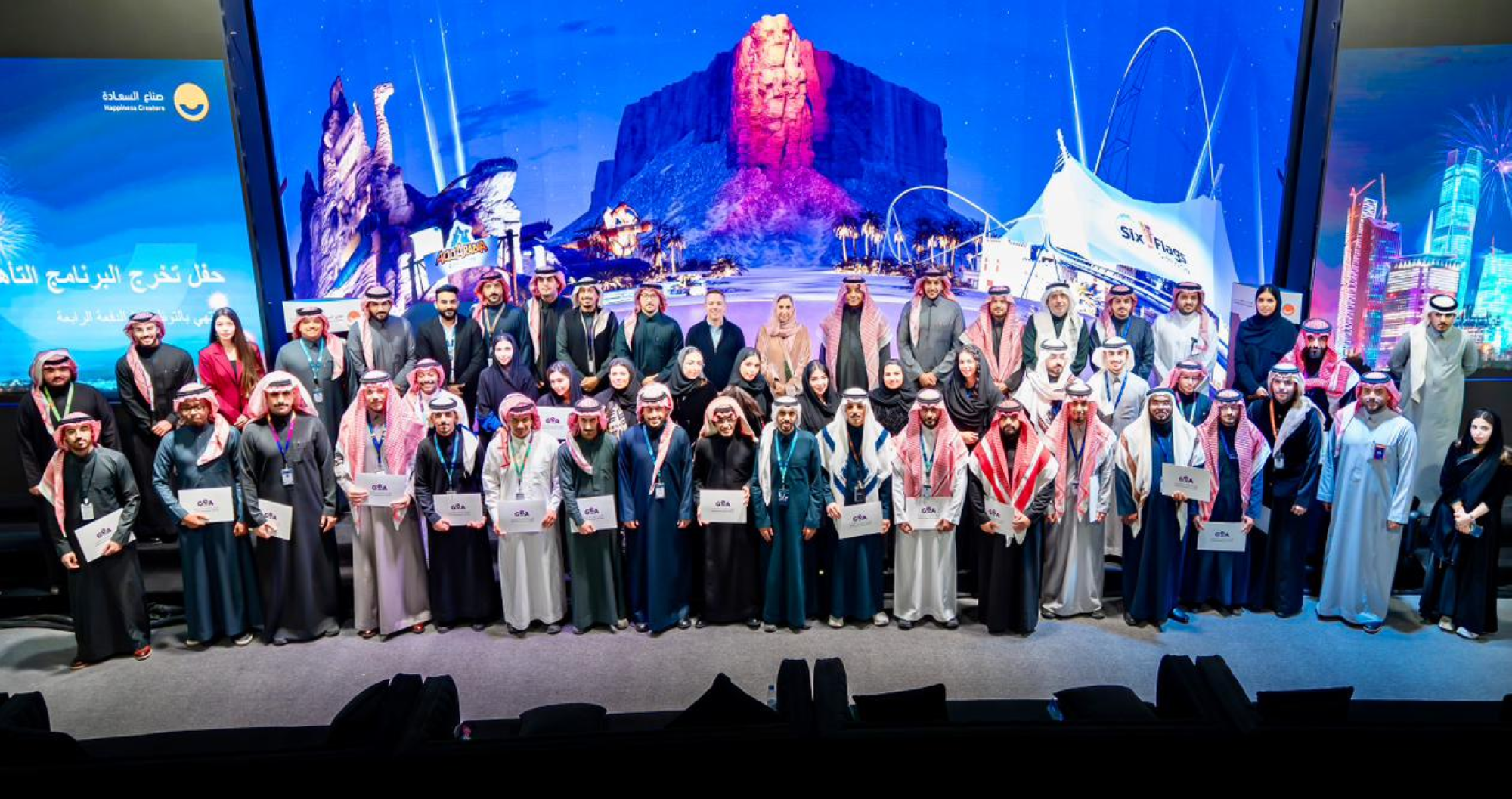
A new batch of national talents supports the promising entertainment sector
In a strategic move aimed at bolstering human capital in one of the most vital and rapidly growing sectors, the General Entertainment Authority celebrated the graduation of 68 students from its "Employment-Guidance Program" at two ceremonies held in Qiddiya and Jeddah. This achievement is part of the ambitious "Makers of Happiness" initiative, which translates into reality the goals of the Kingdom's Vision 2030, which seeks to localize jobs and build a national workforce capable of leading the future of the entertainment industry in Saudi Arabia.
Vision 2030 and the transformation of the entertainment industry
Since the launch of Vision 2030, the entertainment sector has undergone a radical transformation, evolving from a secondary sector to a cornerstone of the economic diversification strategy and a key driver for improving the quality of life for citizens and residents. In response, the General Entertainment Authority was established in 2016 to regulate and develop the sector, launching events and seasons that have attracted millions of visitors. With the launch of mega-projects such as Qiddiya, the Red Sea Project, and NEOM, the critical need for qualified and highly trained personnel, operating and managing these massive entertainment destinations according to the highest international standards, has become apparent—a need that the “Makers of Happiness” program aims to address.
Program details: Theoretical and practical training culminating in employment
Targeting young men and women aged 18 to 30 with high school diplomas or bachelor's degrees, the program is an innovative model of public-private partnership. For a full year, trainees undergo an intensive training program combining theoretical academic study with practical application in real-world work environments. The curriculum is designed to equip them with the professional and soft skills necessary to succeed in a sector that demands creativity and professionalism. Crucially, the program guarantees trainees permanent employment even before the training begins, providing job security and motivating them to achieve their full potential.
Graduation of 40 talents for the Qiddiya Global Project
Qiddiya, the future capital of entertainment, sports, and culture, celebrated the graduation of 40 students from the fourth cohort of its entertainment program. These graduates were immediately hired in permanent positions within the Qiddiya project, becoming part of the workforce that will operate one of the world's largest entertainment projects. In his address at the ceremony, Abdulaziz Al-Humaid, Executive Vice President of Human Capital at the General Entertainment Authority, emphasized that investing in human capital is fundamental to building a sustainable future for the entertainment sector, noting the Authority's commitment to empowering national talent and supplying the market with qualified professionals.
Ongoing support and strategic partnerships
The celebration wasn't limited to Qiddiya; it also included honoring 28 graduates in Jeddah, underscoring the program's nationwide reach and its commitment to meeting the needs of diverse regions. The program enjoys support from key entities such as the Technical and Vocational Training Corporation (TVTC), which awards graduates accredited certificates, and the Human Resources Development Fund (HRDF), which supports their career paths. This integration between government, educational, and private sector entities ensures the graduation of qualified professionals ready to enter the workforce and contribute effectively to the growth of the entertainment sector and the achievement of its ambitious goals.
Local News
Social Security: 12 billion riyals disbursed in pensions for February 2024
The Social Insurance Organization announced the disbursement of 12 billion riyals in pensions for the month of February, confirming its commitment to supporting the financial stability of retirees and strengthening the local economy.

The General Organization for Social Insurance (GOSI) announced the completion of the February pension payments for beneficiaries of the civil and military retirement and social insurance schemes, with the total amount deposited into the accounts of retirees and beneficiaries reaching approximately 12 billion Saudi riyals. This measure comes as part of GOSI's commitment to its obligations towards a broad segment of citizens who have dedicated their lives to serving the nation.
Historical background and the pivotal role of the institution
The General Organization for Social Insurance (GOSI) is the cornerstone of the social protection system in the Kingdom of Saudi Arabia. Since its establishment, it has worked to provide insurance coverage that guarantees citizens a dignified life after retirement, or in cases of disability or death. In recent years, GOSI has undergone significant structural development, most notably the merger with the Public Pension Agency (PPA). This strategic move aims to unify the insurance coverage for public and private sector employees, thereby enhancing operational efficiency and improving the quality of services provided to both subscribers and retirees.
The economic and social importance of pensions
The monthly injection of 12 billion riyals into the local economy is not merely a routine disbursement, but a significant economic driver. This cash flow enhances citizens' purchasing power, positively impacting market activity and the retail and service sectors. On a social level, these pensions provide a financial safety net for millions of Saudi families, ensuring their financial stability and meeting their basic needs, thus contributing to social stability and improving the quality of life for retirees and their families.
Alignment with the objectives of the Kingdom's Vision 2030
This commitment to directly disbursing pensions aligns with the goals of the Kingdom’s Vision 2030, specifically the “Vibrant Society” pillar. The Vision places great emphasis on improving the quality of life for citizens and providing them with the means for a dignified life at all stages. Ensuring the financial stability of retirees is an integral part of these objectives, reflecting the strength and resilience of the state’s financial system and its ability to fulfill its obligations to its citizens, thus reinforcing confidence in the Kingdom’s future development plans.
-
 Local news one week ago
Landslide in Riyadh: Details of the incident in Al-Sahafa neighborhood and containment efforts
-
 Local news one week ago
The death penalty was carried out against a citizen who stabbed another to death in Tabuk
-

 Culture and Art 7 days ago
Haifa Wehbe's absence in Riyadh: A photo crisis or a strained relationship with the media?
-

 Local news one week ago
First birth on the Riyadh train: A heartwarming story at Andalus station
-
 Local news one week ago
Riyadh collapse: Emergency plans to secure water after a main pipeline burst
-

 Culture and Art 7 days ago
City Kitchen series: A drama of conflict and the middle class during Ramadan
-

 Culture and Art 7 days ago
The series "Kasra": Dawood Hussein in a moving social drama this Ramadan
-
 Local News 6 days ago
Applying for the 1447 Opportunities Program for Teachers via the Fares System