Culture and Art
Mohammed Al-Qashami: I am not a writing contractor... and on Sundays I don't respond to anyone
The enlightened intellectual Muhammad bin Abdul-Razzaq has a friend in every city of our country, an impact in every newspaper, and knowledge and ties in every Arab nation

The enlightened intellectual Mohammed bin Abdul-Razzaq has a friend in every city of our country, a trace in every newspaper, and connections and ties in every Arab nation. When fate honored me with his acquaintance, I thought he was an employee of Aramco, for his time is dedicated to production, not consumption. When you meet him, your heart and mind open to a cultural and historical memory that long decades have failed to diminish—and how could they, when it is a memory of love, peace, and friendships with giants? Here is a conversation of memories and a contemporary reading, through which we delve into the soul of the noble (Abu Ya'rub), whose nickname has become more prominent than his given name. So, here is the text of the interview:
• Who are you still writing for?
•• A strange question that “did not answer,” as the singer Mohamed Abdel-Mottaleb said.
• What do you write?
•• In recent years, I have been writing about what I like from gifts given to me by friends.
Why do you care about shadow symbols?
•• My interest in the biographies of some pioneers under the title (Figures in the Shadows) stems from the fact that they are known only to a few, as they did not become famous in the media, but they have a voluntary role in society that cannot be forgotten or overlooked.
How many copies of this series have been published?
•• Three parts were published in the clubs of Al-Baha, Jazan and Al-Madinah, the fourth is with the Jeddah Literary Club, and the fifth is waiting for someone to request it for publication.
Don't you think there are people waiting to print for you?
•• I doubt that, due to the decline in the desire to publish and distribute, as everyone is preoccupied with modern means of communication.
What have you lost because of writing?
•• I lost many of my relationships with some acquaintances and dignitaries because they asked me to write about them or their relatives, and I say to them with all due respect, “I am not a contractor,” but a writer who cares about those who are known for serving their country and community and those I love.
• What if someone embarrasses you?
•• If you are embarrassed, I say: “I will write about you after your death!” and remind him of what the late Muhammad Ali Maghribi said in his book (The Notables of the Hijaz) when his friends pressed him, saying: “Why do you write about so-and-so’s father and not about my father?” He replied to them: “I write about notables, not about prominent figures.” Nevertheless, Maghribi stopped writing for years and returned after the storm had subsided and completed the four parts of his encyclopedia (The Notables of the Hijaz).
What if you couldn't find anyone to read your work?
•• I write for myself so that emptiness does not burn me and so that I do not turn, like others, to social media, which blinds, tires, damages and distracts. That is why I took a day off each week, which is Sunday, when I do not use the phone.
How many books have you published to date?
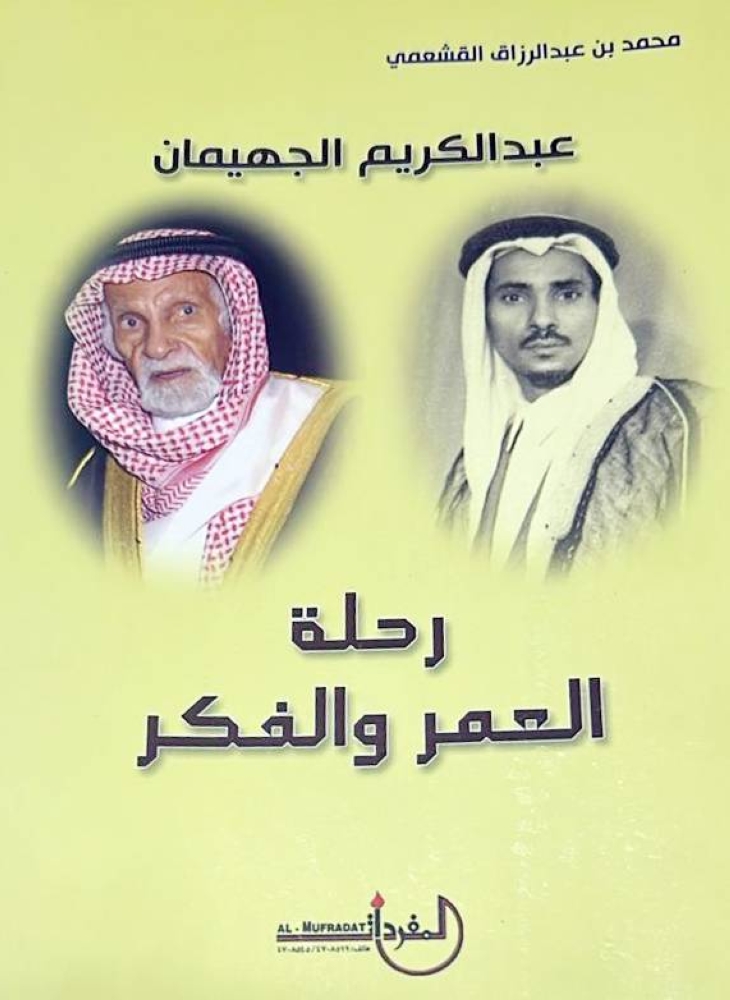
•• The last book that was published and arrived a few days ago from Jeddah dealt with the biography of my father (Sheikh Abdul Razzaq bin Muhammad Al-Qashami) and the artist Abdul Jabbar Al-Yahya, who is only known as a visual artist, but he is a poet and translator and the first to supervise a page for visual arts in Al-Madina newspaper 65 years ago. In a few days, during the International Book Fair, my book (One Hundred Years of Journalism) will be published by Dar Turath Al-Washm on the occasion of the 100th anniversary of the publication of Umm Al-Qura newspaper, and it was written on it as number 52 before the two previous books. With the fourth part of Figures in the Shadows, I have published 55 books so far, all of which are in the cultural history of journalism in its beginnings and biographies of pioneers and others.
When did you feel that enlightenment had triumphed over traditionalism?
I believe that limiting platforms to one group over another strengthens its presence, and when platforms are made available to the other group, people will have a choice, especially if they are able to distinguish between good and bad, and I believe that this era has favored the former over the latter, or almost.
What is your reading and writing system?
•• It is my habit to sleep early and wake up early, and at dawn I enter my home library from seven to ten, and from after the afternoon prayer until the evening prayer I spend between seven to eight hours daily between reading and writing, although I read ten times as much as I write. This has been my fixed program for seven years, and before that I used to spend the morning period at work before retirement.
• What is the secret of your close relationship with book fairs? •• The first fair I traveled to was the Sharjah Book Fair 40 years ago, and when I returned from it with what I had managed to acquire, I dedicated a room in my house to the library. From 1990 until now, I have continued to attend the Cairo International Book Fair and some Arab fairs at intermittent times, including Damascus, Beirut, Casablanca, and Dubai. After the Riyadh Book Fair became regular, it became somewhat sufficient for me, but the Cairo Book Fair remains the most tempting.
• Do you keep all the books you collected over the past 40 years?
•• Unfortunately, many of the books in my library were lost between theft and lending without guarantees.
Which cultural capital do you think has been forgotten?
Historically, I believe there are more than one capital that some have tried to convince us to forget, including Baghdad, Sana'a, and Fez, while Beirut had its own significance.
Do you believe in the saying, "Whoever is caught up in the craft of literature is caught up in poverty"?
•• I believe in the saying “stretch your legs according to your blanket,” and the profession of literature does not guarantee a decent life, but rather drains its lover and practitioner, but it is a drain of passion and love.
• How do you respond to someone who says, “You are living in luxury”? •• Who said I am living in luxury? What are the characteristics of someone living in luxury? During my time at the Ministry of Culture and Information, especially when my friends Dr. Abdulaziz Al-Sabil and Dr. Nasser Al-Hujailan took on responsibilities and tasks, they encouraged me by requesting that some books be provided at the cost of preparing and printing them. Now, I have decided to stop, given that literary clubs have taken on this role, although they have suffered a decline in funding and perhaps, as I hear, are breathing their last.
• Where did you acquire all this resilience and composure?
•• This is due to your good opinion and the love of people. Time is blessed if you do not waste it playing or using social media. I retired seven years ago and I rarely leave the house except when the traffic on the streets decreases on Fridays and Saturdays, and I go out for one errand, while I spend most of my time in the library and attending the distant but important events for me. As for friendships, thank God they remain, except for some who are sensitive and who are sometimes bothered by my frankness, and who keep asking when you will write about me
• What are the most prominent figures who have left a mark on your conscience?
•• The late father Abdulkarim Al-Juhaiman, whom I accompanied during the last 20 years of his life, may God have mercy on him, and about whom I published three books. I also remember my friend Dr. Yahya bin Junaid, who has been a friend for 50 years. He invited me to work at the King Fahd National Library after my retirement from working at the General Presidency for Youth Welfare. Dr. Yahya was the Secretary-General of the Library, and he obligated me to record the oral history of the Kingdom for 25 years, inviting pioneers and intellectuals to record with them in audio and video. Interviews were recorded with more than 400 personalities, and I wrote a book about that (My Experience with Oral History), which I dedicated to Dr. Yahya bin Junaid, and it was published by the Taif Literary Club.
• How did you become friends with the modernists when you are a classicist? •• I am friends, thank God, with everyone, and with all the good people from the first generation and the modernists. I consider myself like the athletes, a supporter, not a player.
• What is your impression of the cultural scene? •• The cultural scene reminds me of the page dedicated to Professors Ahmed and Abdul Rahman Al-Saeed in the Al-Qassim semi-monthly newspaper in 1960, which was titled “Intellectual Authorities.” To this day, I have not accepted or digested the replacement of literary clubs with cafes after a life that extended for half a century. We should evaluate their activity, judge them, and replace them with better ones, and the same applies to the cancellation of public libraries in the Kingdom.
• Who are the people you missed writing about? •• I did not write about many people for whom I could not find sufficient biographies or information, just as I did not write about (my mother) - may God have mercy on her - and no matter what I write, there are those who criticize for the most trivial reasons, including asking to write about his father or about him, and I can give them the numbers of those who write (biographies).
• Who gave you the nickname “Father of the Nation”? •• The late novelist Abdulaziz Mashri gave it to me when I visited him while he was hospitalized at King Faisal Specialist Hospital. He asked me to see Professor Abdulkarim Al-Juhaiman, and Al-Juhaiman welcomed us and we visited him (Al-Juhaiman, Abdullah Al-Abdulmohsen, and his wife, Dr. Nadia Al-Hawashim). I took a picture of us on the occasion, and Mashri thanked me and said: You are not just Abu Ya’rub, you are the Father of the Nation, and it became a proverb and was passed on by riders.
• Who is the intellectual who has not received his due? •• The one who does not "show off" at every location and occasion, who works without fanfare, and who is not appreciated by his community until after his departure, while favoritism and nepotism continue to have the fullest share.


Culture and Art
The truth about Yara El Sokary's injury on Ramez Level the Beast and her fiery response
Yara El Sokary denied being injured on Ramez Level El Wahsh, confirming that she enjoyed the episode. Read the details of her response to the rumors, behind-the-scenes details of her participation with Ramez Galal, and her philosophy on remaining silent.

Young Egyptian actress Yara El Sokary has put an end to the recent controversy circulating on social media, categorically denying that she suffered any physical injuries while filming her episode on the popular prank show "Ramez Level the Monster." El Sokary confirmed that the reports about her physical harm were completely false, noting that everything went smoothly despite the prank's difficulty.
Behind the scenes of the episode: "I was humiliated and I enjoyed myself."
In response to the rumors, Yara El Sokary clarified that the episode ended on a very positive note, saying, "There were no injuries. On the contrary, the episode finished and we were all sitting around laughing and making fun of things that happened." Describing her experience on the show, whose episode aired yesterday, she added, "I was a bit rough around the edges, but I enjoyed it. There were no injuries, contrary to what was reported in the news. Nothing happened." This statement reflects the artist's good sportsmanship and her acceptance of the show's nature, which relies on excitement and big surprises.
Prank shows: Wide popularity and ongoing controversy
Yara El Sokary's participation in "Ramez Level the Monster" comes within the context of Ramadan programs that enjoy record viewership in the Arab world. Ramez Galal's programs are a fixed annual phenomenon that generates as much controversy as it attracts viewers. These types of programs are usually characterized by physical and psychological challenges for the guests, making rumors of injury a recurring theme that plagues many celebrities after their episodes air. Despite the criticism that sometimes arises regarding the severity of the pranks, the appearance of artists on these shows is an indicator of their strong presence in the art scene, guaranteeing them a place on trending topics and search engines, thus enhancing their local and regional fame and popularity.
The philosophy of silence in the face of rumors
On another note, Yara El Sokary discussed her approach to dealing with the rumors that periodically circulate about her. During her appearance on the program "Secrets of the Stars" with journalist Inji Ali, she explained that the rumors no longer bother her; rather, she views them as evidence of her success and influential presence.
Al-Sukkari, expressing her maturity in dealing with social media, said, "I wasn't bothered by the rumors that circulated, and I said things were going well." She continued, explaining her philosophy: "I don't get upset by these things. I'm a patient person, and I always say, 'Give me some time, and everything will become clear.'" She emphasized that silence is her strongest weapon, adding, "I've always been calm, and I've never responded, but as I've grown older, I've learned more, and silence has never let me down. I deal with the noise with complete silence; there's strength in silence in some matters." This approach reflects an awareness of the importance of focusing on artistic work rather than getting caught up in digital squabbles.
Culture and Art
Yasmine Abdel Aziz attacks social media and reveals details of the series "We Forget What Was"
Yasmine Abdel Aziz describes social media as a destroyer of homes and reveals changes in her personality and details of her new series, "We Forget," which was scheduled to be shown in Ramadan 2026 with Karim Fahmy.

In bold statements reflecting a hidden aspect of the stars' suffering with the virtual world, Egyptian star Yasmine Abdel Aziz a scathing attack on social media platforms, describing them as "the worst thing in life," and considering that they have turned into a "tribulation" that has caused the destruction of homes and the ruin of human relationships.
Social media: A professional necessity and a psychological burden
During her recent interview with MBC Shahid, Yasmine didn't hesitate to express her deep dissatisfaction with the pervasive influence of social media on daily life. With her characteristic candor, she said, "Personally, I don't like it, but one has to deal with it for work." She added, with a hint of nostalgia, "I wish things could go back to the way they were.".
These statements come amid a growing global and local debate about the impact of social media on mental health and individual privacy, particularly for celebrities who find themselves constantly under scrutiny. Yasmine Abdel Aziz's remarks reflect a growing desire among a wide range of artists to reclaim the privacy that has been violated by smartphone cameras and hurtful comments, as separating personal and professional life has become a daily challenge for A-list stars.
Personal transformations: from excessive frankness to caution
On a personal level, Yasmine revealed new facets of her personality that have matured over time and through experience. In response to a question about trusting others, she confirmed that she no longer gives her trust as easily as she once did, saying, "Not anymore, it used to happen to me." She also explained that she has abandoned her previous "excessive frankness," preferring silence and careful word choice to avoid problems and misunderstandings.
Regarding the artistic work, Yasmine described the experience of absolute stardom as "sweet and beautiful," while emphasizing the importance of artistic "chemistry" among the team, as she described working with friends as a unique experience that allows for quick understanding and the exchange of ideas, which is reflected positively on the quality of the final artistic work.
Ramadan 2026 marathon and the series "We Forget What Was"
Artistically, Yasmine Abdel Aziz continues her intensive preparations for the Ramadan 2026 drama season with her new series, "We Forget What Was ." This work is considered one of the most anticipated, given Yasmine's immense popularity in the Arab world and her ability to present works that blend social drama with human touches.
The series boasts a stellar cast, reflecting the scale of the production. Alongside Yasmine Abdel Aziz, the cast includes Karim Fahmy, Sherine Reda, Menna Fadali, Khaled Sarhan, Edward, Mohamed Lotfy, Mahmoud Hafez, Elham Wagdy, Cynthia Khalifeh, Lina Sofia, Laila Ezz El Arab, Dareen Haddad, Yara Kassem, Mahmoud Azab, Ahmed El Tohamy, Omar Sharqi, Asmaa Suleiman, Gihan Khairy, and Aya Abdel Razek. Written by the acclaimed writer Amr Mahmoud Yassin and directed by Mohamed El Khibiri, the series promises a strong drama season and fierce competition.
Culture and Art
Filming has wrapped on the series "Al-Set Mona Lisa" starring Mai Omar: Full details
Writer Mohamed Sayed Bashir announced the completion of filming for the series "Al-Set Mona Lisa." Learn more about the project, the cast led by Mai Omar, and the plot of the 15-episode series.

Egyptian writer and screenwriter Mohamed Sayed Bashir officially announced the end of filming for the series “Al-Sit Mona Lisa”, bringing to a close one of the anticipated dramas that brings together a selection of Egyptian drama stars, after an intensive period of work that lasted for several months in different filming locations.
The moment of "breaking up" and celebrating the end
Author Mohamed Sayed Bashir shared a behind-the-scenes photo from the final day of filming on his official social media accounts, expressing his joy at completing the project. Bashir captioned the photo, "Thanks to God's grace and generosity, the series 'Mona Lisa' has wrapped," a common expression in the artistic community to announce the completion of all scenes and the entry of the final editing and mixing stages in preparation for broadcast.
List of the series' cast and crew
The series "Al-Set Mona Lisa" boasts a distinguished cast of stars, blending experience and youth. Leading the cast is Mai Omar, alongside Ahmed Magdy, Injy El Mokaddem, the veteran actress Sawsan Badr, Wafaa Amer, and the comedian Shaimaa Seif, among others. The series is written by Mohamed Sayed Bashir and directed by the acclaimed director Mohamed Ali, who has a long and successful track record of television dramas.
The phenomenon of 15-episode series
The series "Al-Sit Mona Lisa" belongs to the genre of 15-episode dramas, a format that has come to dominate the Egyptian and Arab drama market in recent years, both during Ramadan and outside of it (off-season). This trend comes in response to changing viewing habits among audiences, who now prefer fast-paced, action-packed series free of drawn-out scenes and unnecessary embellishments. This is precisely what these types of shows offer, often streamed on modern digital platforms and achieving high viewership ratings.
A suspenseful social framework
The series unfolds within a suspenseful social framework, a widely popular dramatic genre that blends human issues and complex social relationships with elements of mystery and intrigue. It is expected to generate significant buzz upon its release, given the immense popularity of its stars, particularly Mai Omar, who has achieved consecutive successes in recent drama seasons, leaving audiences eagerly anticipating her new dramatic role as "Mona Lisa.".
-

 Local News 4 days ago
Saudi Arabia approves regulations for the continued presence of Gulf vehicles: duration and penalties
-
Local news two days ago
Jeddah Airport alerts for travelers due to airspace closure and flight disruptions
-
Local news one week ago
The Ministry of Interior begins procedures for a royal pardon for common law prisoners
-
Local News 6 days ago
The deadline for property registration in Hail and Riyadh is Thursday
-
Sports one week ago
Tickets for the Al-Ahli vs. Al-Hilal King's Cup match postponed: New date
-
Local News 7 days ago
Under the patronage of the Minister of Information, an agreement was signed between the Ministry of Information and Waves Marketing Company
-
Culture and Art 5 days ago
The Devil's Prisons series was halted: The full story of "The Emperor's" being moved to YouTube
-
Local news one week ago
Saleh Al-Maghamsi appointed Imam of the Prophet's Mosque: Details of the Royal Decree