Culture and Art
The King Salman Global Complex opens a program to celebrate World Arabic Language Day at the United Nations headquarters
Under the patronage of the Minister of Culture and Chairman of the Board of Trustees of the King Salman Global Academy for the Arabic Language, Prince Badr bin Abdullah bin Farhan, the

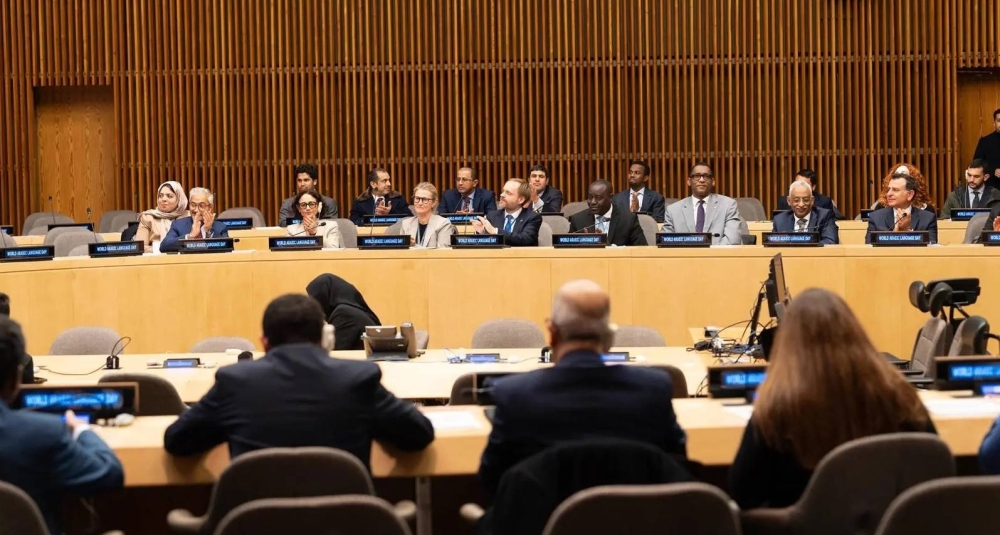
Under the patronage of the Minister of Culture and Chairman of the Board of Trustees of the King Salman Global Academy for the Arabic Language, Prince Badr bin Abdullah bin Farhan, the Academy inaugurated at the United Nations headquarters in New York the program (Celebrating the International Day of the Arabic Language 2024), and the accompanying exhibition, in cooperation with the Permanent Mission of the Kingdom of Saudi Arabia to the United Nations, and its slogan: (The Arabic Language and Artificial Intelligence: Promoting Innovation while Preserving Cultural Heritage).
The celebration began with a speech by the Secretary-General of the Academy, Professor Dr. Abdullah bin Saleh Al-Washmi, in which he pointed out that our country, the Kingdom of Saudi Arabia - within its Vision 2030, and the efforts of its leadership, and based on the fact that it is the land from which the Arabic language emerged, and in which the Holy Quran was revealed - is making great efforts that reflect its constant interest in supporting the Arabic language globally, as it is an integral part of our cultural identity, and that the slogan of this year’s celebration reflects the growing global awareness of the value of the Arabic language, not only as an ancient language whose roots extend back centuries, but also as a vital tool that keeps pace with technological progress and contributes to shaping the future of human creativity.
Dr. Al-Washmi pointed out that the Academy is a leading institution that seeks to enhance the status of the Arabic language, and develop methods for teaching and disseminating it locally and internationally. It operates in more than (60) countries, and carries out serious scientific studies with experts, scholars, universities and organizations, and supports translation, Arabization and educational platforms, and strives to support Arabic language students from around the world, and implements training courses and Arabic language months, and integrates language with culture in language exhibitions, awards, competitions, educational songs, dictionaries and policies.
The complex is actively pursuing digital blogging, computational linguistics, digital dictionaries, computerized language laboratories, and large-scale linguistic models.
On this occasion, the Ambassador and Permanent Representative of the Kingdom of Saudi Arabia to the United Nations, Dr. Abdulaziz Al-Wasil, delivered a speech in which he pointed out that languages are among the most important indicators of the development and prosperity of nations, and are the main pillar in building the identity of societies; and that the Arabic language is one of the most prominent languages that carries a wide cultural richness and a long historical depth.
He pointed to the need for integrated efforts between scientists and innovators to balance preserving Arab cultural heritage and promoting innovation through artificial intelligence to ensure that these technologies are utilized in the field of the Arabic language.
He also explained that the Arabic language has become a communication tool within the United Nations since the General Assembly made its historic decision in 1973 to make Arabic one of the six official languages of the organization.
The opening of the celebration program was attended by a group of high-level diplomatic figures, and the opening session was attended by the Under-Secretary-General for General Assembly and Conference Affairs, the Coordinator for Multilingual Affairs at the United Nations, the Deputy Chief of Staff of the Office of the President of the General Assembly, the Ambassador and Permanent Representative of the Kingdom of Saudi Arabia to the United Nations, the Deputy Permanent Observer of the League of Arab States to the United Nations, and the Secretary-General of the Assembly.
The celebration included a focused panel discussion entitled: (Arabic Translation in the United Nations), enriched by a select group of international experts and specialists, and the opening of an Arabic language exhibition inside the organization’s headquarters to showcase its arts and aesthetics.
As part of the program, a three-day virtual course will be held for the organization’s staff, entitled: (Arabic Translation Skills for Diplomatic Purposes). It aims to introduce speakers to the literature and mechanisms of translation for diplomatic purposes, and to train them to practice and master it and know its terminology.
It is worth mentioning in this context that holding the celebration of the International Day of the Arabic Language for the fourth year in a row comes within the Academy’s efforts to support the presence of the Arabic language in international organizations, and falls within the series of activities it organizes to confirm the Kingdom of Saudi Arabia’s commitment to supporting the Arabic language and introducing its cultural and scientific richness.


Culture and Art
The death of Reda El Bahrawy's mother and details of her funeral in Tanta
Artist Reda El Bahrawy announced the death of his mother after a battle with illness. Details regarding the date and location of the funeral and memorial service in Tanta have been released, amidst great sorrow from his fans and the artistic community.
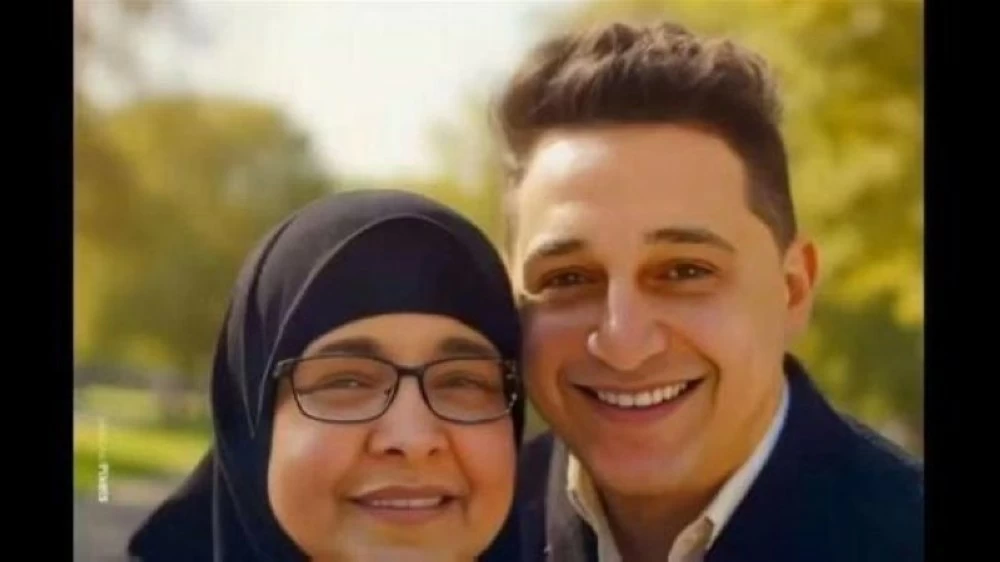
In news that saddened his fans and the artistic community, popular singer Reda El Bahrawy announced the passing of his mother this morning, Tuesday, after a long battle with illness. El Bahrawy shared the heartbreaking news with his fans on his official social media accounts, sparking a wave of condolences and prayers for the deceased and for the artist and his family.
A moving obituary, funeral details, and condolences
In poignant words reflecting the depth of his loss, Reda El Bahrawy mourned his mother, saying, "To God we belong and to Him we shall return. My mother is in God's care… May God have mercy on you, my mother, and make your grave a garden of Paradise, and reunite us with you in the Gardens of Bliss. Please pray for her mercy and forgiveness." El Bahrawy also revealed details of the funeral arrangements, stating that the funeral prayer for the deceased will be held after the noon prayer on Tuesday at the Awara Mosque in Tanta, his hometown, to which he was always deeply attached.
The artist also announced that condolences for his mother will be received tomorrow, Wednesday, in the city of Tanta, in the presence of family, friends and close relatives, so that her fans and relatives can offer their condolences and sympathy for their great loss.
Background about the artist and his career
Reda El Bahrawy is considered one of the most prominent stars of popular Egyptian music in recent years. He launched his career in Tanta, Gharbia Governorate, and with his powerful voice and distinctive performance style, he has built a wide fan base. He is known for his unique blend of authentic Egyptian folk music and modern "festival" rhythms, making him a regular guest at social events and weddings throughout Egypt. His songs, such as "Ibn Dami" (My Blood Son) and "Ana El Malek" (I Am the King), have garnered millions of views on platforms like YouTube, cementing his position as one of the most important voices in his field.
A long struggle with illness and the impact of loss
The late artist's mother had been suffering from a severe health crisis recently, which led to a significant deterioration in her condition, requiring her transfer to intensive care several times for treatment. Despite the doctors' efforts and continuous monitoring, she passed away due to complications from her illness. Bahrawi was always known for his deep bond with his mother and family, which explains the profound grief he is experiencing, reflected in the outpouring of support from his fans who rushed to offer their condolences through thousands of comments and messages.
This event represents a sad turning point in the artist's personal life, and he is expected to step away from the spotlight and artistic activity for a while to mourn his mother, while waiting to overcome this ordeal with the support of his family and fans.
Culture and Art
Nermin El-Feky in the series "Awlad El-Ra'i" (Sons of the Shepherd) Ramadan 2026 | A new role
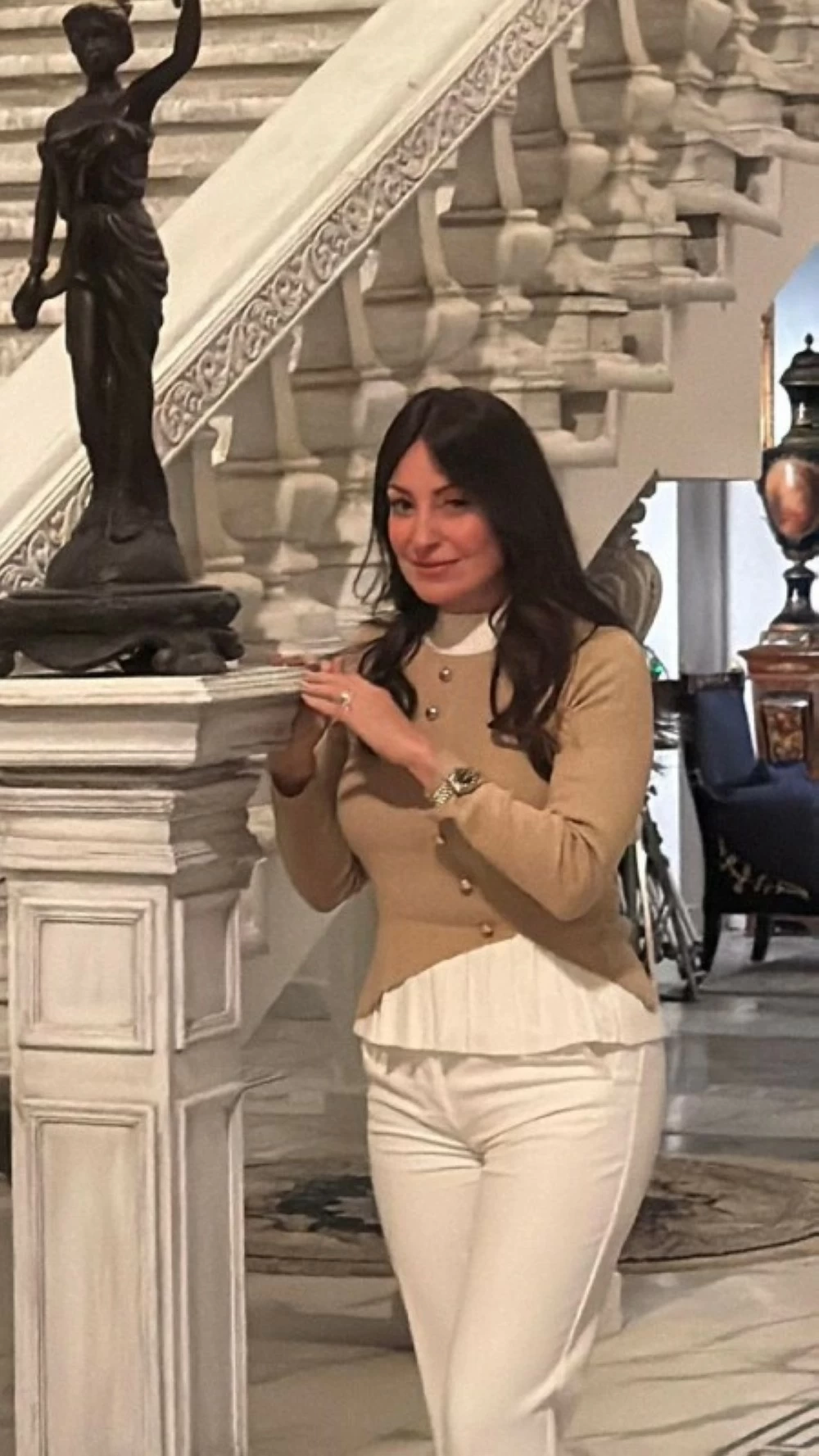
Actress Nermin El-Feky is preparing for the Ramadan 2026 drama season with the series “Awlad El-Ra’i” (The Shepherd’s Sons) with Khaled El-Sawy, where she portrays a mysterious and conflict-driven character in a highly anticipated suspenseful work.
A strong comeback for the Egyptian drama star
The brilliant Egyptian actress Nermin El-Feky is preparing to return to the small screen through a huge drama series entitled “The Shepherd’s Sons,” which is scheduled to compete strongly in the Ramadan drama season of 2026. This participation confirms El-Feky’s strong artistic presence, as she embarks on a new experience in which she embodies an unconventional character, which is expected to be the cornerstone in the escalation of the series’ events.
General context: The importance of the Ramadan drama season
The Ramadan drama season in the Arab world is considered the most prominent annual artistic event, with major production companies and the brightest stars competing to present works that attract viewers. In this competitive context, an actor's selection for a pivotal role in a series airing during this month is a testament to their stardom and influence. Nermin El-Feky's participation in "Awlad El-Ra'i" (The Shepherd's Sons) places it among the most anticipated works, given her distinguished artistic history of roles and the success of her last work, "Muharib" (Warrior), which aired in Ramadan 2024.
Mysterious and plot-driven character details
In "The Shepherd's Sons," Nermin El-Feky delivers a pivotal and complex performance as the wife of Moussa the shepherd, played by the esteemed actor Khaled El-Sawy. Her role transcends that of the protagonist's wife; she is a character with enigmatic psychological dimensions, playing a key part in igniting the familial and social conflicts that define the series, propelling the plot down paths of suspense and intrigue.
An artistic challenge amidst a constellation of stars
Nermin El-Feky expressed her great enthusiasm for this role, emphasizing that it represents a new artistic challenge in her career and allows her to explore different acting territories. This challenge is amplified by the presence of a constellation of the most prominent stars of Egyptian and Arab drama, including Khaled El-Sawy, Maged El-Masry, Ahmed Eid, Ehab Fahmy, and the Algerian star Amal Bouchoucha, in addition to the veteran actress Fadia Abdel Ghani. This large artistic gathering promises strong acting competition on screen, which will raise the overall quality of the production.
A huge production and a captivating story
The series "The Shepherd's Sons" belongs to the genre of social thrillers and consists of 30 episodes. A professional team is behind this production, with the story written by Raymond Makar, and the screenplay and dialogue penned by a writing workshop including Mina Babawi, Mahmoud Shukri, Khaled Shukri, and Taha Zaghloul. Mahmoud Kamel directs the series. It is a co-production between Funoon Misr and the United Media Services Company, ensuring all necessary resources are available to deliver a high-quality production in terms of both visuals and overall production.
Expected impact and regional repercussions
The series is expected to achieve great success not only in Egypt but also throughout the Arab world. The presence of stars from various Arab nationalities and a storyline based on suspense and profound human conflicts make it capable of attracting a wide audience. The show is also expected to spark extensive discussions on social media platforms regarding Nermin El-Feky's performance and her new character, making it one of the highlights of Ramadan 2026 dramas.
Culture and Art
The Dictionary of Paradise: A new collection of poems by Muhammad Hamida at the book fair
Poet Mohamed Hamida is releasing his new collection of poems, "The Dictionary of Paradise," written in Egyptian colloquial Arabic, at the Cairo International Book Fair. The collection includes 39 poems and presents a philosophical vision of love and existence.

Amidst the cultural events of the Cairo International Book Fair, one of the most prominent cultural gatherings in the Arab world, Egyptian poet and journalist Mohamed Hamida released his new poetry collection, "The Dictionary of Paradise." Published by Shams Publishing and Media Foundation, this work adds a new dimension to the literary scene, blending profound experience with the beauty of Egyptian colloquial Arabic.
Cultural context and the importance of the event
The Cairo International Book Fair, first launched in 1969, is a major platform for writers, publishers, and intellectuals in the Middle East. Launching a new literary work during its events grants it significant media and public attention, placing it at the heart of the annual cultural debate. The poetry collection "Dictionary of Paradise" comes within this context, offering readers a new poetic experience within the tradition of Egyptian colloquial poetry, which has deep roots in the popular consciousness and was championed by great poets such as Salah Jahin and Ahmed Fouad Negm.
A critical reading of "The Dictionary of Paradise"
The collection, the poet's fifth, comprises 39 poems written in Egyptian colloquial Arabic. It received critical attention from art critic Dr. Rehab El-Din El-Hawary, who praised Hamida's poetic language, describing it as "refined colloquial Arabic" whose structures approach classical Arabic while retaining the warmth and intimacy of the Egyptian vernacular. El-Hawary noted that the poet begins his collection with the duality of "book/dictionary" in the poem "The Book Was in My Right Hand," lending the poem a special sanctity and making love a framework that blends dreamy romanticism with mystical symbolism.
Style and internal music
Al-Hawari explained that Hamida's poems rely on a quiet "inner music" that avoids harsh rhyme, making the texts seem like a sincere and spontaneous outpouring of emotion. The poet successfully condensed entire narrative stories, using vocabulary that reflects the stages of human experience, from "beginning" and "dream" to "challenge" and "anxiety," culminating in "surrender to beauty." He also used nature and its elements (trees, fruit, trunks) as a mirror reflecting human emotions, highlighting his ability to adapt colloquial language to serve the profound philosophical meanings of love and existence.
Poetic images and existential questions
The critic noted the collection's richness in visual imagery and the technique of "anthropomorphizing inanimate objects," where streets and doors become sentient beings that feel and move, as in the line: "All the streets in winter lean against the walls." He described this opening as brilliant because it captures a state of "need for warmth" and support. Al-Hawari also delved into the profound existential questions and pain in Hamida's texts, particularly in the poem "Our Neighborhood's Children Don't Sleep," where the poet asks: "And how can the winter night sleep in the arms of naked children?" This brings the text to a peak of anguish, evoking feelings of fear and pity in the reader.
The writer's journey
It is worth mentioning that the poet Mohamed Hamida has several previous publications that varied between poetry, research and travel literature, including the poetry collection “The Homeland’s Garment is Engraved with the Blood of the Poplar” (2011), the research book “The Sacred Killing” (2015), the poetry collection “A Night Dreaming of Solace” (2016), and the book “Cairo/Marrakech – A Journalistic Journey to the Atlas Mountains” (2025), which reflects a rich and diverse literary career.
-

 Reports 5 days ago
Achievements of Saudi government sectors in 2025
-
Local news two weeks ago
FDA warns of contaminated Nestle infant formula | Recall details
-
Technology 4 weeks ago
Artificial intelligence regulations in Saudi education and student data protection
-
Technology 4 weeks ago
US ban on drones: reasons and consequences
-
Technology 4 weeks ago
SRMG and Snapchat partnership: The future of digital media in the Middle East
-
Technology 4 weeks ago
Saudi Arabia's Ministry of Islamic Affairs is employing artificial intelligence in public speaking
-
Sports 4 weeks ago
Salah leads Egypt to a thrilling comeback against Zimbabwe in the Africa Cup of Nations
-
Sports 4 weeks ago
Napoli win the Italian Super Cup in Riyadh for the third time (2025)