
Culture and Art
Hani Mehanna: The truth about Halim and Souad's marriage and my assessment of Sherine and Amr Diab
Musician Hani Mehanna reveals the behind-the-scenes details of his relationship with Sherine Abdel Wahab, presents his vision of Amr Diab's career, and puts an end to the controversy surrounding the marriage of Abdel Halim Hafez and Souad Hosny.

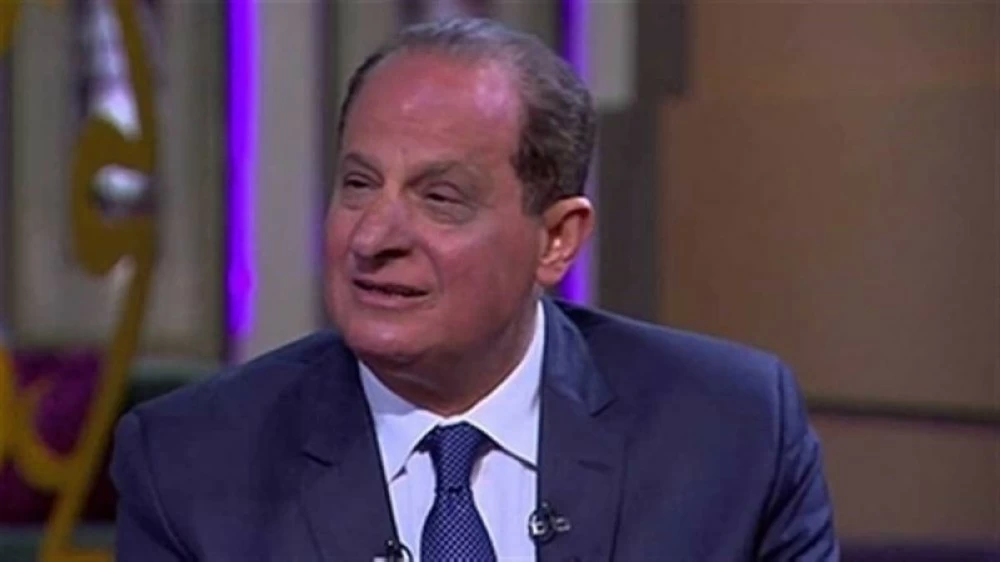
Controversial statements by musician Hani Mehanna
In a frank and bold interview, the great Egyptian musician Hani Mehanna opened his box of artistic and personal secrets, revealing behind-the-scenes details of his meetings with singing stars in Egypt, and presenting his vision that sparked widespread controversy regarding the career of artist Sherine Abdel Wahab, and the phenomenon of Amr Diab, in addition to settling one of the most famous romantic stories in the history of Arab art, which is the relationship of the dark-skinned nightingale Abdel Halim Hafez with the Cinderella Souad Hosny.
Sherine Abdel Wahab: A genuine popular voice and a turning point
Mohanna reminisced about his first meeting with the artist Sherine Abdel Wahab, admitting that he was surprised by the power of her voice and the sincerity of her innate emotion. Despite this initial fascination, Mohanna stated that he did not see Sherine as a singer in the classical sense. During his interview with journalist Yasmine Ezz on the program "Kalam El Nas" (People's Talk), he explained: "I told Sherine frankly that she wasn't suited to being a singer in the traditional sense, and that popular music was the broader field in which she could truly shine." Mohanna attributed his opinion to the nature of her powerful and direct voice, which possesses a unique ability to easily touch the hearts of a wide audience, a characteristic that distinguishes Egyptian popular music.
He noted that the song "Garh Tani" (Another Wound) was a pivotal turning point in her career, solidifying her artistic identity and opening the doors to stardom wide for her. He emphasized that her strong artistic personality and commanding presence contributed to the widespread popularity of her work, making her one of the most important female voices in Egypt and the Arab world over the last two decades.
Amr Diab: Exceptional artistic intelligence reminiscent of Abdel Halim
In his assessment of Amr Diab's career, Mohanna expressed his deep appreciation for him, describing him as one of the most important figures in contemporary music and the owner of a unique artistic experience that has remained at the forefront of the scene for decades. However, he surprised many by saying, "Amr Diab reminds me of Abdel Halim Hafez, even though he's not a singer." Mohanna explained his view by saying that Diab possesses exceptional artistic intelligence that compensates for any artistic shortcomings, just as Abdel Halim Hafez did. He added, "He's very clever; he fills in a singer's artistic deficiencies with his intelligence, and he's one of those stars who have a long life.".
He explained that his concept of a "singer" is linked to the ability to improvise and deliver pure, captivating music, something he believes Amr Diab embodies with intelligence and a well-thought-out approach, rather than relying on traditional methods. He emphasized that this doesn't diminish Diab's value; on the contrary, it highlights his profound understanding of the tools for success and his rare ability to innovate and keep pace with the times, making him a natural continuation of the school of great masters, but with his own unique style.
The truth about the marriage of Abdel Halim Hafez and Souad Hosny: The doctor had his say
Hani Mehanna addressed one of the most controversial issues in the history of Egyptian art: the truth about the marriage of Abdel Halim Hafez and Soad Hosny. Mehanna categorically denied the rumors confirming their marriage, stating, "Abdel Halim and Soad Hosny had a love affair, but they did not marry." He revealed the real reason behind the marriage not taking place, explaining, "The doctor forbade Abdel Halim from marrying due to his health condition.".
Muhanna's statement adds a new dimension to this story that has captivated public opinion for decades. It is well known that Abdel Halim Hafez suffered throughout his life from schistosomiasis and its serious complications, which significantly impacted his personal life and decisions. Muhanna's testimony, as someone close to many stars of that era, confirms that the Nightingale's critical health condition was the primary obstacle to his formal marriage to the woman he loved, leaving their love story as one of the most famous unfulfilled romances in Arab memory.


Culture and Art
Safia Binzagr's painting "City Road Cafe" sold for a record price
The painting “City Road Cafe” by pioneering Saudi artist Safia Binzagr was sold for 7.7 million riyals at a Sotheby’s auction, setting a record that reflects the global value of Saudi art.
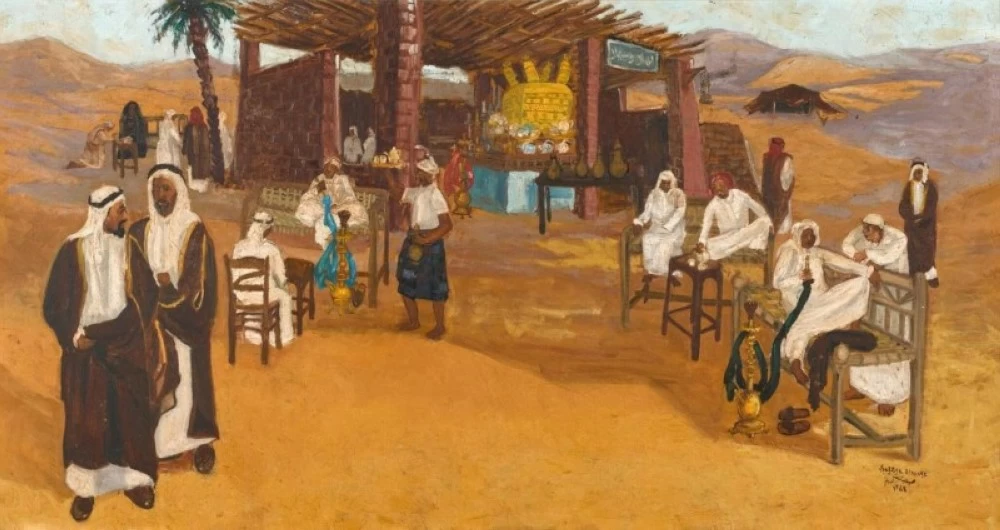
In a landmark art event, the painting “Café on City Road” by pioneering Saudi artist Safia Binzagr sold for an exceptional sum of US$2,063,000, equivalent to SAR 7.736 million. This historic sale took place during the Origins II auction held by Sotheby’s in the heart of historic Diriyah, setting a new record for the late artist’s work and underscoring the growing global significance of modern Saudi art.
A window into Jeddah's rich past
Safia Binzagr's 1968 painting, "A Café on a City Road," is more than just a work of art; it's a rare visual document of social life in Jeddah during the mid-20th century. Through her brushstrokes, she captured the intricate details of daily life during that era, from men gathering in traditional cafés to the features of traditional Hijazi architecture, offering a vivid glimpse into a rapidly changing social and cultural fabric. The work authentically reflects the spirit of that transitional period in the Kingdom's history, as modernity began to blend with the rich traditions of the past.
Safia Binzagr: A pioneer in documenting heritage
Safia Binzagr was more than just an artist; she was a visual historian who dedicated her illustrious career to preserving Saudi heritage, particularly that of the Hijaz region. At a time when the Kingdom was experiencing tremendous development, Binzagr recognized the importance of documenting customs, traditions, fashions, and everyday life that were threatened with extinction. This pioneering artist passed away, leaving behind a rich artistic legacy that has become an integral part of the Kingdom's cultural memory and a shining creative mark on the local and Arab art scene.
The importance of the event and its impact on the art scene
This auction transcends a mere commercial transaction, representing international recognition of the importance and stature of Saudi art. Holding an auction by the prestigious Sotheby's in Diriyah, a city of historical significance to the Kingdom, reflects the cultural openness the country is experiencing under Vision 2030, which aims to bolster the culture and arts sector. The high price achieved by the painting places the works of pioneering Saudi artists on the global art map, encouraging increased interest from international museums and collectors, and raising the overall market value of Saudi art, thus benefiting a new generation of artists.
A lasting legacy: Safia Binzagr House
As a culmination of her decades-long career, the late artist established the Safia Binzagr Foundation in 1995, a unique cultural institution that serves as a permanent museum for her artwork and collection, in addition to housing her studio and private library. In 2000, she published her book, "A Journey of Three Decades with Saudi Heritage," in which she outlined the Foundation's objectives and its mission to preserve heritage in an aesthetically pleasing and constructive manner for future generations, ensuring that her legacy continues to inspire artists and researchers even after her passing.
Culture and Art
Hani Mehanna is under investigation for his controversial statements about Umm Kulthum
The Federation of Artistic Syndicates referred musician Hani Mehanna for investigation after statements deemed offensive to the legendary singer Umm Kulthum and her national role after the 1967 defeat.
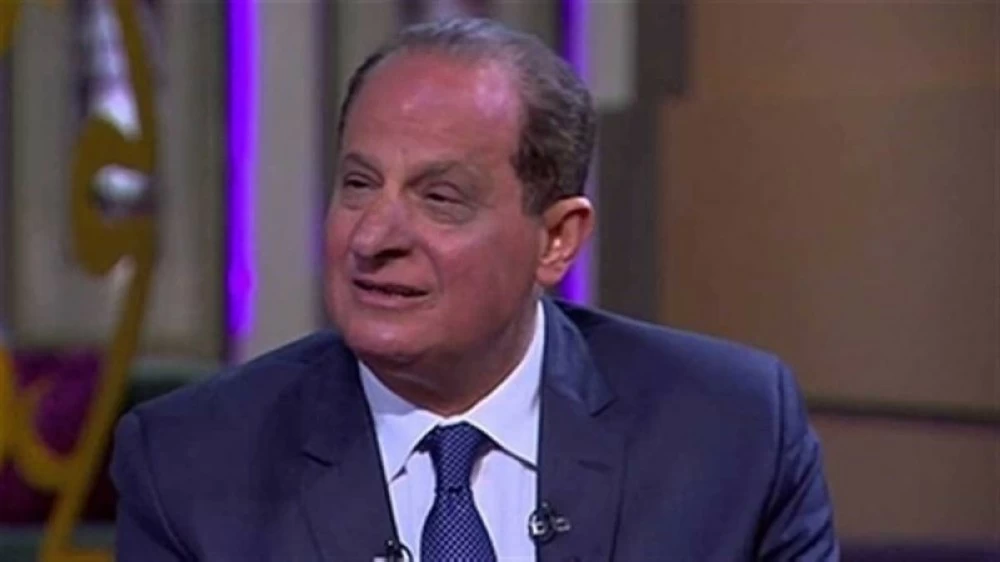
Musician Hani Mehanna sparked controversy after recent television remarks in which he discussed aspects of the life of the legendary singer Umm Kulthum, prompting the General Union of Artistic Syndicates in Egypt to refer him for immediate investigation. The union described Mehanna's statements as "an affront and an insult to the icons of Egyptian art," emphasizing the need to preserve the legacy of artistic figures who have shaped the nation's conscience.
The crisis began when Hani Mehanna stated in an interview that Umm Kulthum was "bankrupt" in the period following the 1967 defeat, and that the Egyptian state, under the direction of the late President Gamal Abdel Nasser, was organizing her famous concerts abroad to raise funds for the war effort. Mehanna indicated that these concerts were not her personal initiative but rather an official commission, which many considered a belittling of the great national role that the "Star of the East" played voluntarily.
The historical context of Umm Kulthum's national role
Umm Kulthum, nicknamed "The Star of the East" and "The Lady of Arab Song," is a cultural and national icon whose stature extends far beyond her exceptional singing talent. Following the defeat of June 1967, Umm Kulthum undertook a historic initiative, touring Arab and Western capitals, from Paris to Khartoum and from Beirut to Tripoli, to perform massive concerts, all proceeds of which were dedicated to supporting the Egyptian treasury and the war effort. She succeeded in raising millions of Egyptian pounds in a patriotic gesture that remains etched in the memory of Egyptians and Arabs alike, as her concerts transformed into artistic and political demonstrations of support for Egypt. Therefore, portraying this role as merely a response to an official directive misses the essence of this historic initiative.
The importance of the event and its expected impact
The significance of this incident lies in its reopening of the debate surrounding the portrayal of national and historical figures. The decision by the Federation of Artistic Syndicates to investigate Hani Mehanna is not merely aimed at holding him accountable, but also sends a clear message that tampering with the legacy of major artistic figures is a red line. Figures like Umm Kulthum, Abdel Wahab, and Abdel Halim Hafez are considered part of the national heritage, and any attempt to distort their image or diminish their achievements provokes widespread public and union outrage. This investigation is expected to lead to stricter regulations governing statements made by artists about their deceased colleagues, especially those who represent pivotal moments in the history of Egyptian and Arab art.
Culture and Art
Amr Saad retires from television drama... "Efrag" is his last work
Egyptian star Amr Saad has announced his retirement from television drama, confirming that his upcoming series “Efraj” in Ramadan 2026 will be his last work on the small screen.
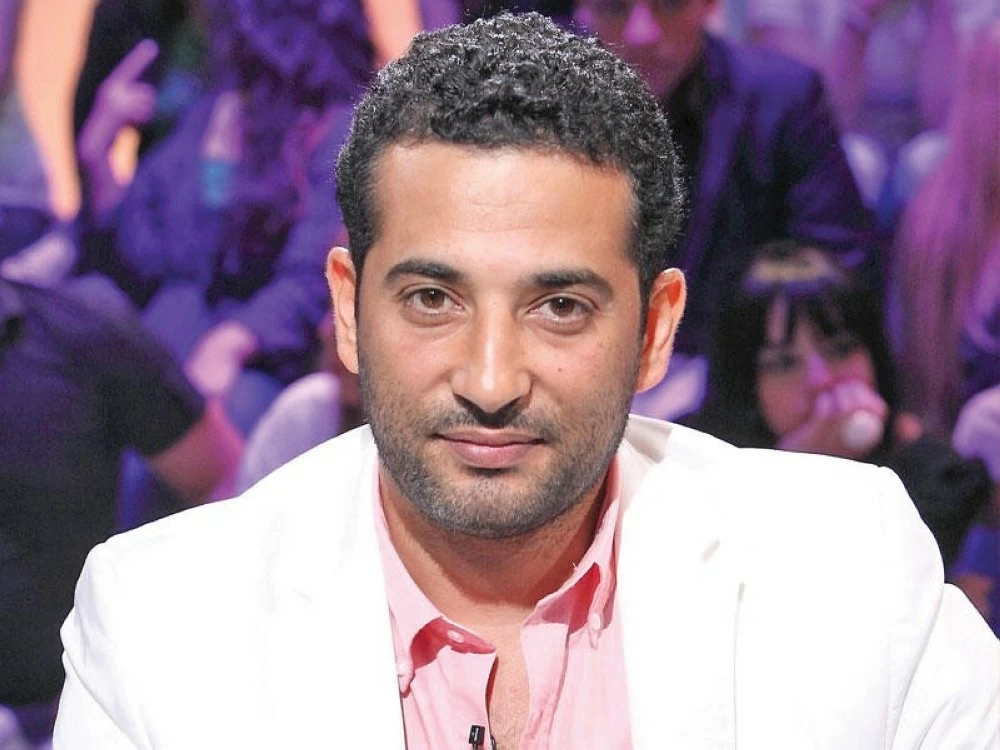
In a surprising move that sparked widespread interest in artistic and public circles, Egyptian star Amr Saad announced his decision to retire from television drama, confirming that his anticipated series “Efrag”, scheduled to be shown in the Ramadan 2026 season, will be his final farewell on the small screen.
Statement of retirement: A huge effort to create work worthy of Egypt
On his official Facebook page, Amr Saad shared this important decision with his followers, revealing the immense effort he put into his latest project. He wrote, "From the series 'Efrag,' I'm putting in a tremendous amount of work every day so that I can leave television next year feeling that I've created something worthy of Egypt." He added, expressing his hope that the series will be well-received by the audience, "I hope to make you happy and that you'll be proud of a series that represents Egyptian drama throughout the Arab world and is worthy of our great history, which has given great stars to the Arab people, not just grand lies.".
A remarkable artistic career: from challenging roles to A-list stardom
Amr Saad's decision to retire comes after a long and distinguished career in television drama, during which he cemented his place as one of the leading stars in Egypt and the Arab world. Saad was known for his boldness in choosing his roles and his ability to portray complex and realistic characters, especially those representing the working class. His true fame began with iconic roles in films such as "When Maysara Was Born" and "Shehata's Shop" by director Khaled Youssef, before he reigned supreme in Ramadan dramas with successful series like "Younis, Son of Fadda," "Kings of Bravery," and "Repentance," which achieved high viewership ratings and widespread acclaim.
"Release": An epic conclusion to a dramatic journey
The series "Efrag" marks the end of Amr Saad's television career, raising expectations for the show. Saad portrays the character "Abbas El-Reis" in a popular social drama inspired by a true story, promising a heavy dose of mystery and suspense. The cast includes a number of stars, most notably Abdel Aziz Makhyoun, Sama Ibrahim, Tara Emad, Hatem Salah, Alaa Morsi, Sarah Baraka, Sherif El-Desouky, Safwat, Basant Shawky, Jihad Hossam El-Din, Ahmed Abdel Hamid, Donia Maher, Reda Idris, and Omar El-Saeed. Written by Ahmed Halaba, Mohamed Fawzy, and Ahmed Bakr, produced by Sadek El-Sabah, and directed by Ahmed Khaled Moussa, the series is a combination that guarantees a strong and well-rounded production.
The impact of the decision on the art scene
The retirement of a star of Amr Saad's stature from television drama is a significant event for the industry. His absence will leave a void in the type of roles he was known for, roles that resonated with a large segment of society. His decision also raises questions about the future of Egyptian drama and its ability to produce new stars with the same charisma and impact. Arab audiences eagerly await the premiere of "Efrag," hoping to witness the final chapter in the career of an artist who has long entertained them with works that combined artistic merit with popular success.
-

 Local news one week ago
Landslide in Riyadh: Details of the incident in Al-Sahafa neighborhood and containment efforts
-
 Local news one week ago
The death penalty was carried out against a citizen who stabbed another to death in Tabuk
-
 Culture and Art 7 days ago
Haifa Wehbe's absence in Riyadh: A photo crisis or a strained relationship with the media?
-

 Local news one week ago
First birth on the Riyadh train: A heartwarming story at Andalus station
-

 Local news one week ago
Riyadh collapse: Emergency plans to secure water after a main pipeline burst
-
 Culture and Art 7 days ago
City Kitchen series: A drama of conflict and the middle class during Ramadan
-

 Culture and Art 7 days ago
The series "Kasra": Dawood Hussein in a moving social drama this Ramadan
-

 Local News 6 days ago
Applying for the 1447 Opportunities Program for Teachers via the Fares System