Culture and Art
"Culinary history of ports"... Coffee was the most prominent export through Jeddah... and "Khafish al-Daba" is the most famous dish of Al-Ula
The Jeddah Book Fair 2024 enriched its visitors with the history of culinary arts in Jeddah, in a seminar it organized as part of its cultural program entitled "Cooking History"

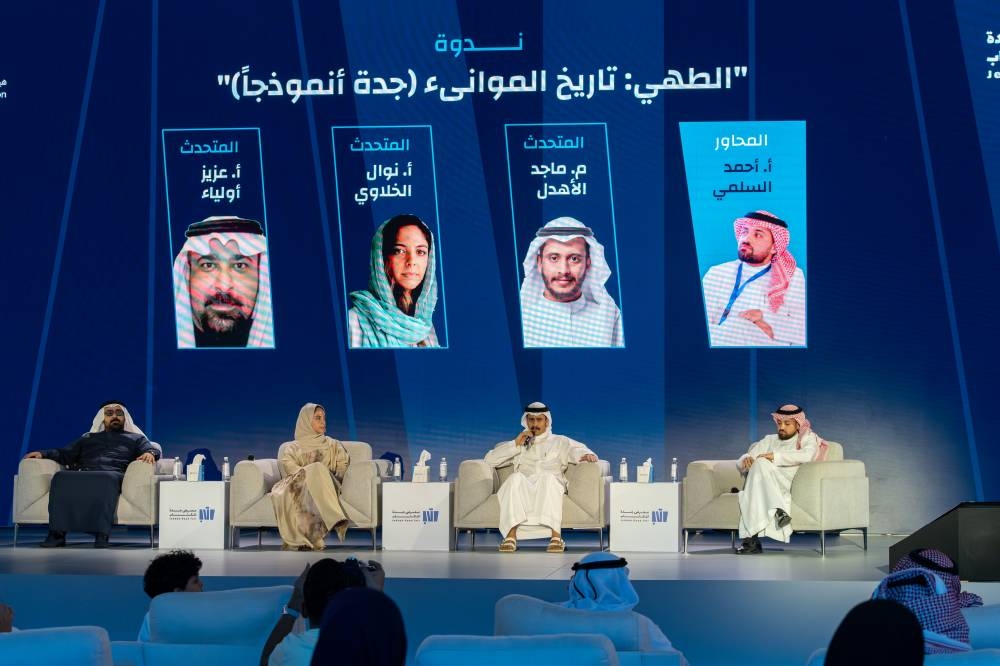
The Jeddah Book Fair 2024 enriched its visitors with the history of cooking in the city of Jeddah, in a seminar it organized as part of its cultural program entitled “Cooking: The History of Ports (Jeddah as a Model)”, in which Engineer Majid Al-Ahdal, Nawal Al-Khalawi, and Aziz Awliya participated, and it was moderated by Ahmed Al-Salmi.
Al-Ahdal stated that throughout history, Jeddah has been a transit point for many products, including grains from neighboring regions and spices arriving from countries outside Saudi Arabia, most notably India. He added, "The food documented throughout history consists of the meals of sultans and princes, not the food of ordinary people, which has only been documented in the last 100 years, when it began to emerge after remaining confined to homes for years.".
He added: “Coffee is the most prominent commodity exported through Jeddah, as it used to come from the port of Mocha to the port of Jeddah, and from there it would be transported to Egyptian ports and from there to Europe, as well as almonds, which used to come from the highlands of Taif and Al-Baha.”.
For his part, Aziz Awliya stressed the need to preserve our cultural components and to be zealous for them, because rooting your culture confirms your existence, as it is impossible to approach another culture by abandoning our original culture.
He continued: “Saudis in general have a very high level of taste, and this taste should be used to strengthen our local culture and take it to the world, especially since tourists are always looking for an experience that enriches them culturally. We must always remember that the tourism economy is the first thing to be affected by crises, and the last thing to recover from their effects.”.
For her part, Al-Khalawi stated that the “Khafish Al-Daba” dish is one of the dishes that Al-Ula Governorate in the northwest of the country is famous for, and she has begun to move it from local to global by introducing and adding some improvements to it, without conflicting with the quality and type of the basic dish.
She added: “This dish is known to be a winter dish, and it is often consumed by the residents of Al-Ula during the cold season, but I had the idea of transforming it from a winter product into one that can be used in the summer, through some minor additions.”.


Culture and Art
Yasmine Abdel Aziz threatens to sue those who published her doctored photos
Artist Yasmine Abdel Aziz announces that she will resort to the judiciary and the Internet Crimes Unit to pursue those responsible for publishing fabricated photos of her, considering it a systematic campaign to tarnish her reputation.

Egyptian actress Yasmin Abdel Aziz announced her intention to take all necessary legal action against those spreading fabricated and defamatory images of her that recently circulated on social media platforms. In her statement, she affirmed that she will not tolerate this campaign, which she described as "systematic," aimed at tarnishing her reputation and damaging her successful artistic career.
Legal escalation and a strongly worded warning
In an angry post on her official Facebook page, Yasmine Abdel Aziz addressed a direct message to those behind the campaign, saying: “The campaigns have begun… Fine, we’ll file a lawsuit and the cybercrime unit will find out who’s behind these campaigns and the defamation of my image in this way.” This statement reflects her seriousness in dealing with the situation, as she didn’t stop at verbal threats but explicitly announced her intention to resort to the relevant authorities, specifically the cybercrime unit, which is responsible for investigating cybercrimes in Egypt, thus giving her action significant legal weight.
Suspicious timing linked to artistic success
Yasmine Abdel Aziz linked the timing of the spread of these fabricated images to the release of the promotional trailer for her new series, scheduled to air during Ramadan. She asked incredulously, "All this because the trailer for the series was released? What will you do when the series actually airs?" This connection suggests her belief that the campaign is not random, but rather an organized reaction aimed at negatively impacting her new project and distracting the public from its anticipated success, especially given the fierce competition among stars during the Ramadan drama season.
The phenomenon of targeting celebrities and legal protection
The case of Yasmine Abdel Aziz highlights a broader and more dangerous phenomenon: the targeting of public figures and celebrities with online smear campaigns using forgery and fabrication techniques. These incidents are no longer isolated but have become a recurring pattern faced by artists in the Arab world, causing them significant psychological and professional damage. In this context, Egyptian law provides protection for victims. Article 25 of the Cybercrime Law No. 175 of 2018 criminalizes attacks on any of the principles or values of the Egyptian family and violations of privacy, which applies to such cases.
A final message and public support
The artist concluded her post by addressing those behind the campaign, saying, “To whoever created these pages and posts, I have only one thing to say… May God suffice me, and He is the best disposer of affairs.” Her action received widespread support from her fans and colleagues in the art world, who condemned this method of settling scores and demanded that those involved be held accountable to put an end to these unethical practices that pollute the digital space.
Culture and Art
Haifa Wehbe's doctored video: Legal developments against AI-powered forgery
Investigations continue into the fabricated video of Haifa Wehbe. The Egyptian Public Prosecution is examining a technical report revealing the use of artificial intelligence and is pursuing those involved in the digital defamation crime.

The Cairo judicial system is witnessing rapid developments in the case of the fabricated video attributed to Lebanese artist Haifa Wehbe, a case that represents a significant turning point in the fight against modern digital crimes. In this context, the artist's legal advisor, lawyer Sherif Hafez, revealed that crucial documents have been submitted to the Economic and Money Laundering Prosecution Office as part of the pursuit of the network of individuals responsible for producing and distributing this offensive content.
During a hearing held on Wednesday, Hafez presented a detailed technical report prepared by a consulting firm specializing in digital technologies and information security. The report definitively confirmed that the circulated videos were not authentic, but rather the product of a sophisticated deepfake operation. This operation employed advanced artificial intelligence software and complex computational algorithms to superimpose the artist's face and voice onto unrelated video content, with the deliberate intent to defame and slander her.
General context: Deepfakes as a weapon of defamation
This case comes amid a worrying global spread of deepfake technology, which has become more widely available in recent years. Once the preserve of specialists, modern applications and software have made it easy for non-experts to create deceptively realistic fake videos. This technology is frequently exploited to target public figures and celebrities, especially women, in systematic smear campaigns aimed at damaging their reputations, blackmailing them, and negatively impacting their careers and personal lives, making it a form of digital violence.
The importance and expected impact of the issue
This case is particularly significant as it is one of the first high-profile cases in the Arab region to directly address artificial intelligence crimes. The legal proceedings are expected to set an important precedent in Egypt and the Middle East, contributing to shaping future legislation to combat this type of crime. The authorities' success in tracking down the perpetrators and bringing them to justice will send a strong deterrent message to anyone contemplating using technology to harm others.
Internationally, these efforts align with the global trend toward regulating the use of artificial intelligence and demanding that major social media platforms, such as Facebook, TikTok, and Telegram (mentioned in the original report), assume their responsibilities in monitoring content and removing fabricated material that violates individual privacy and threatens social harmony. The Economic Prosecution Office has instructed the relevant technical authorities to examine all electronic links that disseminated the fabricated content, trace their sources, and identify the servers that hosted them, in a serious step toward dismantling the network responsible for this cybercrime.
Culture and Art
Mohamed Henedy in Riyadh Season 2024 with the play "The Happiness Merchant"
Superstar Mohamed Henedy returns to Riyadh Season stages with his new play, "The Happiness Merchant." Find out about the show's details, cast, and ticket availability.

A strong comeback for the comedy star on Riyadh stages
Egyptian comedy star Mohamed Henedy is preparing to return to his Saudi Arabian audience with a new play titled "The Happiness Merchant." This production is part of the prominent artistic events of the current Riyadh Season and is scheduled to run at the Mohammed Al Ali Theater from January 27th to February 2nd, promising audiences an intense dose of laughter and entertainment.
Riyadh Season: The region's premier entertainment destination
The hosting of the play "The Happiness Merchant" comes within a broader context reflecting the growing importance of Riyadh Season as one of the largest entertainment festivals in the Middle East. Since its launch as part of the Saudi Vision 2030 initiatives, the season has successfully established Riyadh as a global tourist and cultural destination. Each year, the season attracts the brightest stars of Arab and international theater and presents a diverse and high-caliber production that caters to all segments of society, thus enhancing cultural exchange and artistic dialogue between the Kingdom and various countries around the world, particularly Egypt, a leader in the field of theatrical arts.
Mohamed Henedy and the Saudi audience: A special relationship
This show cannot be viewed in isolation from the long history that connects Mohamed Henedy with Saudi and Gulf audiences. Henedy is considered one of the icons of comedy in the Arab world, and his previous theatrical works, such as "Afroto" and "Hazemny Ya," achieved unparalleled popular success in the region. His return to the stage with a new production is a highly anticipated event, as audiences trust in his ability to deliver sophisticated comedy that addresses social issues in a satirical and engaging manner.
Details and cast of the play "The Happiness Merchant"
His Excellency Turki Al-Sheikh, Chairman of the General Entertainment Authority, officially announced the release of tickets for the play, emphasizing that it will offer a unique comedic experience. The cast includes Mohamed Henedy and a distinguished group of stars, including Rahma Ahmed, who has achieved widespread fame in recent years, as well as veteran actors Alaa Morsi, Mohsen Mansour, and Mohamed Mahmoud, in addition to Reham El-Shenawy and several other theatrical talents. The play relies on social comedy, drawing its situations from everyday life, which is guaranteed to engage the audience.
Henedy's future artistic projects
On another note, Mohamed Henedy’s artistic activities are not limited to the stage only, as he is currently preparing for his new television series “Uncle Qandil”, which brings him together with the great writer Youssef Maati and the director Hassan Al-Manbawi, and it is expected that filming will begin after the next Eid al-Fitr, to be a new addition to his full artistic career.
-

 Reports 6 days ago
Achievements of Saudi government sectors in 2025
-
Local news two weeks ago
FDA warns of contaminated Nestle infant formula | Recall details
-
Technology 4 weeks ago
US ban on drones: reasons and consequences
-
Technology 4 weeks ago
SRMG and Snapchat partnership: The future of digital media in the Middle East
-
Technology 4 weeks ago
Saudi Arabia's Ministry of Islamic Affairs is employing artificial intelligence in public speaking
-
Technology 3 weeks ago
Saudi Arabia launches the world's largest government data center, 'Hexagon'
-
Technology 3 weeks ago
Merging KSA Map and Baladi Plus: A step towards Saudi digital sovereignty
-
Technology two weeks ago
Hexagon: Saudi Arabia strengthens its data sovereignty with the world's largest government center