
Culture and Art
The rhythmic image in the collection "Walkers with the Breath of Deer"
The collection of poems (Walking with the Breath of Gazelles) by the poet Muhammad Al-Harz is a deep poetic journey into the worlds of existence, self, and the search for meaning.

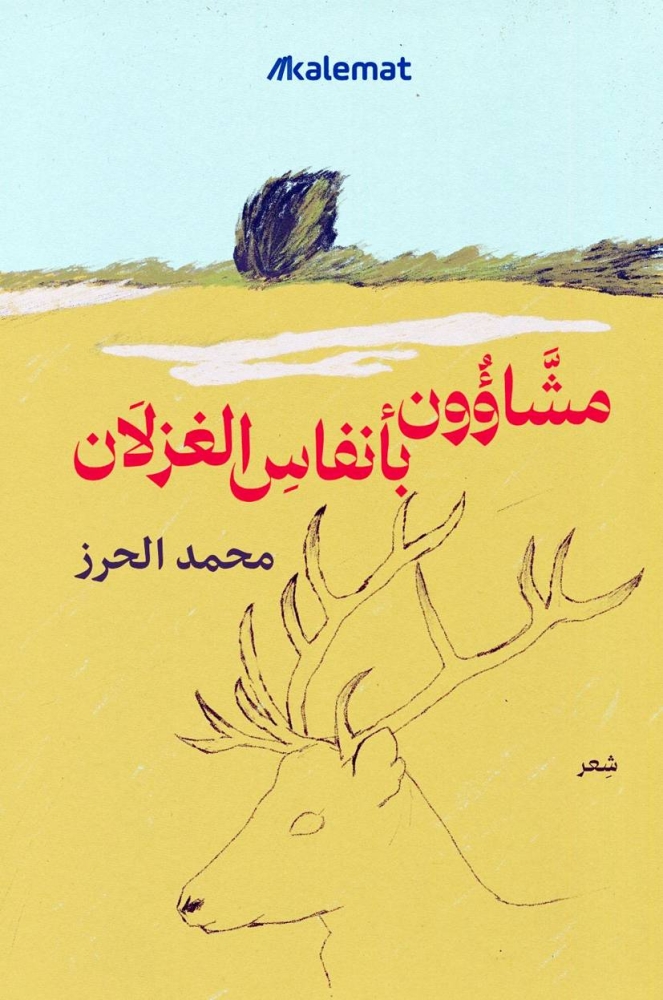
The poetry collection "Walking with the Breath of Gazelles" by poet Mohammed Al-Harz is a profound poetic journey into the realms of existence, self, and the search for meaning. This collection showcases a unique blend of rich poetic imagery and philosophical elements that invite contemplation, as the poet guides the reader through sensory and abstract details representing different dimensions of human life. Through a transparent and dense language and multi-layered imagery, Al-Harz successfully conveys his deep feelings about issues of existence, time, loss, and memory, transforming the poem into a contemplative space open to interpretation.
The collection explores themes that touch the very core of the human experience, such as the struggle between presence and absence, the search for meaning in life amidst the absurdity of existence, and the interplay between nature and humanity. The poet also employs conceptual blending techniques that combine the real and the imaginary, the sensory and the abstract, the human and the natural, lending the poems a depth and spirituality that invites the reader into an intellectual and emotional dialogue with the text.
(Walking with the Breath of Deer) is not just a traditional poetry collection, but a space for searching for the self and reflecting on what lies beyond the apparent, and a reminder of the status of poetry as a bridge that connects man to himself and to the world around him.
The poetic imagery in this collection is characterized by depth and diversity, as the poet employs complex and expressive images that reflect philosophical ideas and existential meanings. Here, images are not merely aesthetic expressions, but rather tools for exploring the self and the world, used to present visions that transcend superficial description, reaching profound sensory and symbolic expressions.
Examples of poetic imagery in the collection:
Cosmic image:
In his words, “As if I were cultivating trees in my sleep, only to awaken to find their fruit falling,” the poet uses the image of trees growing in sleep and bearing fruit as a metaphor for thoughts or feelings that take shape in the unconscious and surface upon waking. This image carries connotations of immersion in the poetic experience and the constant anticipation of its harvest.
Expressing loss:
The poet paints a poignant picture of loss in his words: “Memory… is capable of creating a deep rift, at every moment, in the souls of his loved ones and family.” Here, memory becomes like a polished mirror reflecting longing and pain, leaving profound marks on the living. The imagery here employs the relationship between memory and wounds, portraying memory as a force that influences and transforms permanently. This is also found in the poem “A Poet Who Dies Only from His Amazement,” dedicated to the poet Ali al-Dhamini.
Composite images of simple objects:
In another passage, the poet says: “To abandon poetry in the face of these difficulties… is to respect it, and respecting it means only one thing: to declare that you have Alzheimer’s.” Here, the poet merges poetry and memory loss in a composite image, reflecting the understanding of poetry as the essence of existence and continuity, and that distancing oneself from it means losing a fundamental part of one’s identity.
Sensory imagery in describing family memories:
He says: “I scream in your books, I hide among their words, I delete a line here and add two lines there.” This image carries a vivid feeling of the poet as he tries to reshape his memories and his past through manipulating words, as if he is reformulating his relationship with time and people through texts.
Surreal images:
In another text he writes: “Life near broken stairs will not prevent the blind man from the virtue of climbing,” where he blends surreal scenes and symbolic expressions to highlight the existential aspect of life. This image expresses the struggle between despair and hope, and shows climbing as a value that transcends physical disability.
The poetic imagery in this collection transcends its role as a means of conveying meaning; it functions as a catalyst for the reader's reflection and contemplation, placing them in direct confrontation with emotions of sorrow, loss, love, and the search for self. Through the interplay of sensory and abstract imagery, the poet creates a complex atmosphere that reflects his unique philosophy of existence, memory, and absurdity.
On a rhythmic level, the poems in the collection "Walkers with the Breath of Gazelles" employ a range of artistic techniques that imbue the texts with an internal musicality without relying on traditional meters. Here are some examples from the collection illustrating these elements:
Internal rhythm: We find extensive use of internal rhythm resulting from the repetition of phrases, such as his saying:
"They go on as if nothing happened. They write as if nothing happened. Then they leave life as if nothing happened.".
The repetition of the word “was not” gives the sentence a rhythmic tone that reinforces the feeling of futility and absurdity, and this repetition forms an internal music that helps to emphasize the meaning.
Switching between short and long sentences:
Another text says:
“Every time he knocks on your door, he casts his fishing line and pulls a word or two from your poem, then bids you farewell until we meet again soon.”.
Here we find short sentences followed by longer ones, creating an oscillating rhythm that resembles rapid and slow breathing, giving the reader a sense of continuity and pause, as if the text leaves spaces for contemplation.
Semantic repetition: The poet uses semantic repetition to deepen the meaning, as in the following text:
“Writing is the destruction of the world… I only want to smash its skull with the axe of words.”.
The repetition of the words “destruction” and “shattering” here contributes to a violent rhythm that reflects the writer’s strong desire to rebel and demolish, which enhances the power and momentum of the text.
Sensory visual language:
The author resorts to sensory images that captivate the reader and involve him in the experience, as is evident in his statement
"Time passes like a contagious disease... and the water has been withdrawn from the pipes to allow your hidden days to breathe.".
These images create a sense that the words are moving and breathing, enhancing the rhythm of the poem through the moving scenes in the reader's mind, and giving the text a kind of life and movement.
Meditation and free time:
The poet leaves gaps for reflection, as is evident in his style when discussing the meaning of life and time:
“Word after word, the sky descends naked into my hands, and the one wounded by the dagger of time has his face covered with the blood of language.”.
Here, the spaces between the phrases give an opportunity to pause and reflect, making the reader contemplate the images and sense the weight of time, adding a rhythmic dimension stemming from the silence of the text.
The rhythm of the poems in this collection is based on creating a smooth flow between images and linguistic structures, accompanied by elements of repetition and reflection, which gives the texts a distinctive and different musical dimension, and reflects the poet’s experience with existence and time in a way that deepens communication with the reader.
There are various types of conceptual blending in the collection that enhance the depth of the poetic imagery and lend the texts a philosophical and symbolic character. Here are some examples from the collection that illustrate these types of conceptual blending:
The fusion of the human and the natural: The poet uses imagery that combines humanity with elements of nature to illustrate his emotional and existential states, such as his line: “As if I were nurturing trees in my sleep, only to awaken to the falling of their fruit.” In this image, Al-Harz expresses his psychological experience through the image of a tree that bears fruit in secret, then its results become visible, reflecting a process of maturation and inner reflection.
Blending reality and fantasy:
In one image, the poet blends reality and imagination to present a philosophical idea, as in his expression: “Writing is the destruction of the world.” Here, he equates writing with an imaginative act, equivalent to destruction, which adds a surreal dimension and symbolizes the poet’s desire to reshape the world through words, thus imbuing the texts with a mythical quality.
Blending the concrete and the abstract:
The poet's ability to blend sensory imagery with abstract meanings is evident in his statement: "Memory... is capable of creating a deep rift in the soul of his loved ones and family." Here, Al-Hirz uses a sensory image of a wall to express the profound pain that memory can inflict, thus giving a tangible feel to abstract emotions.
The fusion of the cultural and the universal: The amulet draws on cultural elements that allude to history and existence, as seen in its description: “Your voice surprises you, emanating from your deepest recesses.” Here, it combines cultural knowledge of the human psyche with existential contemplation to present an image that conveys a sense of self-connection and profound awareness of the world.
Finally, Muhammad Al-Harz relies on these types of conceptual blending to expand the scope of the poems’ meanings, where images interact with deep philosophical and human ideas that make the reader contemplate new dimensions of the self and the world around him.


Culture and Art
Iraqi artist Maksad Al-Hilli dies at the age of 71
The Iraqi Artists Syndicate mourned the passing of the great artist Maqsoud Al-Hilli, who died after a battle with illness. Al-Hilli was one of the most prominent Iraqi folk singers and left behind a timeless artistic legacy.

The Iraqi Artists Syndicate announced on Wednesday the death of the great Iraqi artist, Maqsoud Al-Hilli, at the age of 71, after a long struggle with a terminal throat disease, bringing to a close an artistic career full of contributions that enriched the Iraqi conscience for decades.
In a moving official statement published on its Facebook page, the Iraqi Artists Syndicate mourned the late artist with profound words: “With deep sorrow and grief, the Iraqi Artists Syndicate mourns the passing of the artist Maqsoud Al-Hilli.” The Syndicate prayed for God’s mercy and forgiveness for the deceased, and that He grant his family, loved ones, and colleagues patience and solace in this great loss that has befallen the Iraqi artistic community.
The health condition of the late artist had deteriorated significantly in his last days, which necessitated his urgent transfer to Baghdad Medical City Hospital, where he was admitted to the intensive care unit to receive the necessary treatment, but God’s will prevailed.
Context and History: A Voice from the Land of Babylon
The singer Maqsoud Al-Hilli was born in the village of Anana in the province of Hilla (Babylon), a city steeped in history and civilization, and known as a wellspring of poets, intellectuals, and artists. Al-Hilli grew up in a traditional rural environment, immersing himself from a young age in its rich musical heritage, which later shaped his artistic identity. He rose to prominence in the 1970s, considered the golden age of Iraqi song, appearing alongside giants of rural music such as Yass Khader, Hussein Neama, and Saadoun Jaber, and carving out a unique niche for himself thanks to his powerful voice and distinctive performance style.
Artistic significance and cultural impact
Maksad al-Hilli is considered one of the pillars of Iraqi rural singing, an art form characterized by its profound emotion and close connection to the land, its people, and the southern and Euphrates environment. Al-Hilli was renowned for his powerful and unique voice, which enabled him to perform the most challenging rural singing styles and authentic Iraqi mawwals such as the "Abudhiya." He was not merely a singer, but a faithful custodian of the heritage, contributing significantly to documenting this musical genre and protecting it from extinction in the face of modern musical trends.
The passing of Maqsoud Al-Hilli is not only a loss for his family and fans, but a profound loss for Iraqi culture as a whole. With his departure, Iraq loses a truly authentic national voice that served as a living memory of a significant part of its artistic and popular history. Al-Hilli left behind a rich artistic legacy of songs that will remain etched in the hearts of Iraqis, and he established an artistic school that inspired many young artists who sought to follow in his footsteps in preserving authentic Iraqi musical identity.
Culture and Art
Menna Fadali: Details of the attempt to kidnap me and my stance on the nursing home
Egyptian artist Menna Fadali reveals for the first time that she was subjected to an armed kidnapping attempt, and how the experience prompted her to learn kickboxing, and explains her opinion on aging.

Menna Fadali reveals a shock that changed her life
In a poignant statement, prominent Egyptian actress Menna Fadali revealed details of a shocking incident she experienced years ago, when she narrowly escaped a kidnapping attempt by armed men. Fadali, known for her diverse roles in Egyptian cinema and television, confirmed that the incident left a profound psychological impact that continues to haunt her, noting that it radically altered her perspective on life and safety.
During a television interview, she explained that she was surprised to find armed individuals attempting to overpower her, which terrified her and caused her immense psychological distress. She described the details of that night as still haunting her whenever she recalls them, reflecting the profound trauma she experienced. This incident highlights the security challenges faced by celebrities and public figures, whose increased public profile makes them more vulnerable to such risks, thus sparking a broader discussion about privacy and personal safety in the age of fame.
From fear to strength: Kickboxing as a means of self-defense
Menna Fadali didn't let the fear instilled in her by the experience stop her; instead, she decided to transform this negative feeling into a positive motivator. She indicated that this incident was the direct reason behind her decision to learn kickboxing. She emphasized that mastering self-defense wasn't just a hobby, but a means to enhance her sense of security and self-confidence, and to empower her to protect herself in difficult situations. This transformation reflects a powerful message about women's empowerment and the importance of possessing the necessary tools for self-defense, a topic that resonates widely both locally and regionally, as calls increase to raise women's awareness of their rights and their ability to confront violence.
A philosophical view of aging and the concept of nursing homes
In another part of her interview, Menna Fadali addressed her perspective on aging, emphasizing that she does not fear this natural stage of life. She believes that changes in appearance and the appearance of wrinkles are signs that reflect a person's journey and experiences. Regarding the idea of living in a nursing home in the future, she explained that she is not considering this option, justifying this by saying that she is accustomed to solitude and feels self-sufficient and emotionally fulfilled. This opinion touches on an important social and cultural issue in the Arab world, where the idea of nursing homes is still associated negatively in the minds of many, while others see it as a choice for independence in old age. Fadali's remarks open the door to a societal discussion about the changing family and social values with the evolution of lifestyles.
She concluded her speech with a calm, philosophical view of life and death, stressing that the idea of death does not frighten her, and that what concerns her most is achieving inner peace, living with purity and a clear heart, and being careful not to harm others, which reflects a depth in her personality that transcends the spotlight and fame.
Culture and Art
Yasmine Abdel Aziz... a legal battle against defamation using artificial intelligence
Artist Yasmin Abdel Aziz is taking decisive legal action against defamation pages and deepfake photos, in a move that supports women's digital rights.

Egyptian artist Yasmine Abdel Aziz announced that she has taken decisive legal action against all pages and accounts that published fabricated photos and offensive content that harms her personal and artistic reputation, in a move described as bold to confront the chaos of defamation across social media platforms.
In an official statement, Yasmine said: “I announce that I have taken the necessary legal measures, and filed lawsuits and official reports, against all the pages and accounts that published fabricated images or offensive content that is not befitting of me, my name, my artistic history, my audience, and above all, is not befitting of me as an Egyptian woman and mother.”.
Broader context: Artificial intelligence as a weapon of defamation
This step comes amid a rise in cyberbullying and defamation targeting public figures, especially female artists in the Arab world. With rapid technological advancements, artificial intelligence tools, such as deepfake technology, have emerged as dangerous weapons in the hands of malicious actors. These tools are used to create incredibly realistic fake videos and images for the purpose of blackmail or defamation. This phenomenon is not limited to Egypt alone; it has become a global issue that is raising concerns among governments and human rights organizations, given its ability to undermine trust and violate individual privacy in an unprecedented manner.
A message of support that goes beyond the personal
Yasmine Abdel Aziz confirmed that she will no longer remain silent or ignore the matter, despite her confidence in her audience's awareness, emphasizing that what happened crossed all boundaries. She added that her decision represents a message of support for every woman subjected to defamation or fabrication, urging them to resort to the law, which guarantees protection and dignity. She clarified that legal accountability will extend even to indirect allusions or suggestions if sufficient to identify her to the public, noting that Egyptian law does not require explicit mention of a name for a crime to be established, provided intent and harm are proven.
Significance and expected impact: a potential legal precedent
The case of Yasmine Abdel Aziz is particularly significant because it could set an important legal precedent in Egypt and the Arab region regarding AI-related crimes. By resorting to the courts, she is not only defending her personal rights but also highlighting the need to update and strengthen legislation to address these emerging digital challenges. Domestically, this step reinforces confidence in Egypt’s Cybercrime Law (Law No. 175 of 2018) and encourages other victims to speak out. Regionally, her courageous stance inspires a broader discussion about protecting women in the digital sphere and underscores that fame should not be a justification for violating human dignity.
Widespread support and confidence in the judiciary
Yasmine received widespread support from her fans and public figures, most notably media personality Radwa El-Sherbiny, who declared her full support and described the move as decisive against abuse against women. Yasmine expressed her complete confidence in the fairness of the Egyptian judiciary and the Ministry of Interior's ability to enforce the law and control the chaos on social media platforms, emphasizing that she will utilize all her constitutional and legal rights and that the current measures are not the last.
-

 Local News 4 days ago
Landslide in Riyadh: Details of the incident in Al-Sahafa neighborhood and containment efforts
-
 Local News 5 days ago
The death penalty was carried out against a citizen who stabbed another to death in Tabuk
-

 Culture and Art, 1 week ago
Ramez Galal in Ramadan 2026: Details of the bloody prank show
-

 Local News 6 days ago
First birth on the Riyadh train: A heartwarming story at Andalus station
-

 Local News 4 days ago
Riyadh collapse: Emergency plans to secure water after a main pipeline burst
-

 Culture and Art 4 days ago
Haifa Wehbe's absence in Riyadh: A photo crisis or a strained relationship with the media?
-

 Culture and Art 4 days ago
City Kitchen series: A drama of conflict and the middle class during Ramadan
-

 Culture and Art 4 days ago
The series "Kasra": Dawood Hussein in a moving social drama this Ramadan