Local News
Saudi Arabia sends its 71st relief plane to support Gaza
Saudi Arabia sends its 71st relief plane to support Gaza, reinforcing its ongoing commitment to supporting the Palestinian people through the King Salman Humanitarian Aid and Relief Center.


The 71st Saudi relief plane arrives at El Arish Airport: Unwavering support for the Palestinian people
In a new step reflecting the Kingdom of Saudi Arabia’s commitment to supporting the Palestinian people, the 71st Saudi relief plane landed today (Monday) at Al-Arish International Airport in Egypt.
This plane, operated by the King Salman Center for Relief and Humanitarian Aid in coordination with the Ministry of Defense and the Embassy of the Custodian of the Two Holy Mosques in Cairo, carries food baskets and shelter kits in preparation for their transfer to those affected in the Gaza Strip.
Continued support amidst difficult circumstances
This aid comes as part of a series of ongoing efforts by the Kingdom through the King Salman Relief Center to support the Palestinian people in the Gaza Strip, where the population is suffering from harsh living conditions that require urgent and continuous intervention.
This relief plane is part of a large-scale humanitarian initiative aimed at alleviating suffering and providing necessary support to families in need in the besieged sector.
Statistics and figures reflect the scale of the efforts
Since the start of the crisis, Saudi Arabia has sent dozens of planes loaded with humanitarian aid to Gaza. With the arrival of the 71st plane today, the total aid provided exceeds hundreds of tons of food and other essential supplies.
This support reflects Riyadh’s commitment to providing assistance to brotherly peoples in times of crisis, and underscores the strong and historic relations between the Saudi and Palestinian peoples.
Technical and tactical analysis of the initiative
High-level coordination : This initiative demonstrates effective coordination between various governmental and private entities to ensure the rapid and efficient delivery of aid. The collaboration between the King Salman Center, the Ministry of Defense, and the Saudi Embassy in Cairo serves as a model for international humanitarian work.
Rapid response to urgent needs : These efforts are a direct response to the urgent needs of Gaza's residents, who face daily challenges due to a lack of basic resources. The focus on providing food baskets and shelter kits reflects a deep understanding of the local community's needs.
Future expectations and continued support
Continued humanitarian flow : Saudi Arabia is expected to continue providing further assistance in the coming period, especially given the ongoing difficult conditions faced by the residents of the Gaza Strip. This commitment stems from a comprehensive humanitarian vision that seeks to achieve stability and social well-being for affected populations.
Strengthening bilateral relations : Such initiatives are not limited to the humanitarian aspect, but also strengthen bilateral ties between the two countries and reflect the Kingdom’s leading role in supporting Arab and Islamic causes on the international stage.




Local News
The crescent moon of Ramadan 2026 adorns the skies of the Kingdom... Details of the astronomical scene
The Kingdom's skies will witness the crescent moon of Ramadan this evening in a beautiful astronomical display. Learn more about the crescent sighting and the phenomenon of Earth's illumination with engineer Majed Abu Zahra.

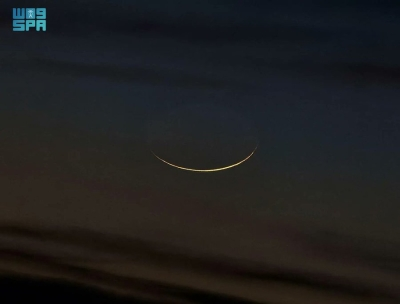
As the sun sets on Wednesday, February 18, 2026, the eyes of astronomy enthusiasts and observers in the Kingdom of Saudi Arabia will turn towards the southwestern horizon, where the crescent moon of the holy month of Ramadan will adorn the sky in a magnificent astronomical scene, announcing the beginning of the Ramadan nights, and providing an ideal opportunity for astronomical photography and documentation when the atmosphere is clear.
Details of the conjunction and the beginning of the lunar month
In detailing this astronomical event, Engineer Majid Abu Zahra, President of the Jeddah Astronomical Society, explained that the moon reached its conjunction phase yesterday, Tuesday, February 17, at 3:01 PM Mecca time. This conjunction is the primary astronomical sign marking the end of one lunar month and the beginning of a new one, as the moon moves from west to east of the sun, beginning its usual monthly journey around the Earth.
Abu Zahra explained that the crescent moon observed today will begin to move away angularly from the sun, and will gradually rise in the sky over the coming days, leading to an increase in the area of its illuminated part night after night, in an accurate embodiment of the precise cosmic system and the movement of celestial bodies.
Earthlight phenomenon and crescent moon brilliance
Among the aesthetic aspects of observing tonight's crescent moon is the potential appearance of what is known as "earthlight" or gray glow. This phenomenon occurs when sunlight reflected off the Earth's surface is refracted towards the moon, illuminating its dark portion with a faint and enchanting glow. This spectacle creates an exceptional beauty that can be observed with the naked eye, especially in areas far from urban light pollution, making it a prime target for astrophotographers.
The importance of astronomical observation and its connection to the Islamic calendar
The observation of the new moon in the Kingdom and the Islamic world holds immense importance that transcends the purely astronomical and scientific dimensions, touching upon religious and cultural aspects, as the Islamic calendar is entirely based on the moon's orbit around the Earth. The process of observation and verification is a long-standing tradition that combines religious heritage with precise astronomical calculations, thus strengthening the integration between Islamic jurisprudence and astronomy.
Observers are advised to choose locations with an open horizon free of obstructions such as buildings and mountains, and to stay away from bright city lights to ensure a clearer view of the thin crescent and the faint celestial objects that may appear close to its path during these first nights of the holy month.
In conclusion, the moon continues its apparent eastward movement among the stars day after day, serving as a visual guide and a natural celestial timer through which people follow the passing of the days of the holy month, in an experience that combines visual enjoyment with contemplation of God’s creation.
Local News
The Meteorology Department raises its readiness to monitor the weather in the Two Holy Mosques during Ramadan 1447 AH
The National Center for Meteorology announces its plan for the Ramadan season of 1447 AH by monitoring the atmosphere of the Two Holy Mosques and the prayer times through advanced technologies and linking with the Nusuk and Tawakkalna applications for the safety of pilgrims.

The National Center for Meteorology announced its full operational and technical readiness in preparation for the holy month of Ramadan 1447 AH, as part of a comprehensive strategic plan aimed at enhancing the accuracy of geographic coverage and utilizing advanced technological capabilities in the Makkah and Madinah regions. The plan focuses intensively on the Two Holy Mosques, the designated prayer times, international and regional airports, as well as the entry points and highways used by pilgrims.
This step comes within the framework of the utmost importance that the Kingdom of Saudi Arabia places on serving pilgrims and visitors during religious seasons. The month of Ramadan, in particular, typically witnesses a high volume of people, requiring meticulous management of all logistical and security services, in which weather is a significant and influential factor. The relevant authorities are working in harmony to ensure that the rituals are performed in a safe and secure environment, leveraging the advanced digital infrastructure established by the Kingdom's Vision 2030.
Through its seasonal plan, the center aims to provide real-time and future weather data around the clock, while enhancing the efficiency of monitoring and forecasting potential weather phenomena before they occur. To achieve this, the center has utilized a wide network of geographically distributed observatories across the Kingdom, supported by modern weather radars, high-resolution satellite imagery, the Saudi numerical weather prediction model, and manned observatories, as well as automated and mobile stations covering vital areas.
As part of the digital transformation and to facilitate access to information for beneficiaries, the operational plan focused on issuing specialized weather bulletins for prayer times and providing accurate and up-to-date coverage of the weather conditions in the Two Holy Mosques. The plan also included displaying weather forecasts and early warnings on highways via electronic road signs, making real-time weather information and 10-day forecasts available through the "Anwaa" application, and establishing direct technical links with national smart platforms such as the "Nusk" and "Tawakkalna" applications to ensure alerts reach the largest possible segment of pilgrims.
Regarding air navigation, the plan included raising the level of performance and efficiency at the center's observatories in various airports across the Kingdom to ensure air navigation safety and professional handling of the anticipated increase in air traffic during the holy month. Accurate meteorological information at airports is a fundamental pillar for flight scheduling and avoiding any weather disturbances that could affect air traffic.
The center concluded its preparations by utilizing 14 diverse media platforms to ensure the rapid delivery of information and weather alerts to the public and relevant authorities, thereby enhancing community awareness and readiness to deal with any weather fluctuations, and contributing to achieving the highest standards of security and safety for those visiting the Holy Mosque and the Prophet’s Mosque.
Local News
King Abdulaziz Airport Operational Plan for the 1447 AH Umrah Season
Learn about the operational plan for King Abdulaziz Airport for the peak Umrah season of 1447 AH, which includes preparing the halls and recruiting 10,000 employees to serve pilgrims during Ramadan.

As part of intensive preparations to welcome pilgrims and provide them with the best possible services, Jeddah Airports Company has officially adopted the operational plan for King Abdulaziz International Airport for the peak Umrah season of 1447 AH. This comprehensive plan aims to accommodate the increasing number of pilgrims expected to arrive during the holy month of Ramadan and until the end of the Umrah season, through the activation of an integrated operational system focused on operating three main terminals: the Hajj and Umrah Terminal Complex, Terminal 1, and the North Terminal.
Season schedule details
According to the established timeframe for the 1447 AH Umrah season, the arrival period for pilgrims will end on Shawwal 15, 1447 AH (April 3, 2026). The departure date for Umrah visa holders will be Dhu al-Qi'dah 1, 1447 AH (April 18, 2026). This timeframe was set to ensure smooth operations and to organize flight schedules in accordance with the airport's capacity.
Huge logistical resources and qualified personnel
The operational plan includes a massive mobilization of logistical and human resources to ensure a seamless travel experience. 407 baggage claim counters have been set up to minimize waiting times, and 463 passport control counters to ensure rapid passenger flow. Additionally, 56 jet bridges will be operational to transport passengers directly to aircraft, along with 35 baggage carousel stations and 81 customs inspection devices, reflecting a high level of preparedness to enhance the efficiency of arrival and departure processes.
In terms of humanitarian and health services, the plan includes operating four fully equipped health centers within the airport to provide urgent medical care, and allocating three welcome lounges to organize and guide pilgrims. To ensure maximum comfort, 20 air-conditioned rest areas have been opened in the public area of the Hajj and Umrah terminal complex. This system is supported by a large workforce of 10,000 employees representing various governmental, operational, and security agencies, working around the clock to serve visitors.
Strategic context and regional importance
This plan is of paramount importance within the framework of the Kingdom's Vision 2030, which aims to facilitate the hosting of pilgrims to the Two Holy Mosques and enhance the quality of services provided to them. King Abdulaziz International Airport in Jeddah is the primary gateway to the Two Holy Mosques, through which the vast majority of pilgrims from around the world pass. Therefore, the success of the operational plan for the peak Ramadan season will positively impact the Kingdom's international reputation in crowd management and large-scale logistics.
For his part, the CEO of Jeddah Airports Company, Engineer Mazen Johar, confirmed that this plan was not a spur-of-the-moment decision, but rather was developed through close cooperation and full integration with 27 governmental and operational entities. He noted that Jeddah Airports continues its diligent efforts to facilitate arrival and departure procedures, while adhering to the highest safety and quality standards, and intensifying security and operational coordination to ensure a successful and safe Umrah season.
-

 Culture and Art 7 days ago
The "Between and Between" exhibition in Jeddah: 5 artists reshape Saudi memory
-
Local News 5 days ago
Saudi Arabia's National Arabic Language Policy: 8 Principles to Promote Identity
-
Culture and Art, 1 week ago
Shakira's concert in Jeddah: Details of the international star's first concert in Saudi Arabia
-
Local News 4 days ago
Adopting the National Policy for the Arabic Language: Strengthening Identity and Vision 2030
-
Local News 5 days ago
The Riyadh-Rin-Bisha dual carriageway, spanning 559 km, has been completed
-
Culture and Art, 1 week ago
Ramez Level the Monster: Details of Ramez Galal's program in Ramadan 2026
-
Local news one week ago
Launch of the new Dammam project with investments of 98 billion riyals
-
Local News 3 days ago
The Supreme Court calls for the sighting of the crescent moon of Ramadan 1447 on Tuesday evening