Local News
Surah Al-Fatihah in a million-digit mosaic: A rare masterpiece
Discover the magnificence of the Quran at the Makkah Museum, where a stunning mosaic of Surah Al-Fatihah, made up of one million pieces, is on display, taking you on a spiritual journey through time.

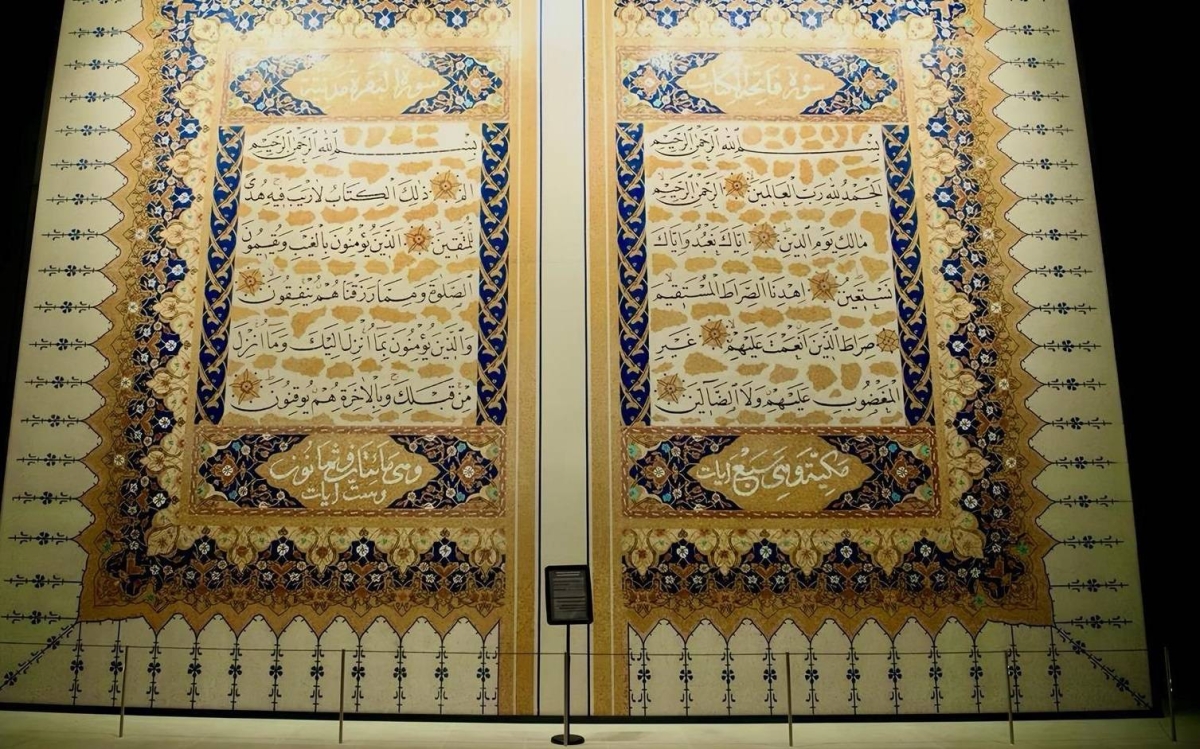
The Holy Quran Museum: A Journey Through Time in the Heart of Mecca
In the heart of Mecca, where spirituality meets history, lies the Museum of the Holy Quran in the Hira Cultural District. This museum is not merely a place to display artifacts, but a magical gateway that takes you on a journey through the ages to discover the magnificence of the Holy Quran.
A stunning mosaic: a million pieces of beauty
Imagine yourself standing before a massive mosaic panel depicting Surah Al-Fatihah and the opening verses of Surah Al-Baqarah, spanning an astonishing 76.67 square meters. This panel is not merely a work of art; it is a masterpiece comprised of over a million meticulously crafted porcelain mosaic pieces.
The artwork is inspired by a Qur'an written by the calligrapher Mustafa Dhu al-Fiqar in Naskh script in 1066 AH (1656 CE). Imagine the effort and precision required to create such a magnificent work of art! The original manuscript of this Qur'an is carefully preserved in the King Abdulaziz Complex for Endowed Libraries in Medina.
Rare treasures and ancient manuscripts
The museum doesn't stop at this painting; it also houses an amazing collection of rare artifacts and Qur'anic manuscripts . You can see firsthand how the writing of the Holy Qur'an evolved throughout different eras, from ancient manuscripts to antique Qur'ans written in various scripts.
Have you ever wondered about the largest Quran and the largest Quran stand in the world? Well, you will find the answer here! These two giants are proudly registered in the Guinness Book of World Records under the name of the Holy Quran Museum.
Interactive technologies and captivating visual displays
To add a modern touch to this historical legacy, the museum offers state-of-the-art interactive technologies showcasing the magnificence of the Holy Quran . You can enjoy visual displays that highlight the history of the Quran's compilation and the evolution of its script throughout the ages.
“It’s not just a museum; it’s an unforgettable cultural and spiritual experience .” This is how visitors describe their experience at the Holy Quran Museum in the Hira Cultural District. If you’re looking for an experience that blends culture, history, and spirituality, don’t miss this unique place near the famous Mount Hira.


Local News
Cabinet: Founding Day is a source of historical pride and the adoption of the biosecurity strategy
Chaired by the Custodian of the Two Holy Mosques, the Cabinet affirms that the founding day is a source of pride in the history of the state, congratulates on the approach of Ramadan, and approves the National Strategy for Biosecurity and several international agreements.

The Custodian of the Two Holy Mosques, King Salman bin Abdulaziz Al Saud, chaired the Cabinet session held today (Tuesday) in Riyadh. The Cabinet began its session by extending its congratulations to all citizens and Muslims worldwide on the approaching holy month of Ramadan, praying to God Almighty to accept everyone's good deeds and to perpetuate the blessings of security and safety upon the Kingdom under the leadership of the Custodian of the Two Holy Mosques.
Pride in the founding day and historical depth
In the context of national occasions, the Cabinet affirmed that the Kingdom's celebration of its National Day, which falls on February 22, represents a profound expression of pride in the deep-rooted foundations of the Saudi state, which extend back nearly three centuries. The Cabinet noted that this day commemorates the pillars of justice, unity, and stability established by the imams and kings, making the Kingdom a leading model among nations. This celebration serves to connect current generations with their glorious history, reinforcing national identity and the authentic values upon which the state was founded.
Record successes in serving the guests of God
The Council discussed the efforts made to serve pilgrims to the Two Holy Mosques, expressing its gratitude to God Almighty for granting the Kingdom success in managing the Hajj and Umrah seasons. The Council commended the Kingdom's projection of receiving 19.5 million pilgrims and Umrah performers from outside the Kingdom by 2025, a figure that reflects the rapid development in infrastructure, digital services, and logistics, in line with the objectives of the Kingdom's Vision 2030 and the Guests of God Service Program, which aims to facilitate the hosting of pilgrims and enrich their religious and cultural experience.
A firm stance towards the Palestinian cause
On the political front, the Cabinet reiterated the Kingdom's condemnation of the Israeli occupation authorities' decision to designate lands in the West Bank as "state land." The Cabinet affirmed that these illegal measures undermine the prospects for peace and constitute a blatant violation of the historical rights of the Palestinian people. The Cabinet emphasized the Kingdom's unwavering position calling for the establishment of an independent Palestinian state within the June 4, 1967 borders, with East Jerusalem as its capital, and urged the international community to fulfill its responsibilities to halt these violations.
Strengthening military industries and international partnerships
The Council commended the resounding success of the third edition of the World Defense Show in Riyadh, noting the strategic agreements and partnerships signed during the event. The Council affirmed that these steps directly contribute to supporting the localization of military industries, technology transfer, and strengthening local supply chains, which are fundamental pillars for achieving self-sufficiency and enhancing the Kingdom's defense capabilities in line with the objectives of the National Vision.
Strategic decisions and approvals
The Council concluded its session by issuing several important decisions, most notably approving the National Strategy for Biosafety and Biosecurity , which aims to strengthen the system for preventing and protecting against biological risks. The Council also approved regulations governing the continued presence of vehicles registered in the Gulf Cooperation Council (GCC) countries within the Kingdom, and amended the name of the "World Cup Esports Foundation" to the "Esports Foundation."
On the international relations front, the Council authorized a number of ministers to discuss and sign memoranda of understanding with several countries, including Japan in the areas of city management and traditional arts, Italy in the field of justice, Indonesia in the palm and date sector, Bahrain in government communication, and Algeria in digital government, in addition to agreements with China, Brazil and the African Centers for Disease Control.
Local News
Princes and ministers take the oath before the Custodian of the Two Holy Mosques in Riyadh
Riyadh witnessed the swearing-in of a number of princes and officials before King Salman bin Abdulaziz, signaling the commencement of their new duties in the emirates of the regions and the Ministry of Investment.

A number of Their Highnesses and Excellencies were honored today in the capital, Riyadh, to take the oath before the Custodian of the Two Holy Mosques, King Salman bin Abdulaziz Al Saud - may God protect him - following the issuance of the generous royal orders that stipulated their appointment to new leadership positions in the emirates of the regions, the Shura Council and the Ministry of Investment.
Details of the oath-taking ceremony for new officials
The oath was taken by His Highness Prince Fahd bin Saad bin Abdullah bin Abdulaziz bin Turki, on the occasion of his appointment as Deputy Governor of Al-Baha Region, His Highness Prince Dr. Saad bin Saud bin Mohammed bin Abdulaziz Al Saud bin Faisal, Member of the Shura Council, His Royal Highness Prince Saud bin Nahar bin Saud, Deputy Governor of Madinah Region, and His Royal Highness Prince Mohammed bin Abdullah bin Abdulaziz, Deputy Governor of the Northern Borders Region.
Their Highnesses repeated the oath, saying: “I swear by Almighty God to be loyal to my religion, then to my King and my country, not to divulge any of the state’s secrets, to protect its interests and systems, and to perform my duties with honesty, integrity, sincerity, and justice.”.
The ceremony also included the swearing-in of His Excellency the Minister of Investment, Mr. Fahd bin Abduljalil bin Ali Al-Saif, who said: “I swear by Almighty God to be loyal to my religion, then to my King and my country, not to divulge any of the state’s secrets, to protect its interests and systems, and to perform my duties with honesty, integrity and sincerity.”.
The implications of the new appointments and their strategic importance
This significant protocol step comes as a culmination of royal decrees aimed at revitalizing the government and administrative apparatus in the Kingdom of Saudi Arabia. These appointments reflect the wise leadership's commitment to enhancing performance efficiency in the regional emirates, where deputy governors play a pivotal role in overseeing development projects and addressing citizens' needs, thus contributing to balanced development across the Kingdom's various regions.
On the economic front, the appointment of the Minister of Investment is of particular importance in light of the Kingdom's Vision 2030, which relies heavily on attracting foreign and domestic investment and diversifying sources of income. The swearing-in ceremony marks the beginning of a new phase of dedicated work to achieve the objectives of the National Investment Strategy and enhance the Kingdom's position as a leading global investment destination.
The oath... a pledge, loyalty, and responsibility
Taking the oath before the Custodian of the Two Holy Mosques is a long-standing tradition in the Saudi system of governance. It represents a legal and religious contract in which the official pledges, before God, the King, and the nation, to perform his duties with integrity and honesty. This procedure underscores the weight of responsibility placed upon the newly appointed officials, the necessity of adhering to regulations, maintaining state secrets, and working diligently to serve the public good.
The swearing-in ceremony was attended by His Royal Highness Prince Abdulaziz bin Saud bin Nayef bin Abdulaziz, Minister of Interior, and His Excellency the Deputy Special Secretary to the Custodian of the Two Holy Mosques, Mr. Tamim bin Abdulaziz Al-Salem.
Local News
Residents deported and 1,550 violators arrested for transporting passengers without a license
The Transport Authority announces the arrest of 1,550 violators and the deportation of residents for practicing passenger transport without a license (unlicensed taxis), and reveals fines of up to 20,000 riyals and the impounding of vehicles.

The Public Transport Authority in Saudi Arabia announced the results of its intensive field inspection campaigns targeting land transport activities across the Kingdom. These inspections, conducted between February 8 and 14, 2026, resulted in the identification of 1,550 violators of transport regulations. These campaigns are part of the Authority's efforts to regulate the transport sector and enhance compliance with applicable laws and regulations.
In its announcement, the authority confirmed the deportation of two foreign nationals for operating unlicensed passenger transport services, a practice known locally as "Kaddada." The authority clarified that the penalties for non-Saudis engaging in this activity include permanent deportation from the Kingdom, in addition to a fine of up to 12,000 riyals, to ensure that such violations, which negatively impact the quality of the sector, are not repeated.
Details of violations and deterrent penalties
Official statistics released by the authority revealed that violations observed last week ranged from various practices, with preparatory work related to "calling" tolls topping the list at 897 violations, followed by 653 violations related to the actual practice of transporting passengers without a valid license. These figures indicate the authority's seriousness in pursuing violators at airports, transport stations, and on public roads.
The Public Transport Authority outlined the strict penalties stipulated in the new system. The penalty for illegally soliciting passengers through unauthorized means is a fine of 11,000 riyals and vehicle impoundment for up to 25 days. If a driver is caught transporting passengers without a license, the fine increases to 20,000 riyals, and the vehicle impoundment is extended to 60 days, reflecting the firm enforcement of the regulations.
Context of organizing the transport sector and its economic and security importance
These campaigns are of paramount importance, extending far beyond simply collecting fines. Through regulating the land transport sector, the Kingdom aims to enhance safety and security for its users. Eliminating the phenomenon of unregulated transportation is a crucial step in protecting passengers from the security and social risks associated with riding with unknown drivers who are not subject to any institutional oversight and whose vehicles lack tracking devices or necessary insurance.
Furthermore, regulating the sector contributes to supporting the national economy by promoting fair competition among licensed companies, licensed taxi drivers, and approved ride-sharing applications. The presence of unlicensed drivers harms the interests of legitimate investors who adhere to the technical and regulatory requirements and standards set by the authority, thus necessitating decisive intervention to protect the market.
Banning arbitrary practices in the new system
The authority emphasized in its statement that the new road transport system has put an end to old practices, as it strictly prohibits anyone from engaging in transport activities without a license. The ban also includes all behaviors associated with unregulated transport, such as soliciting or calling out to passengers in arrival halls, pursuing them, obstructing their path, or gathering at their locations for the purpose of transporting them illegally.
The authority concluded its statement by emphasizing the continuation of monitoring campaigns to ensure that all carriers comply with the approved regulations and requirements, calling on the public and beneficiaries to cooperate with it by relying exclusively on licensed carriers to ensure safe and reliable journeys, and to contribute to raising the level of quality of services provided in the transport sector in the Kingdom.
-

 Culture and Art 6 days ago
The "Between and Between" exhibition in Jeddah: 5 artists reshape Saudi memory
-
Local News 4 days ago
Saudi Arabia's National Arabic Language Policy: 8 Principles to Promote Identity
-
Culture and Art, 1 week ago
Shakira's concert in Jeddah: Details of the international star's first concert in Saudi Arabia
-
Local News 3 days ago
Adopting the National Policy for the Arabic Language: Strengthening Identity and Vision 2030
-
Culture and Art, 1 week ago
The truth about Nancy Ajram's video and Epstein Island, and her legal response
-
Local News 4 days ago
The Riyadh-Rin-Bisha dual carriageway, spanning 559 km, has been completed
-
Local news one week ago
Launch of the new Dammam project with investments of 98 billion riyals
-
Culture and Art, 1 week ago
The truth about Wael Awni's conversion to Islam... The artist responds sarcastically to the rumors